Clear Sky Science · en
The eco-evolutionary assembly of complex communities with multiple interaction types
Why tiny neighbors and their relationships matter
From forests to the microbes in our gut, living communities are built from countless species linked by cooperation, competition and predation. Yet scientists still struggle to explain how such tangled webs remain both diverse and stable over time. This study uses computer simulations to explore how new species arise, invade and inherit relationships from their ancestors, and shows that a simple balance between the benefits and costs of interacting can split ecosystems into two very different “worlds”: one ruled by rivalry, the other by cooperation.
Building a community one newcomer at a time
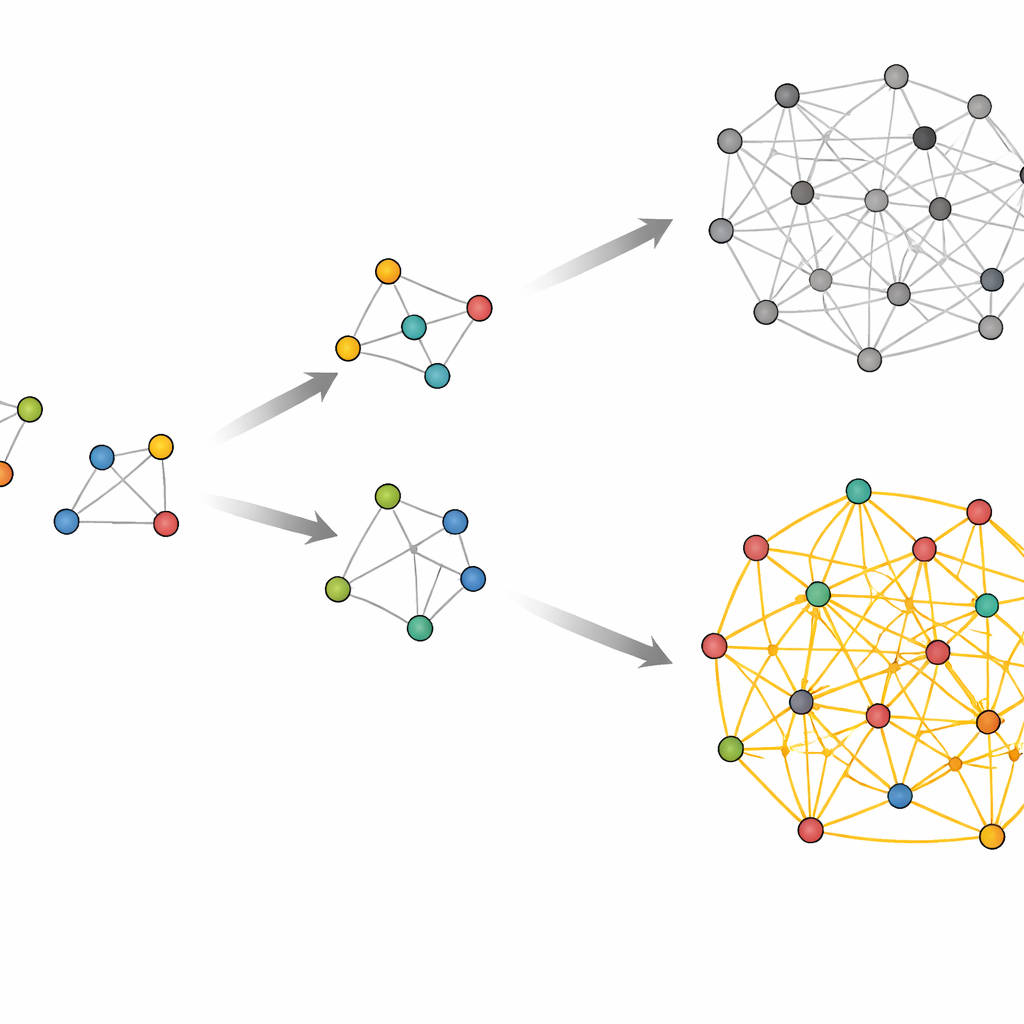
The authors model community assembly as a stepwise process. They start with just a handful of species that do not interact. New species then arrive in two ways. In an evolutionary “speciation” step, a newcomer is a modified copy of an existing species and tends to inherit many of its relationships, with some links added or removed. In an ecological “invasion” step, a stranger arrives from outside and forges entirely new links, without any inherited pattern. After each arrival, the model lets populations grow, compete, cooperate or feed on one another until they reach a new balance point. Species that dwindle below a threshold are considered extinct and removed, and the process repeats hundreds of times, gradually constructing a complex web.
When help is cheap, cooperation flourishes
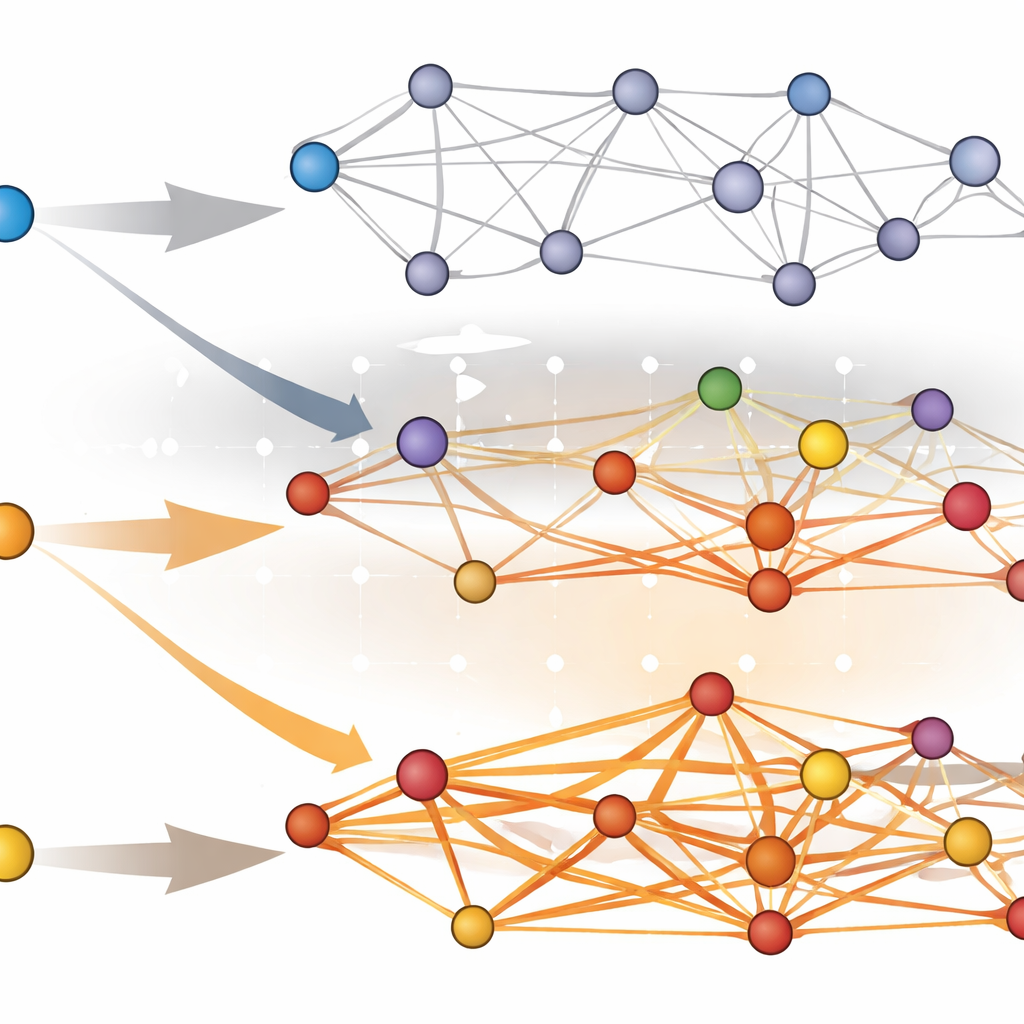
A central feature of the model is that positive relationships, such as mutual help or feeding on a resource, are never free. Each beneficial link comes with a cost, standing in for the energy and machinery needed to maintain it. By varying how strong the benefits are and how costly each link is, the authors discover a sharp threshold that divides ecosystems into two types. When benefits are weak or costs high, communities end up dominated by competitive ties: species mostly hinder each other, and only a few links connect the web. When benefits are strong and costs low, mutually helpful relationships spread, the network becomes densely connected, and overall complexity—measured as a combination of how many species there are and how many links they share—rises dramatically.
Family resemblance shapes who interacts with whom
To tease apart what matters more—the simple filtering of which interaction types survive, or the inheritance of relationships—the authors contrast evolutionary and invasion-based assembly under a range of conditions. Inheritance turns out to be a powerful force. When new species closely resemble their parents in who they interact with, communities develop more pronounced signatures of either competition or mutualism, depending on the cost–benefit setting. This inherited structure also makes networks more modular, meaning they break into clusters of tightly connected species, and produces uneven patterns of how many links each species has. Both features are hallmarks of real ecological networks, from plant–pollinator systems to microbial consortia.
Microbial worlds as a test bed
The study goes a step further by comparing its virtual communities with large datasets from human-associated microbiomes, including gut, mouth and skin bacteria. These real communities show consistent patterns in how common different microbes are and how their abundances rise and fall together over time. Models without interactions, or with mostly competitive webs, fail to match these patterns. In contrast, simulated communities where mutualistic benefits are strong, and where relationships can evolve and be inherited, reproduce key aspects of the observed distributions and correlations. This suggests that many microbial communities may live on the cooperative side of the threshold, supported by rich, beneficial exchanges such as cross-feeding.
Two broad community types and why they matter
In plain terms, the work proposes a simple classification of ecosystems based on their mix of interaction types. When it is hard or costly for organisms to maintain beneficial links, communities tend toward a “competitive” type: many species can still coexist, but they interact only weakly and sparsely. When strong benefits outweigh costs, a “mutualistic” type emerges: species weave dense webs of help and resource sharing, achieving higher complexity without sacrificing stability. Evolutionary inheritance of who interacts with whom further amplifies these differences and offers alternative routes to complexity—either by adding more species or by increasing how tightly they are connected. Understanding where real ecosystems sit along this spectrum could improve our ability to conserve biodiversity, manage microbiomes and anticipate how communities will respond when environmental change alters the costs and benefits of living together.
Citation: Araujo, G., Lurgi, M. The eco-evolutionary assembly of complex communities with multiple interaction types. Nat Commun 17, 3511 (2026). https://doi.org/10.1038/s41467-026-70117-8
Keywords: ecological networks, community assembly, mutualism and competition, microbiomes, eco-evolutionary dynamics