Clear Sky Science · en
Template-directed vertical photopolymerization for construction of triphenylamine-based poly(diacetylene) nanofibers
Building Tiny Wires with Nature’s Playbook
Electronics are shrinking toward the molecular scale, but wiring at that size is hard. Nature solves similar problems with DNA and proteins, where weak attractions first line up molecules and then chemical bonds “lock in” the structure. This paper borrows that trick to build ultra-thin, light-responsive polymer fibers from tailor‑made dye molecules. The work points toward new ways to make stable, highly ordered materials for flexible electronics, sensors, and energy devices.
Why Vertical Matters in Tiny Circuits
Most plastic electronics move charges sideways, along flat films. For next‑generation solar cells, batteries, and sensors, engineers also want currents to flow straight through the thickness of a device. That requires polymers whose chains are not tangled at random but aligned like bundles of vertical wires. Existing methods can stack molecules using weak forces such as hydrogen bonding or “sticky” aromatic interactions, yet those stacks are fragile. Heat, solvents, or processing can easily disturb them, and because they lack strong bonds along the stacking direction, they are hard to handle or integrate into real devices.
Letting Molecules Line Up Themselves
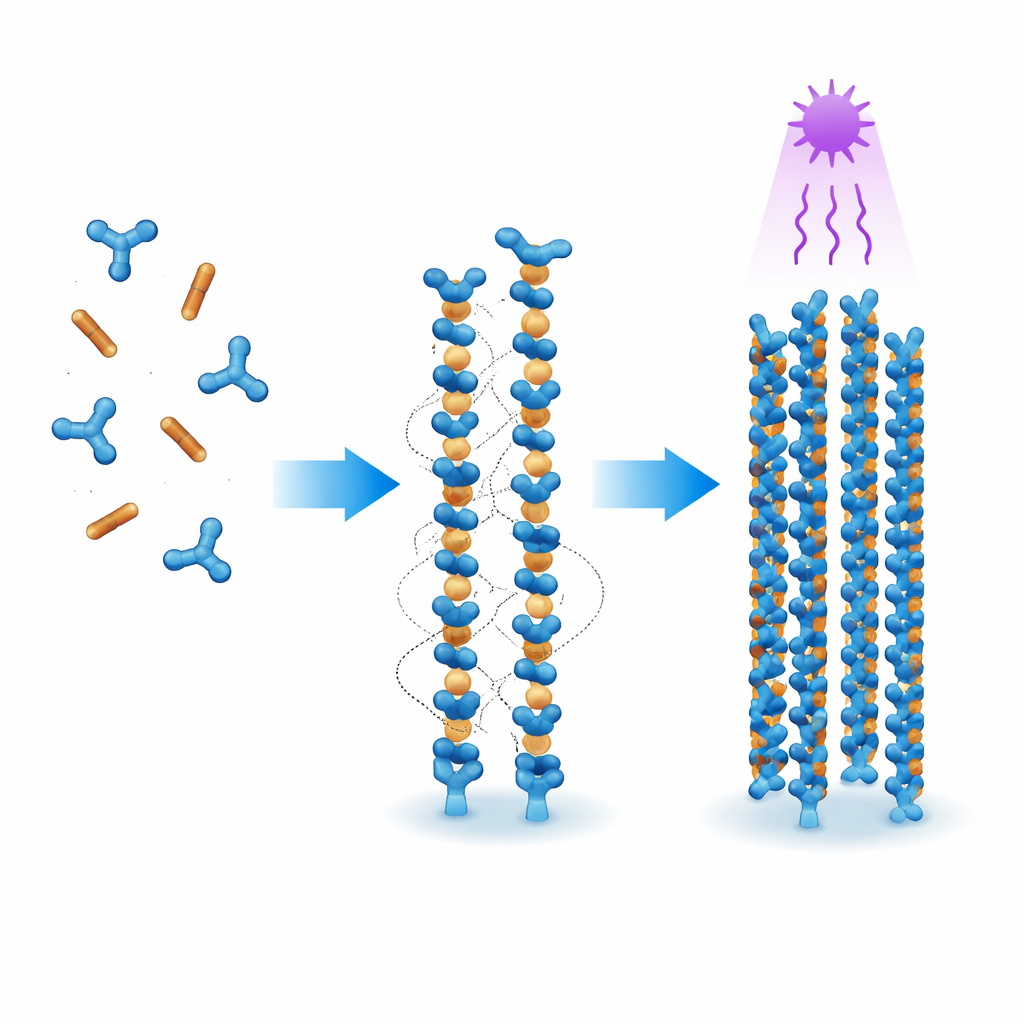
The researchers designed two complementary building blocks based on triphenylamine, a well‑known light‑absorbing, charge‑transporting unit. One component carries hydrogen‑bonding groups and heavy halogen atoms; the other carries matching sites and three reactive “diyne” units that can later be fused by light. When mixed in the right 3:1 ratio, these pieces spontaneously snap into place through a cooperative web of hydrogen bonds and halogen bonds. Atomic‑scale measurements show that, as concentration increases, more of the molecules join these organized clusters. At the same time, microscope images reveal a striking shape change: each component alone forms only blobs or tiny dots, but together they grow into long, hair‑like fibers that weave into a soft network.
Freezing Order with a Flash of Light
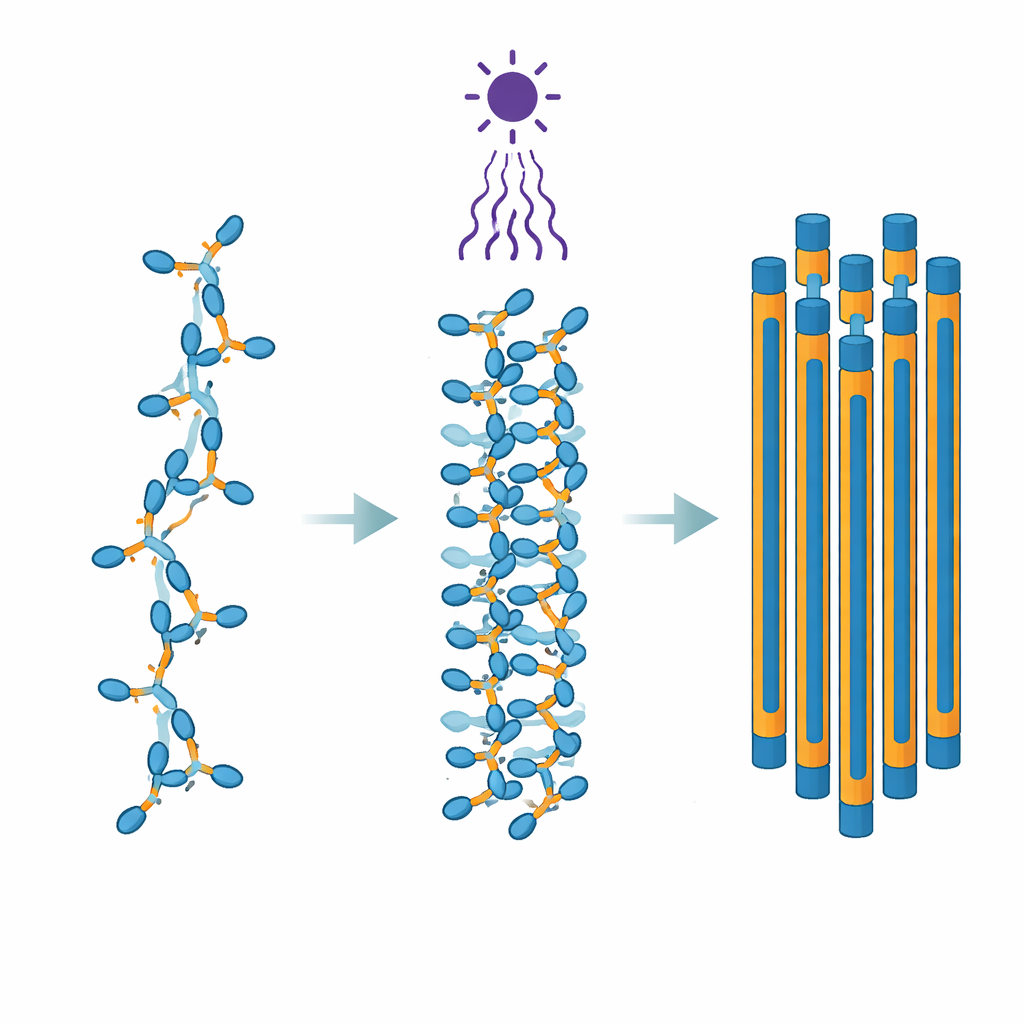
Once the molecular “scaffolding” is in place, ultraviolet light provides the curing step. The diyne units on neighboring molecules sit at just the right spacing to undergo a photochemical reaction that stitches them into continuous chains known as poly(diacetylenes). Spectroscopy shows that in the absence of the template, shining UV light mostly degrades the reactive groups or causes short, random connections. With the template present, by contrast, the absorption spectrum changes in a clean, concerted way, signaling the growth of an extended one‑dimensional backbone. Fluorescence measurements and high‑resolution atomic force microscopy track the same story in real space: flexible, loosely connected strands transform into thicker, straighter, more rigid fibers, eventually forming a robust mesh of uniform pores.
Removing the Training Wheels
A key test of this strategy is whether the sacrificial template can be stripped away without destroying the new polymer. The authors exploit the fact that acid breaks the halogen‑based contacts and converts one partner into a water‑soluble salt, while the resulting polymer prefers organic solvents. Through a sequence of acid and base washes, they selectively dissolve and remove the template molecules. Nuclear magnetic resonance signals from the template vanish, confirming successful extraction, while infrared spectra show that the newly formed polymer backbone remains largely intact and highly ordered. Electron microscopy reveals nanofibers hundreds of nanometers long, corresponding to chains containing roughly several hundred repeating units—far longer and more continuous than those formed without templating.
From Molecular Threads to Future Devices
In everyday terms, the team has taught small dye molecules to first hold hands in an orderly line and then permanently fuse into sturdy, wire‑like strands, after which the “hand‑holding” helpers quietly step aside. This self‑assemble‑then‑cure approach offers a general recipe for building vertical polymer architectures that combine the adaptability of soft, reversible assembly with the toughness of covalent bonds. Because the strategy relies on common noncovalent forces and light‑driven chemistry, it could be adapted to many other symmetric molecules, opening routes to precise, vertically aligned nanostructures for use in light‑harvesting, sensing, and filtration technologies.
Citation: Lu, Y., Jin, L., Wang, J. et al. Template-directed vertical photopolymerization for construction of triphenylamine-based poly(diacetylene) nanofibers. Nat Commun 17, 3731 (2026). https://doi.org/10.1038/s41467-026-70114-x
Keywords: supramolecular polymerization, triphenylamine nanofibers, photopolymerization, poly(diacetylene), hydrogen and halogen bonding