Clear Sky Science · en
Measurement of ion acceleration and diffusion in a laser-driven magnetized plasma
Why tiny lab storms matter for space
Cosmic rays—high‑energy particles zipping through space at nearly the speed of light—have puzzled scientists for over a century. We can measure how energetic they are, but not exactly how or where they get such a powerful kick. This study uses a carefully controlled experiment on Earth to mimic conditions in distant space and watch how charged particles gain and lose energy as they pass through a magnetized cloud of hot gas, or plasma. The findings offer a new window into how invisible waves and fields in space may boost particles to extreme energies.
Building a pocket-sized cosmic environment
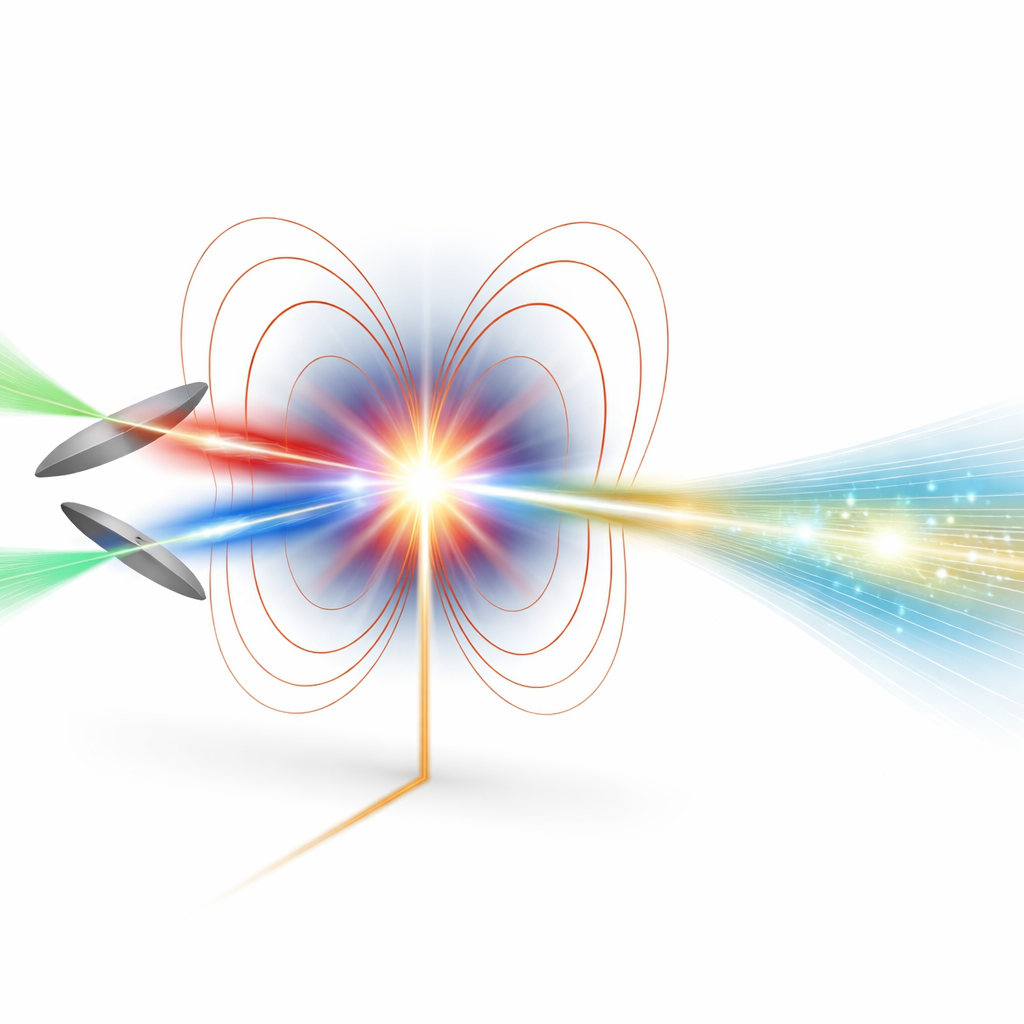
To recreate a piece of astrophysical space in the lab, the team used powerful lasers at the GSI Helmholtz Center for Heavy Ion Research in Germany. They fired these lasers at two thin plastic foils facing each other, blasting material off each surface and launching two opposing jets of plasma. As these jets rushed toward one another, natural processes in the hot gas generated magnetic fields that wrapped around the collision region. Where the two flows met, they formed a compact, roughly cylindrical zone of dense, magnetized plasma—a miniature stand‑in for the kinds of environments where cosmic rays are thought to be accelerated in space.
Sending a test beam through the storm
The researchers then sent a beam of chromium ions—heavy, positively charged particles—straight through this interaction region. The beam had a well‑known, nearly single energy at the start, like a ruler for measuring any later changes. Specialized detectors downrange recorded exactly when ions arrived, allowing the scientists to reconstruct the spread of ion energies after crossing the plasma. Other instruments, including an optical interferometer and a track detector, measured how dense the plasma was and how strong its magnetic fields became. Together, these measurements showed that the plasma was hot and magnetized, but did not exhibit strong, large‑scale turbulent swirls.
Hidden waves doing the heavy lifting
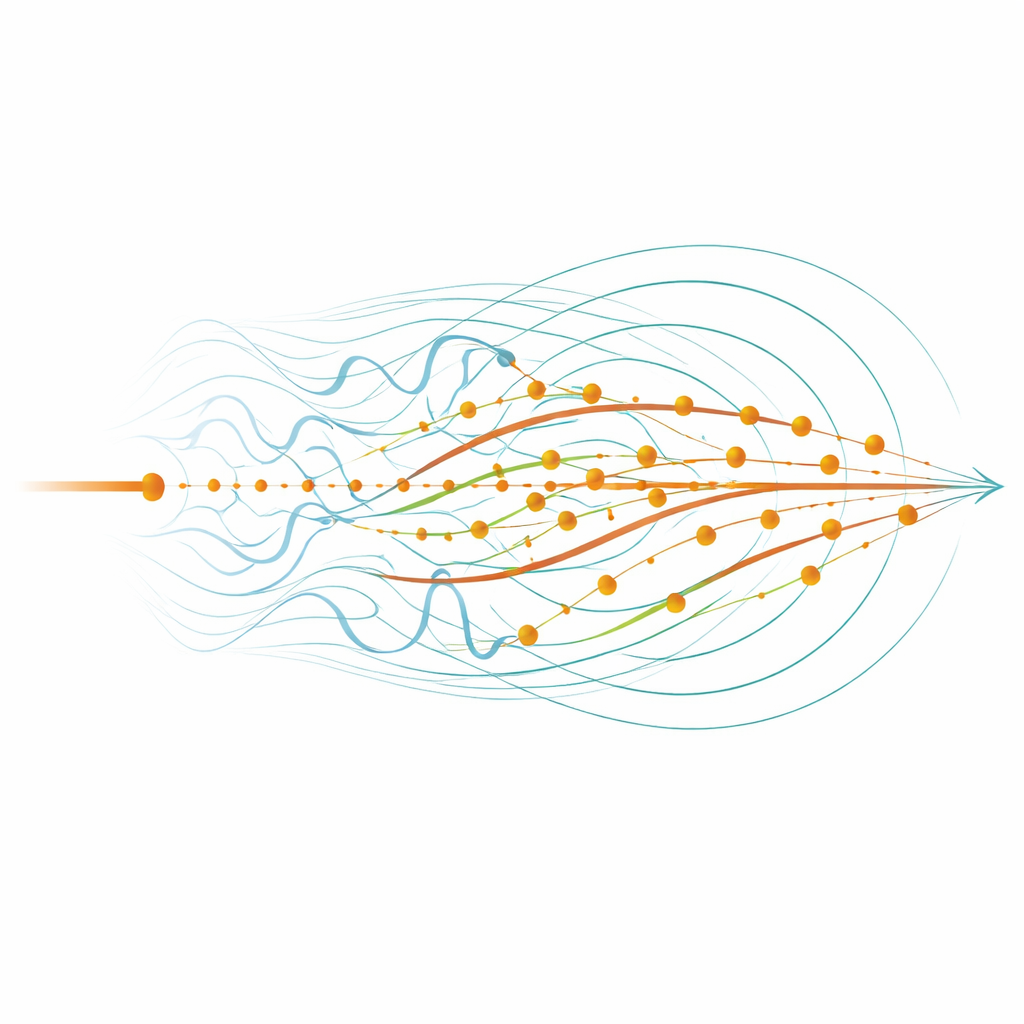
Despite the lack of big turbulent eddies, the ion beam emerged measurably altered. In shots where both foils were driven, the ions showed clear signs of both acceleration (a shift in average energy) and diffusion (a broadening of the energy spread). Careful analysis ruled out simple explanations such as ordinary collisions with plasma particles or gentle scattering by random magnetic patches; those effects were far too small. Instead, the data point toward interactions with much smaller, rapidly growing plasma waves, driven by sharp changes in density and magnetic field. A leading candidate is the "lower‑hybrid drift" instability, a type of kinetic wave that can tap these gradients and set up fluctuating electric fields that push on ions.
Zooming in on the invisible mechanism
Using the measured plasma densities, temperatures, and magnetic fields, along with supporting computer simulations, the authors estimated how fast these lower‑hybrid waves could grow and how much energy they could transfer to the ions. The numbers lined up: the predicted energy changes from this wave‑particle process were large enough to match what the detectors saw, while the classic Fermi picture—ions bouncing off moving magnetic structures—fell orders of magnitude short under the same conditions. The beam itself was too dilute to drive its own instabilities, confirming that it acted mainly as a passive probe of the plasma’s internal activity rather than as the source of the turbulence.
What this means for cosmic rays
In everyday terms, the experiment shows that even when a magnetized plasma looks calm on large scales, it can hide a sea of small, fast waves capable of giving charged particles a noticeable energy boost in a very short distance. This supports the idea that short‑scale, wave‑driven processes—rather than only large, chaotic flows—may play a vital role in the cosmic "accelerators" that produce high‑energy particles throughout the universe. By proving that such mechanisms can be created, controlled, and directly measured in the laboratory, the work opens a path to testing long‑standing theories about the origins of cosmic rays and other energetic particles in space.
Citation: Chu, J.T.Y., Halliday, J.W.D., Heaton, C. et al. Measurement of ion acceleration and diffusion in a laser-driven magnetized plasma. Nat Commun 17, 3354 (2026). https://doi.org/10.1038/s41467-026-70113-y
Keywords: cosmic ray acceleration, laboratory astrophysics, magnetized plasma, wave–particle interactions, plasma turbulence