Clear Sky Science · en
Obsidian forms by slow cooling
Why this shiny rock matters
Obsidian, the glossy black volcanic glass used for Stone Age blades and today’s surgical scalpels, has long been thought to form when hot lava chills almost instantly. This idea fits our intuition: glass usually means a liquid froze before crystals could grow. But obsidian also has another striking feature—it is nearly bubble‑free, even though the molten rock it comes from is usually loaded with dissolved water and gas. This paper shows that to remove those bubbles, obsidian cannot form by a sudden quench. Instead, it must cool surprisingly slowly, over months to decades, rewriting how we think about both volcanoes and a material central to human history.
A closer look at a seemingly simple glass
Silicic magmas—the thick, sticky melts rich in silica that feed many explosive eruptions—can hold several percent by weight of dissolved water at depth. As this magma ascends toward the surface, pressure drops and water comes out of solution as gas bubbles, like fizz in a shaken soda. When the magma finally solidifies, those bubbles are usually frozen in place as vesicles. Yet most obsidian on Earth contains less than one percent bubbles by volume, even though almost all of the original water has escaped. Two main ideas have tried to solve this puzzle: that bubbles link together into a foam that drains gas away, or that the magma first shatters into fine ash, which then welds back together while losing its gas. Both mechanisms explain how gas can escape, but they still predict several percent bubbles locked in at the end—far more than the glassy obsidian we see.
Watching bubbles grow and shrink in real time
To test a different idea, the authors created a synthetic obsidian similar to natural rhyolite but tuned so that processes would happen fast enough to watch during an experiment. They produced tiny cylinders of bubble‑bearing glass containing water and a little argon gas, then heated and cooled them inside a synchrotron X‑ray beam. This powerful setup allowed them to take 3D images of the internal bubble structure at magmatic temperatures, tracking vesicles through time. As the sample was heated, bubbles grew dramatically, driving the overall volume of the sample up far beyond what simple thermal expansion of the gas could explain. This showed that water was diffusing out of the melt into the bubbles as temperature rose, just as theory predicts.
How slow cooling makes bubbles vanish
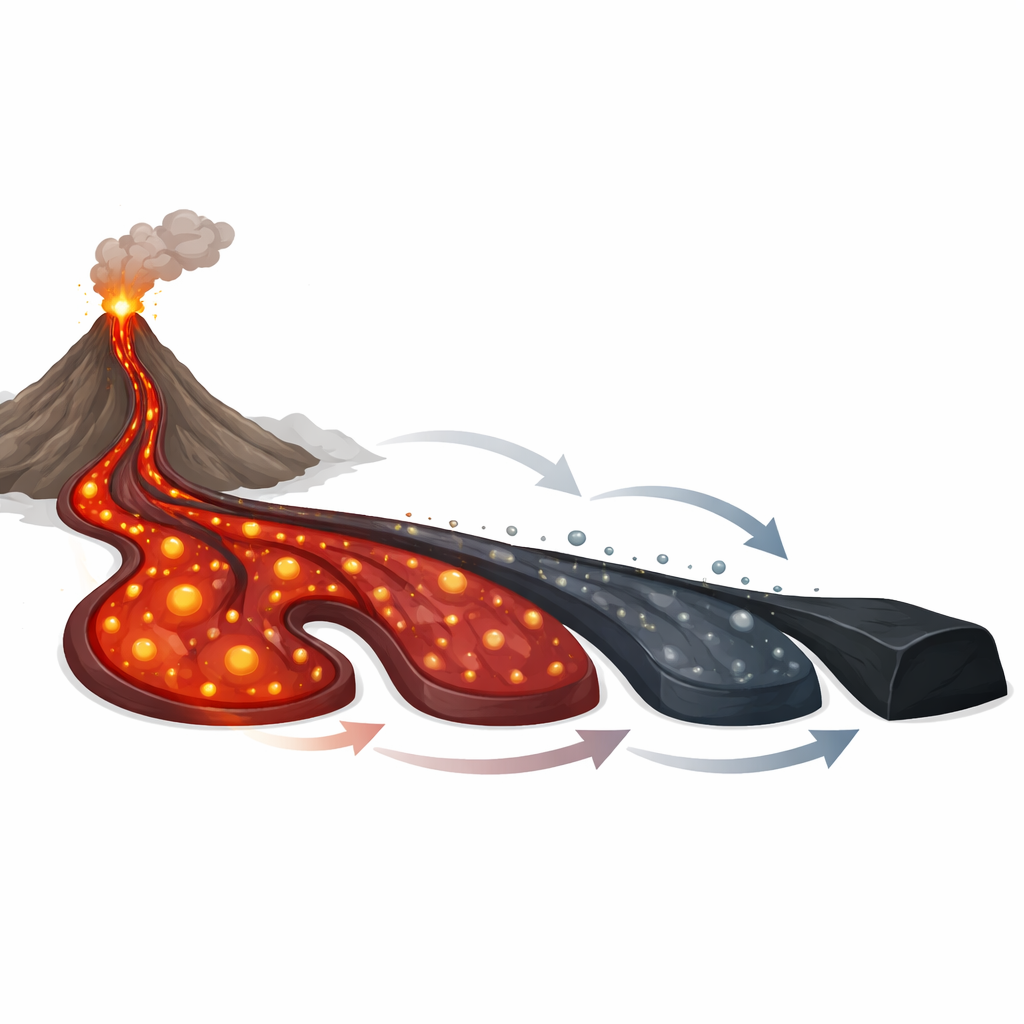
The most revealing stage came during cooling. As the hot, bubbly glass was cooled from over 1000 °C down to about 750 °C, the overall vesicle content fell from roughly 13–16 percent to about 4.5 percent, and the sample physically shrank. Simple gas compression by cooling could not account for such a large drop. Instead, the images captured bubbles literally shrinking as water molecules diffused back into the surrounding melt—"resorption" driven by the fact that cooler melts can hold more dissolved water at the same pressure. Because a small amount of argon is much less soluble, the bubbles did not disappear completely in the experiment, but the observed trend matched a detailed numerical model of bubble growth and shrinkage. This agreement validated the model for both directions of change, not just for growth as in earlier work.

From lab experiments to real lava flows
Armed with the validated model, the researchers explored what happens in natural rhyolitic lavas as they cool. They started from states that match the two gas‑loss scenarios: one with about 30 percent bubbles and one with about 3 percent, and then let the virtual lava cool at different steady rates. The simulations showed that if cooling is too fast, bubbles only partly shrink before the melt becomes glassy and diffusion effectively stops, leaving a bubbly rock. But if cooling is slow—on the order of 10⁻⁴ to 10⁻⁸ degrees Celsius per second, corresponding to months to decades for a lava flow a few to a few tens of meters thick—then bubbles can resorb completely, creating dense, nearly bubble‑free obsidian. The team also compared these timescales with how long it takes crystals to start forming in similar magmas. They found a comfortable window where lava cools slowly enough for bubbles to vanish, yet quickly enough that crystals still do not have time to appear, preserving the glassy texture.
Rethinking how obsidian really forms
In everyday imagery—from textbooks to video games—obsidian is portrayed as lava that turns to glass the instant it touches water or ice. This study overturns that picture. The glassy, crystal‑poor nature of obsidian still requires cooling fast enough to beat crystal growth, but its bubble‑free nature demands slow, steady cooling to allow water to be re‑absorbed into the melt and bubbles to fade away. The authors argue that this slow‑cooling, bubble‑resorption pathway is not a rare special case but a general mechanism that should operate wherever thick silicic lavas or welded deposits cool over months to decades. That insight reshapes how geologists reconstruct volcanic histories and offers a fresh explanation for the remarkable uniformity of a material that has been vital to human technology for thousands of years.
Citation: Llewellin, E.W., Wadsworth, F.B., Sullivan, P. et al. Obsidian forms by slow cooling. Nat Commun 17, 3266 (2026). https://doi.org/10.1038/s41467-026-70110-1
Keywords: obsidian, volcanic glass, bubble resorption, silicic lava, slow cooling