Clear Sky Science · en
Alkylsilane-extended hydrogen migration enhanced photothermal Sabatier reaction
Turning Sunlight and Carbon Dioxide into Clean Fuel
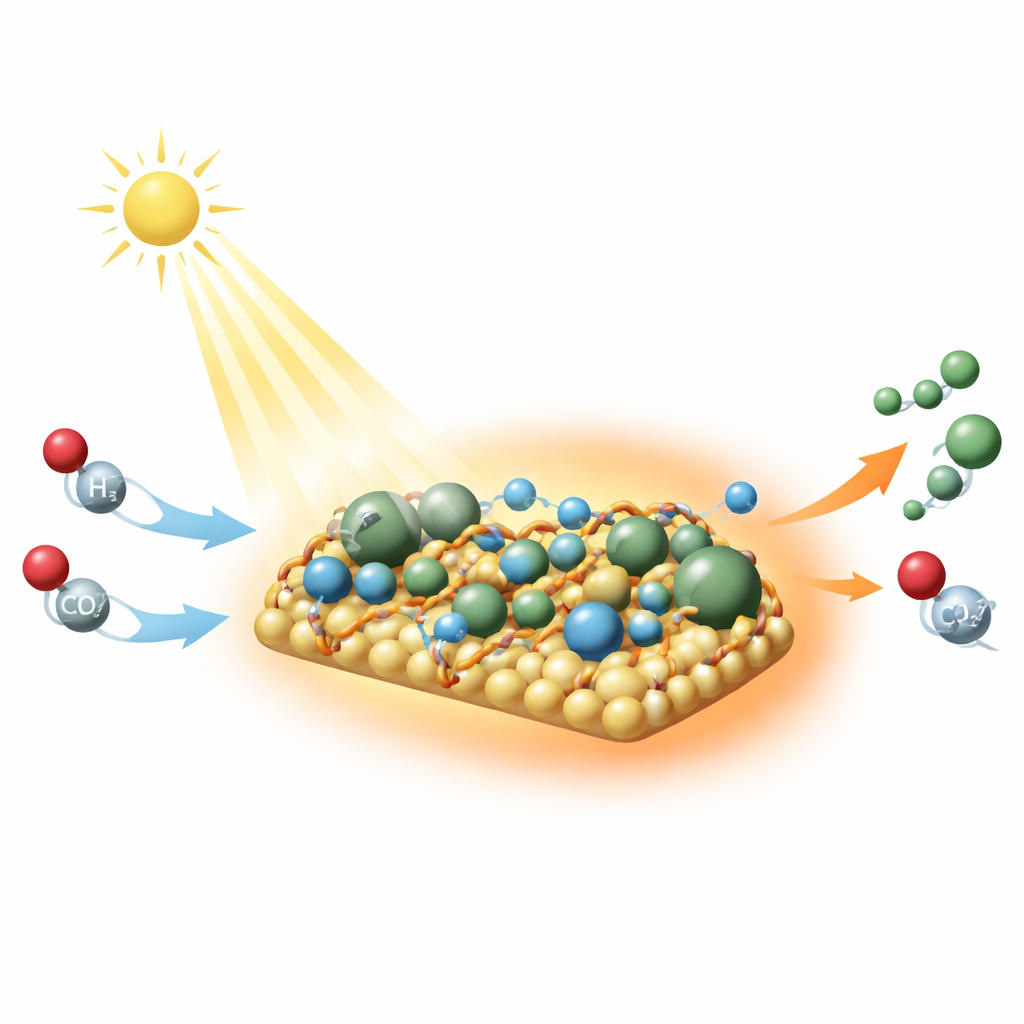
Imagine a device that can sit in the sun and quietly turn carbon dioxide, a major greenhouse gas, into methane, a useful fuel that can flow through today’s natural-gas pipelines. This study explores exactly that possibility. The researchers show how a tiny tweak on the surface of a common catalyst helps hydrogen atoms travel farther and faster, dramatically boosting the efficiency of a solar-powered process that converts carbon dioxide into methane.
Why Moving Hydrogen Atoms Matters
At the heart of many clean-fuel technologies is a simple idea: use hydrogen to “upgrade” carbon dioxide into energy-rich molecules. For this to work well, hydrogen atoms must move efficiently across the surface of a solid catalyst so they can meet and react with adsorbed carbon dioxide species. Traditionally, scientists believed these hydrogen atoms mainly hopped along oxygen atoms on the surface of metal oxides. But that pathway can be limited or even blocked when the oxide is reduced, capping how fast the reaction can run. Finding a more stable and extended “highway” for hydrogen on a catalyst surface could therefore unlock much better performance.
Adding a Molecular Highway to a Workhorse Catalyst
The team started from a well-known catalyst: tiny nickel particles supported on cerium oxide (Ni/CeO2), a leading material for the Sabatier reaction that turns carbon dioxide and hydrogen into methane. They then gently coated the surface with a very small amount of alkylsilane—molecules that feature a silicon head and a short hydrocarbon tail. These chains are usually used simply to make surfaces water-repelling. Here, they are repurposed as potential bridges for hydrogen migration. Structural measurements showed that the modified catalyst, labeled S2, kept the same overall crystal structure but had smaller, better-dispersed nickel particles and a thin layer of these hydrocarbon chains lying close to the metal sites.
Solar-Driven Methane with Near-Perfect Yield
When tested in the Sabatier reaction, the alkylsilane-decorated catalyst clearly outperformed the original material. Under controlled lab conditions, S2 converted more carbon dioxide and produced methane with higher selectivity than the unmodified catalyst, especially under light. At around 250 degrees Celsius, the system reached a solar-to-chemical efficiency of about 43 percent—nearly five times higher than the baseline. Outdoor trials using concentrated natural sunlight pushed the performance even further: a single pass of the gas mixture over S2 converted up to 99.9 percent of the carbon dioxide, with almost every carbon atom emerging as methane. The setup operated stably for more than 100 hours, demonstrating that the improvement is not just a fragile laboratory curiosity.
How Hidden Chains Steer Hydrogen
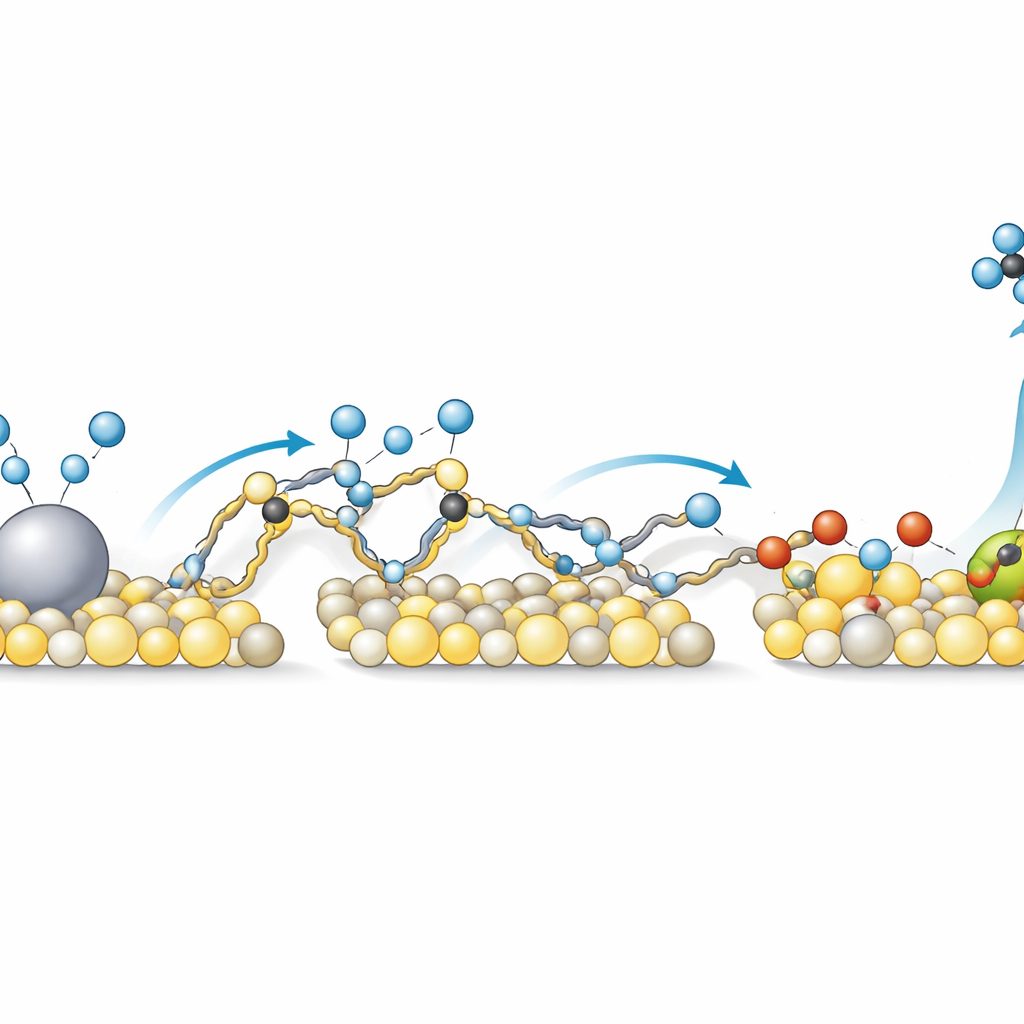
To understand why such a small surface modification has such a big effect, the researchers probed the reaction mechanism in detail. Experiments tracking how reaction rates depend on hydrogen pressure showed that S2 behaves as if hydrogen is always readily available on the surface: the reaction became almost insensitive to hydrogen concentration, signaling very easy hydrogen migration. Infrared measurements using hydrogen and its heavier twin, deuterium, revealed that hydrogen atoms can temporarily lodge along the alkyl chains and move away from the nickel particles. These mobile hydrogen atoms then rapidly hydrogenate carbon dioxide–derived species—such as carbonates and formates—spread across the cerium oxide surface. In effect, the hydrocarbon chains act as flexible molecular conduits that extend the reach of active hydrogen far beyond the immediate metal sites, opening extra reaction routes and speeding up methane formation.
From Laboratory Insight to Real-World Impact
Beyond the chemistry, the study evaluates how this improved catalyst could affect future energy systems. A techno-economic analysis, informed by process simulations, suggests that a solar-driven Sabatier plant using the enhanced catalyst could produce synthetic methane at costs comparable to or lower than coal-to-methane technology—especially as green hydrogen becomes cheaper and carbon taxes increase. Because the process directly uses carbon dioxide and sunlight, while operating with high efficiency and long-term stability, it could serve as a bridge between today’s fossil-based gas infrastructure and tomorrow’s carbon-neutral energy cycles.
A New Pathway for Cleaner Fuels
In simple terms, the researchers have found a way to lay down extra “lanes” for hydrogen atoms on a catalyst surface using a sparse carpet of molecular chains. This extended hydrogen highway allows the catalyst to turn carbon dioxide and hydrogen into methane more completely and with less wasted energy, especially under sunlight. The result is a nearly closed-loop, solar-driven route to synthetic natural gas that could help store renewable energy and recycle carbon dioxide, nudging our energy system toward a more sustainable future.
Citation: Lu, Z., Liu, W., Zhang, Z. et al. Alkylsilane-extended hydrogen migration enhanced photothermal Sabatier reaction. Nat Commun 17, 3592 (2026). https://doi.org/10.1038/s41467-026-70109-8
Keywords: CO2 methanation, solar fuels, hydrogen migration, Sabatier reaction, Ni catalysts