Clear Sky Science · en
Topology-controlled dynamic conjugated oligomers from tetra-arylsubstituted alkene building blocks
Shaping Light with Nano-Sized Building Blocks
Imagine being able to dial in new glowing fibers or tiny rod-like crystals simply by changing how a molecule branches, much like rearranging the frame of a playground structure. This study explores how the “shape” or topology of special light-emitting molecular chains controls how they twist, glow, and assemble into larger structures that resemble springs, neural networks, and tiny rods. Such control over structure and light could one day help design smarter sensors, flexible displays, and materials that move or change color on demand.
From Simple Units to Designer Molecular Shapes
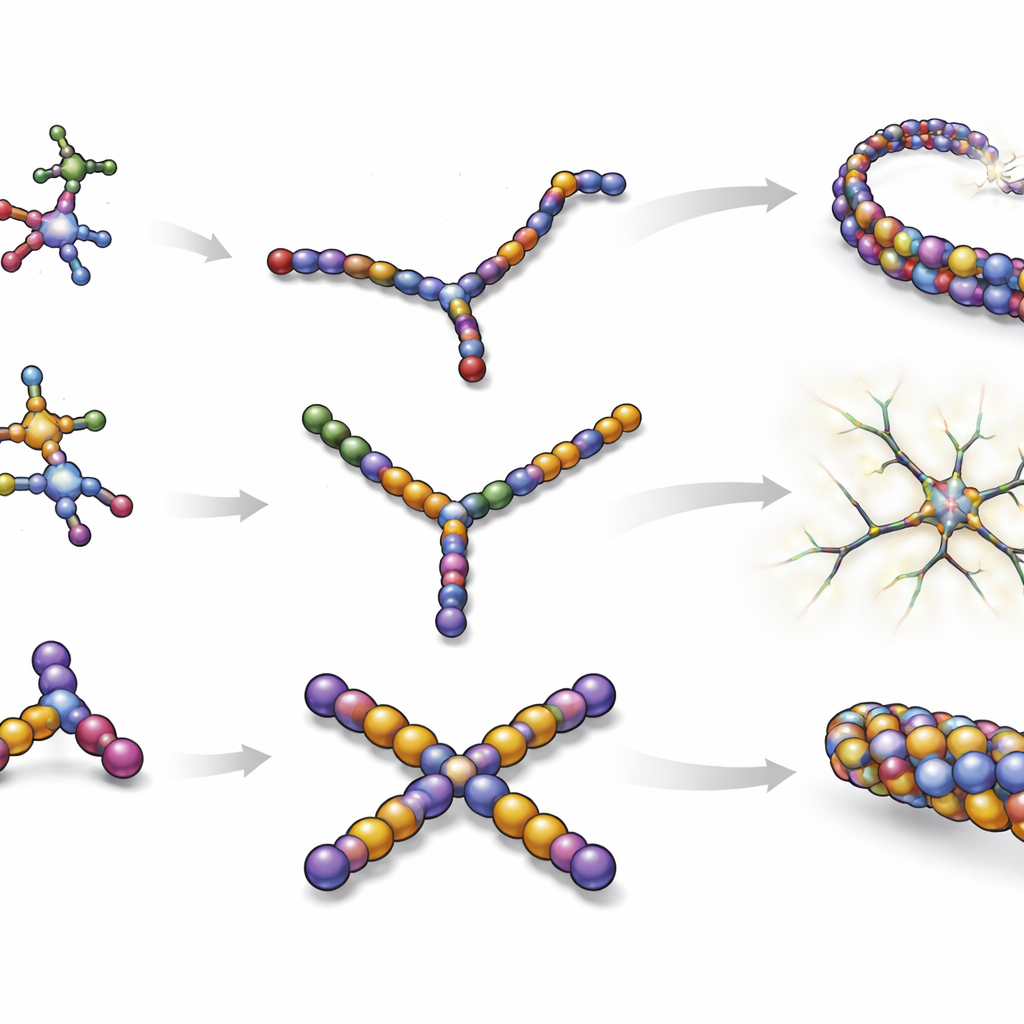
At the heart of this work are small carbon–carbon double bonds decorated with four ring-shaped groups. These units can quietly flip between two mirror-like forms, known as cis and trans, even at room temperature. The authors use these dynamic units as Lego-like pieces to build three kinds of precisely sized molecular chains: a straight, one-dimensional chain (called PL9), a Y-shaped three-armed molecule (PY12), and an X-shaped four-armed structure (PX16). An iterative chemical method lets them “snap” these pieces together in solution with great precision, controlling both length and branching while keeping the materials stable and soluble.
Molecules That Constantly Rearrange Themselves
Because each building block can switch between cis and trans forms, every chain is actually a shifting family of closely related shapes, rather than a single frozen structure. Advanced separation methods show that each type of chain exists as many stereoisomers – subtly different three-dimensional arrangements with nearly identical overall composition. In solution, these differences blur together, so the chains behave as a dynamic ensemble whose average behavior can be tracked by their light absorption and weak glow. In the solid state, however, motion is constrained, and individual shapes become trapped, giving rise to multiple distinct light-emission patterns for each topology.
Light That Switches On When Molecules Huddle
When these chains are alone in a good solvent, they glow only faintly because their moving parts drain away the energy. But when the researchers coax the molecules to huddle together into aggregates or powders, the motion is restricted and the glow switches on dramatically. All three topologies emit similar greenish light, yet their brightness and details of their spectra depend strongly on how many arms they have. The three-armed Y-shaped molecule in particular reaches exceptionally high brightness in the solid state, with most of the absorbed energy released as light instead of heat. Calculations suggest that in all three systems, only a small, triangular segment of four to five connected building blocks effectively carries the electronic excitation, and the branching pattern tunes how that segment is embedded and how easily it can twist.
From Helical Fibers to Neural-Like Networks
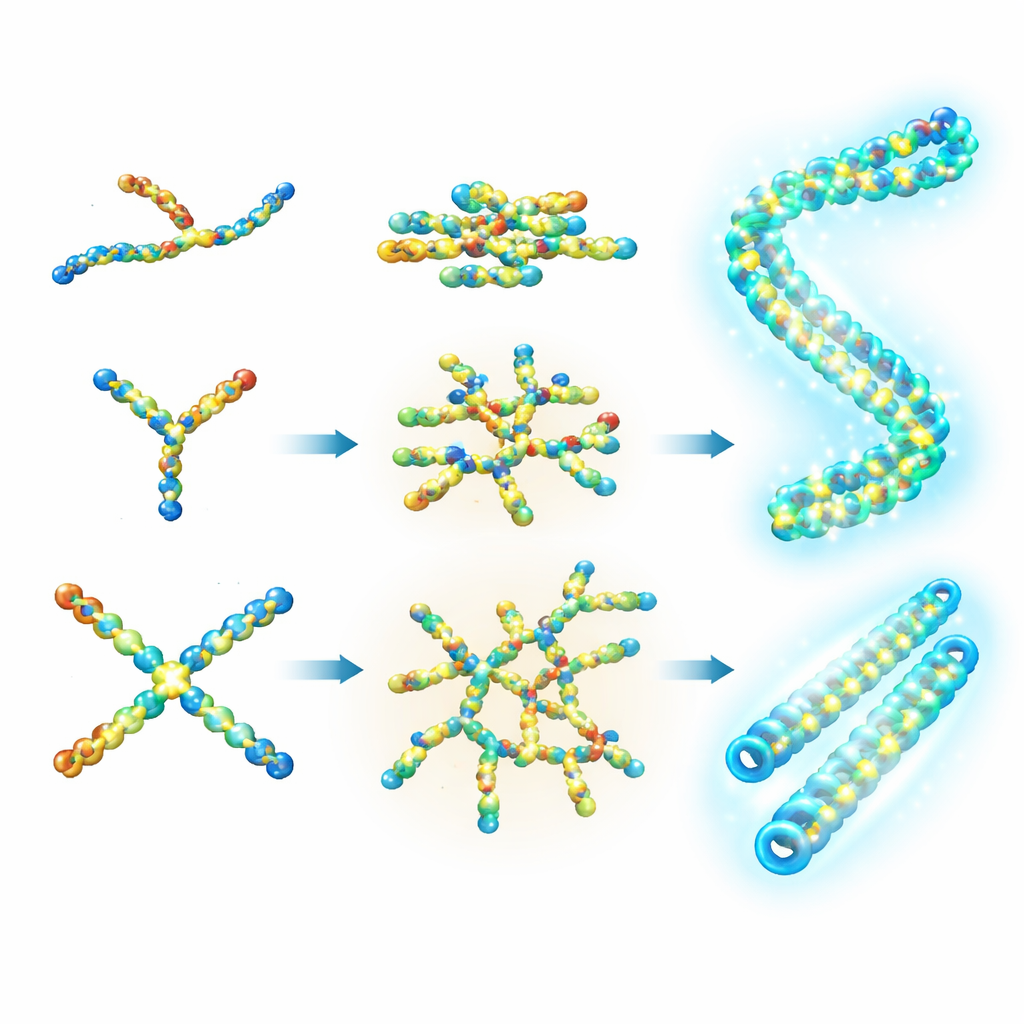
By slowly evaporating solutions, the team watches how these molecules organize themselves on surfaces. The straight two-armed chains weave into long, flexible helical fibers, like nanoscale springs. The Y-shaped molecules grow into nanowires that branch and cross to form intricate, network-like patterns reminiscent of nerve cell connections, with fiber-like links radiating from nodal “hubs.” In contrast, the four-armed X-shaped molecules pack more compactly into short, thick helical rods with a regular internal order. Computer simulations help unpack how terminal group-to-group contacts and the balance between cis and trans segments drive this hierarchy: first setting local twists along each chain, then guiding how chains stack and finally determining whether the material becomes a fiber, a network, or a rod.
Why the Overall Shape Matters
Taken together, the findings show that simply changing how many arms a dynamic chain has – linear, Y-shaped, or X-shaped – is enough to reroute how the molecules move, how efficiently they glow, and what larger shapes they ultimately form. The work offers a blueprint for designing new soft materials where the overall connectivity of the building block, rather than just its chemical recipe, controls properties like brightness and self-assembly into helical fibers or neural-like networks. In the long run, this kind of topology-guided design could be used to program light-emitting materials that mimic biological structures or perform responsive functions at the boundary between chemistry, materials science, and nanotechnology.
Citation: Bian, Q., Zhao, Y., Zhang, C. et al. Topology-controlled dynamic conjugated oligomers from tetra-arylsubstituted alkene building blocks. Nat Commun 17, 3306 (2026). https://doi.org/10.1038/s41467-026-70106-x
Keywords: dynamic conjugated oligomers, molecular topology, aggregation-induced emission, self-assembled nanostructures, helical and neural-like fibers