Clear Sky Science · en
Crystallization-driven template autocatalysis induces mirror symmetry breaking and amplification
Why One Handedness Rules Life
Life on Earth seems strangely one-sided. The DNA in our cells twists almost exclusively to the right, and the building blocks of proteins all share the same “handedness.” How such a universal preference first appeared from an originally symmetric, non-living world is a deep scientific puzzle. This study explores a new way that matter can spontaneously choose one twist over another while it is crystallizing, offering a fresh clue to how nature may have picked a single biological handedness long before cells existed.
From Flat Molecules to Twisting Fibers
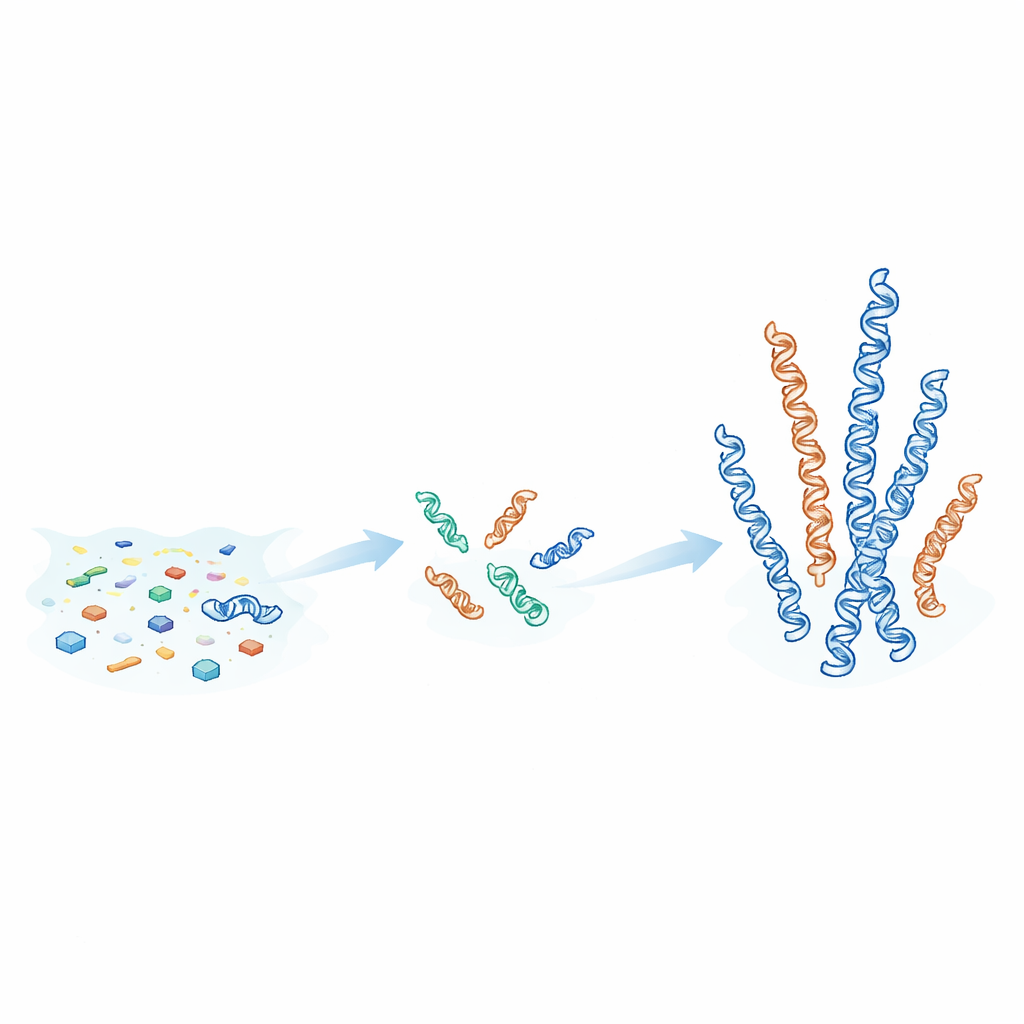
The researchers work with specially designed flat, ring-shaped dye molecules called naphthalocyanines. These colorful molecules do not float around alone: when formed in a hot liquid, they stack on top of one another and grow into long, solid fibers. Under carefully chosen conditions, these fibers twist into helices, much like microscopic springs. The team begins with precursor molecules that can chemically join together to make the rings. A helper liquid, a thiol compound, donates electrons and protons so that, at high temperature, the precursors close into the ring-shaped dyes while everything is still molten.
A Self-Accelerating Crystal Factory
Crucially, once a few rings have formed and stacked into a tiny crystal, that crystal becomes an active template that speeds up the production of more rings. At the hot temperatures used, the precursors remain fluid, but the new ring stacks stay solid and ordered. Fresh precursor molecules are attracted to the ends of these stacks, where they are held in a specific orientation by simple forces: face-to-face stacking of the flat rings and rows of hydrogen bonds. This pre-organization makes it easier for the precursors to close into new rings right where they are needed, so the fiber grows from its tips in a self-reinforcing, autocatalytic way.
How Symmetry Gets Broken
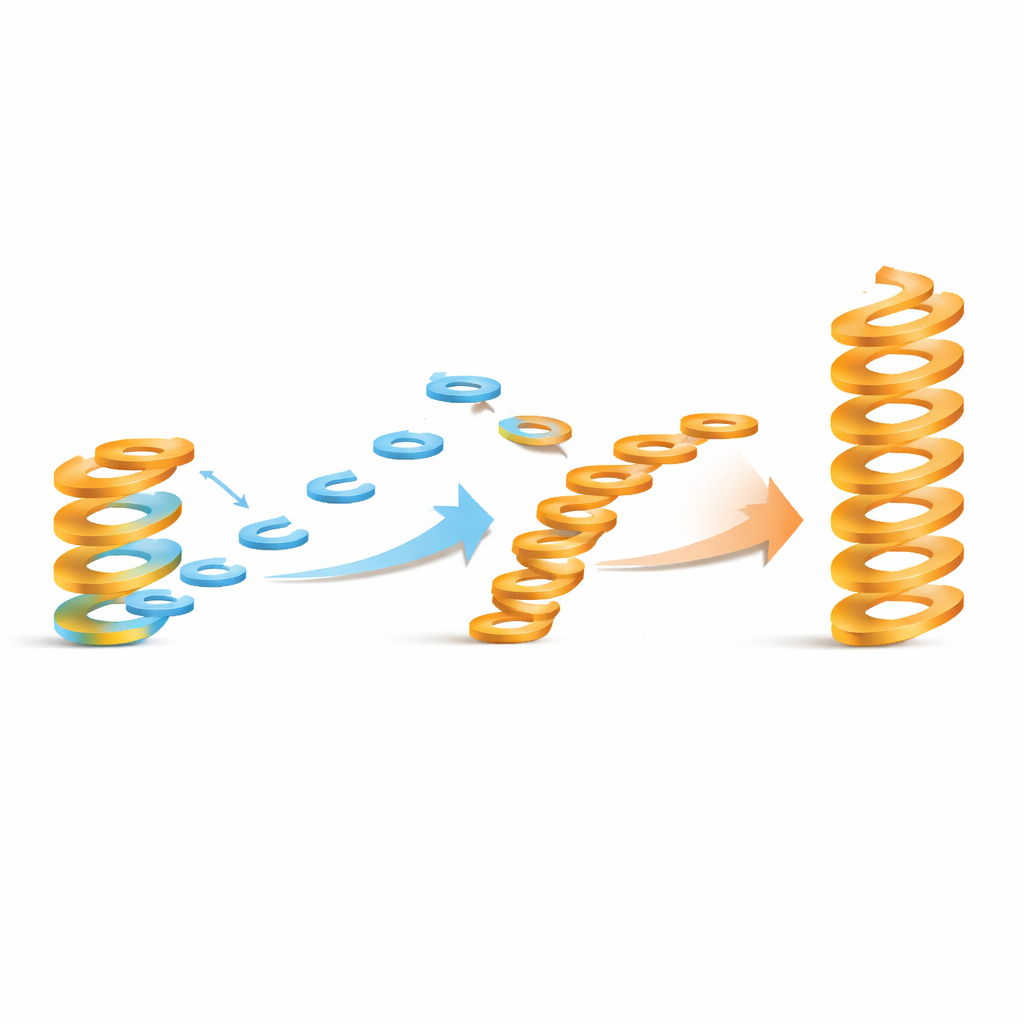
In principle, these helical fibers could twist equally to the left or to the right. Yet when the team starts from achiral, that is, non-handed, building blocks, they consistently observe a bias toward right-handed helices. Sensitive optical measurements show a preferred twist, and electron microscopy reveals more right-handed than left-handed fibers. This bias appears during the early “nucleation” phase when the first tiny crystal seeds form, and it is then magnified as the fibers elongate through the template-driven reaction. When the same molecules are allowed to crystallize slowly from a regular solution, without this self-accelerating growth, the crystals are straight and show no overall handedness. That contrast reveals that the non-equilibrium, crystallization-driven autocatalysis is essential for breaking mirror symmetry.
Passing On and Boosting a Chiral Signal
The system can also be steered. If the researchers begin with ring molecules that already carry chiral side chains, the resulting fibers are purely single-handed—right-handed side chains give right-handed helices, and the mirror-image side chains give left-handed helices. Even more striking, tiny amounts of pre-formed chiral fibers can be mixed into an achiral precursor melt. These seeds act as “sergeants” that command a large crowd of “soldier” molecules: new fibers grow out from the seeds and inherit their twist, so a small initial imbalance produces a strong overall handedness. External influences such as chiral additives or circularly polarized light during nucleation can also tip the balance, making one twist dominate the other.
What This Means for Life’s One-Sidedness
Taken together, the findings show how a simple physical process—crystals that help make more of themselves while they grow—can both choose a helical direction and amplify that choice. Once a slight excess of one twist appears, perhaps seeded by a trace impurity or a random fluctuation, the crystallization-driven, template-based autocatalysis locks in that bias and spreads it through the entire material. While this study uses synthetic dye molecules rather than biological ones, it demonstrates a realistic route by which non-living matter could spontaneously adopt and strengthen a single handedness. Such mechanisms may have helped set the stage for the uniform molecular handedness that all known life now shares.
Citation: Wu, H., Chen, Q., Gao, D. et al. Crystallization-driven template autocatalysis induces mirror symmetry breaking and amplification. Nat Commun 17, 3277 (2026). https://doi.org/10.1038/s41467-026-70105-y
Keywords: homochirality, autocatalysis, supramolecular helices, crystallization, self-replication