Clear Sky Science · en
Condensed lignin depolymerization via C–C bond cleavage with a disordered crystalline mesoporous zeolite
Turning Wood Waste into Treasure
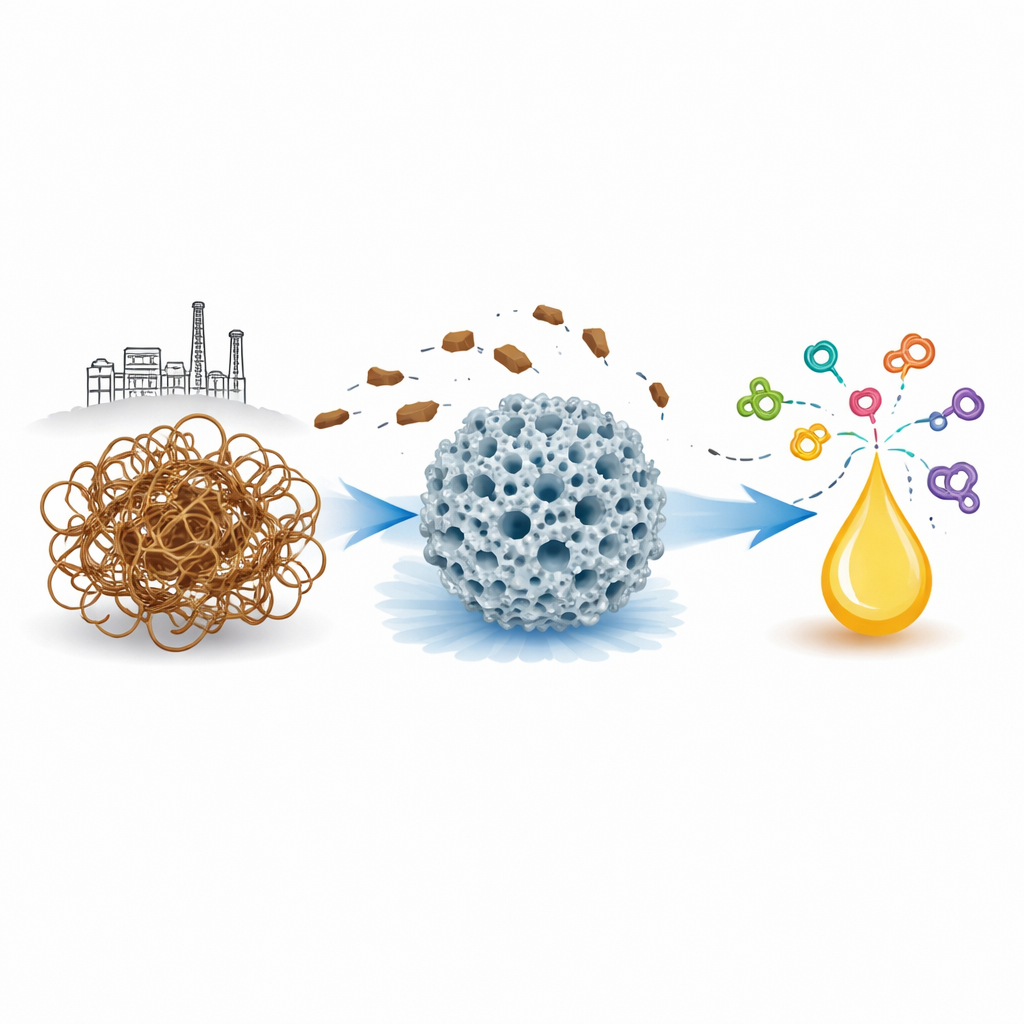
Lignin is a major component of wood and plant biomass, and every year pulp and paper mills generate tens of millions of tons of it as a low-value byproduct, often burned just for heat. Much of this lignin has already been heavily “cooked” and chemically altered, making it stubborn and difficult to turn into useful chemicals or fuels. This study shows how a specially designed porous mineral catalyst can crack open some of the toughest chemical bonds in this waste lignin, dramatically boosting the yield of high-value molecules that could feed into renewable fuels and materials.
Why Tough Plant Glues Are Hard to Break
Lignin acts like a natural glue that stiffens plants and binds cellulose fibers together. When wood chips are digested in harsh industrial processes to make paper or bioethanol, the original lignin structure is badly rearranged. Fragile bonds that are easy to cut are broken, while new, much stronger carbon–carbon links are formed. These new links behave like molecular rivets: they are both thermally and chemically resistant, locking the lignin into large, unreactive chunks. Because of this, most existing “lignin-first” strategies—designed to protect and gently disassemble native lignin—do not work on these already-condensed, heavily processed lignins that dominate industrial waste streams.
A Sponge-Like Mineral with Hidden Highways
The authors tackle this problem with a catalyst called a disordered crystalline mesoporous zeolite, referred to as Meso-Z. Zeolites are aluminosilicate minerals with highly ordered internal channels, widely used in oil refining. Traditional zeolites have very narrow pores, which are excellent for shaping small molecules but act like narrow hallways for bulky lignin fragments, slowing their movement and limiting how many can reach active sites. Meso-Z preserves the strong acidic sites of a conventional zeolite but builds them into a coral-like framework threaded with larger, irregular mesopores. These wider channels act as molecular highways, giving large lignin oligomers room to diffuse, reorient, and contact the catalytic sites deep within the material.
Snapping the Strongest Bonds
Using carefully chosen model compounds that mimic the structures found in condensed lignin, the team shows that Meso-Z can selectively break the very strong carbon–carbon bonds that usually survive pulping. In an optimized mixture of ethanol and water at high temperature, the catalyst converts these models almost completely into simple aromatic building blocks. Detailed computational studies reveal how different types of acidic and basic sites inside the zeolite cooperate with the solvent. Brønsted acid sites protonate key positions on the lignin-like molecules to form reactive intermediates; Lewis acid sites and nearby basic sites then guide hydrogen transfers from ethanol or attacks by water. Together, these steps lead either to “hydrogenolysis,” where fragments are reduced and capped, or to “hydrolysis,” where small units like formaldehyde are released, preventing the broken pieces from stitching themselves back together.
From Real Industrial Lignin to Fuel Precursors
The researchers then put the system to a tougher test: five different real condensed lignins from pulping and biorefining plants. After an initial treatment that removes the remaining weaker bonds, they isolate lignin fragments held together only by strong carbon–carbon links. When these are exposed to Meso-Z in the ethanol–water mixture, the catalyst produces 32–45.6 weight percent of aromatic monomers and dimers—three to eight times more than a conventional zeolite with similar acidity but only narrow pores. These yields far exceed what would be possible by breaking oxygen-linked bonds alone, demonstrating that the stubborn carbon–carbon backbone is truly being cut. Follow-up work shows that these aromatic products can be upgraded to energy-dense cycloalkanes with properties comparable to high-performance jet fuels.
How Bigger Pores Speed Up the Chemistry
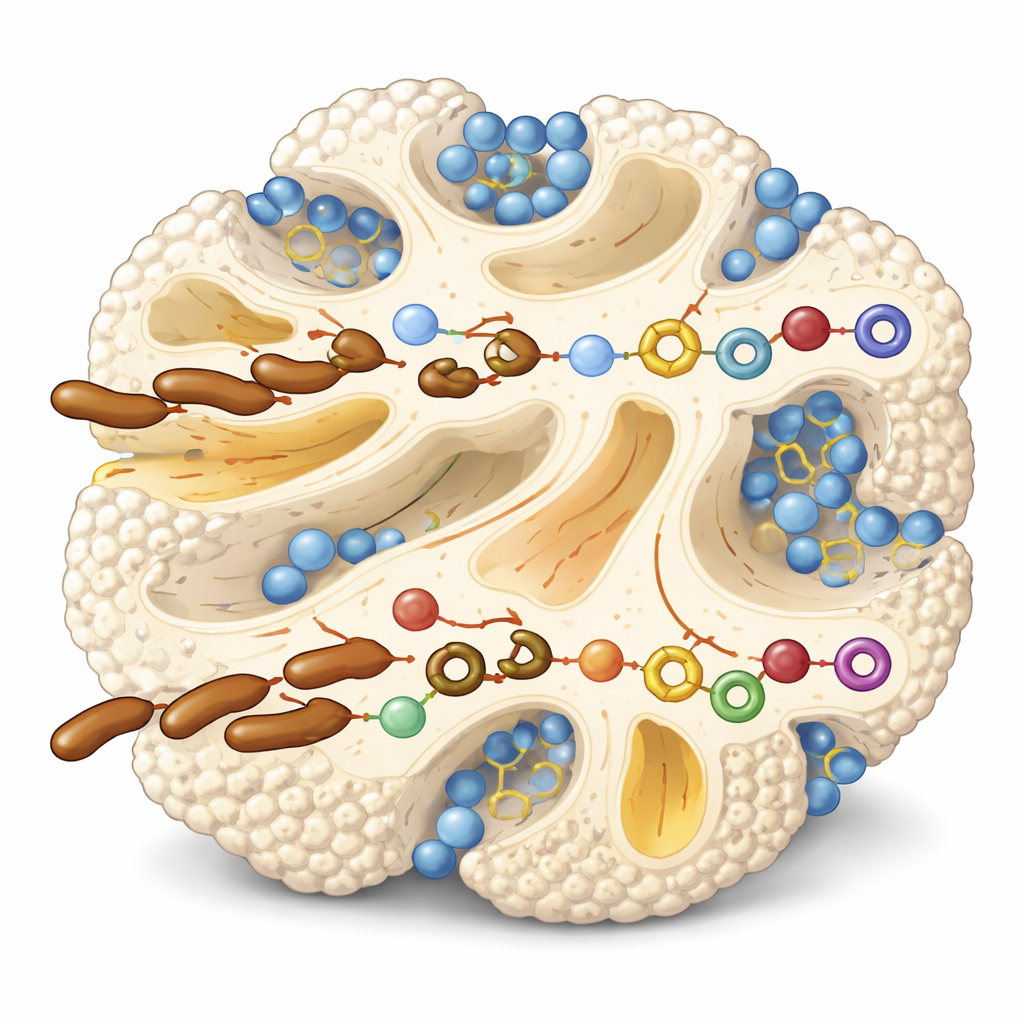
Computer simulations provide a molecular picture of why Meso-Z outperforms traditional catalysts. In a narrow, microporous channel, a lignin-sized fragment is almost frozen in place, strongly attracted to the pore walls and able to move only sluggishly. In contrast, within a wider mesopore, the same fragment can flex, change shape, and diffuse more than eighty times faster. The weaker, more glancing interactions with the pore surface allow it to reach and leave active sites efficiently rather than becoming stuck. This balance—strong enough to activate bonds, but not so strong as to trap the molecules—turns the mesoporous framework into an efficient reactor for breaking down large biopolymer pieces.
From Difficult Waste to a Renewable Resource
Overall, the study outlines a blueprint for turning one of the hardest-to-use biomass residues into a rich feedstock for chemicals and fuels. By marrying strong acidity with a sponge-like, multi-scale pore structure, the Meso-Z catalyst can cut through the toughest bonds in condensed lignin and deliver aromatic products in record yields, all while remaining stable over many cycles and regenerable by simple heating. For a general audience, the key message is that smarter catalyst architecture—not just stronger chemistry—can unlock new value from industrial waste, moving lignin closer to becoming a central pillar of sustainable, carbon-efficient manufacturing.
Citation: Kong, X., Bie, L., Liu, C. et al. Condensed lignin depolymerization via C–C bond cleavage with a disordered crystalline mesoporous zeolite. Nat Commun 17, 3291 (2026). https://doi.org/10.1038/s41467-026-70103-0
Keywords: lignin depolymerization, mesoporous zeolite, biorefinery, carbon–carbon bond cleavage, renewable jet fuel