Clear Sky Science · en
Photothermal CO2 methanation over (NiO/Ru0)/TiO2 catalysts via hydrogen spillover
Turning Waste Gas into Useful Fuel
Carbon dioxide from burning fossil fuels is the main driver of climate change, but it is also a carbon-rich resource. If we could efficiently turn CO2 into fuels using only sunlight and hydrogen, we could store renewable energy and cut emissions at the same time. This study reports a specially engineered catalyst that uses light and heat together to convert CO2 into methane—an energy-dense gas—almost completely and with remarkable selectivity, while revealing in detail how hydrogen atoms move across the catalyst surface to make the reaction work better.
Why This Reaction Is So Hard
Transforming CO2 into methane is much more complicated than simply mixing gases. CO2 is a very stable molecule, and converting it into CH4 requires several tightly choreographed steps in which protons and electrons are added one after another. In most existing systems, these steps are slow and energy-hungry, so much heat or high pressure is needed. Scientists have long suspected that a process called hydrogen spillover—where hydrogen atoms, once split from H2 on one material, migrate onto a neighboring surface—could help speed things up. But how this actually reshapes the reaction pathway, and what kind of catalyst structure best supports it, has remained poorly understood.
Building a Teamwork Catalyst
The researchers designed a “teamwork” catalyst by combining three components: ruthenium metal (Ru), nickel oxide (NiO), and titanium dioxide (TiO2). Each plays a distinct role. Ru is exceptionally good at splitting H2 into highly active hydrogen atoms. NiO is especially good at grabbing and activating CO2 molecules thanks to its surface oxygen and nickel sites. TiO2 serves as a stable support and a light-absorbing base that helps manage the flow of charge. By carefully arranging Ru and NiO nanostructures on TiO2 so that they touch at many interfaces, the team created channels where hydrogen atoms can easily spill over from Ru to nearby oxygen sites on NiO, right where CO2 is bound and ready to react. 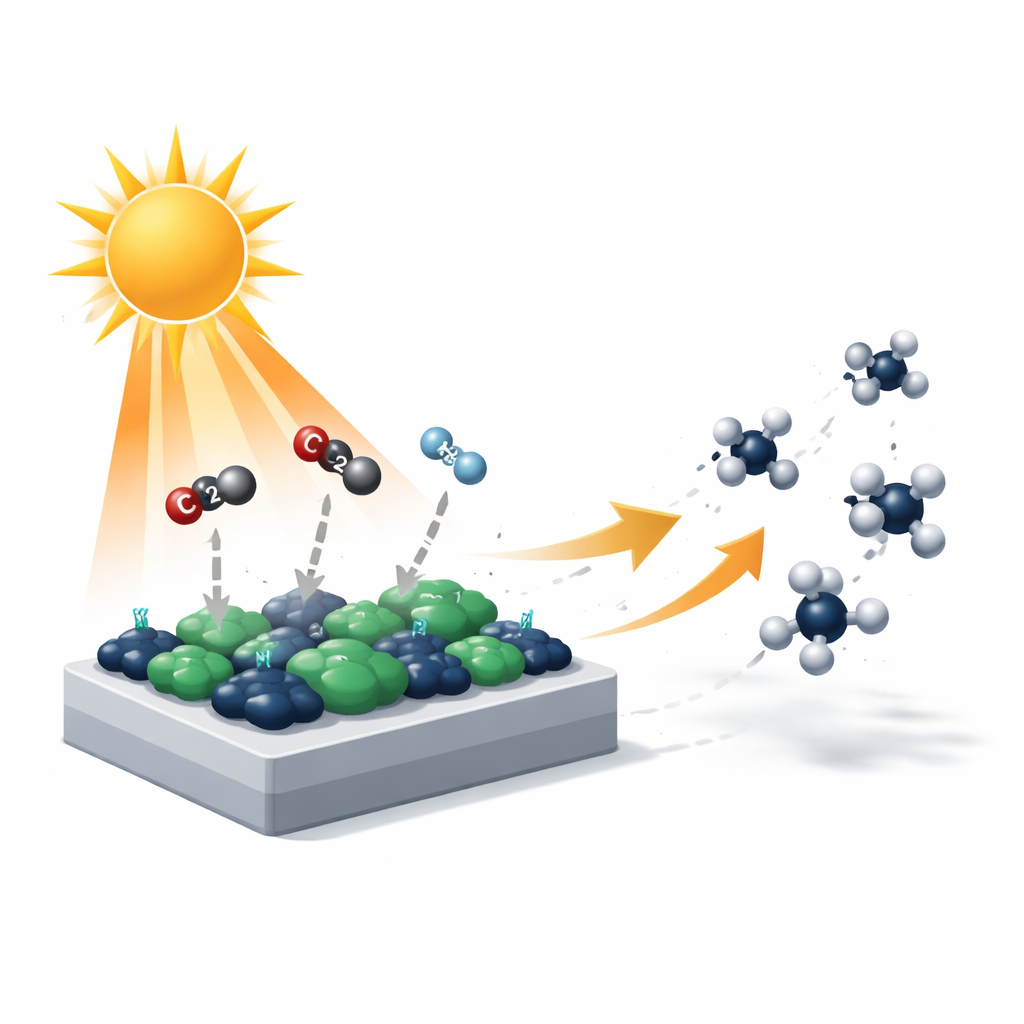
Sunlight, Heat, and Moving Charges
When this composite catalyst (called NR-TiO2) is illuminated, it heats up and also generates mobile electrons and holes. Compared with versions containing only NiO or only Ru, NR-TiO2 absorbs light more strongly, reaches higher operating temperatures under the same light intensity, and shows much lower apparent activation energy for the reaction. Measurements of light-induced voltages and glow from recombining charges reveal that adding Ru and NiO greatly improves the separation and transport of photogenerated carriers across the surface. As a result, the catalyst supplies both energetic electrons and a warm environment that together drive methanation more efficiently than heat alone could. Under concentrated light (25.5 suns), the system reaches about 220 °C, converts CO2 completely, and produces methane almost exclusively, at rates several times higher than the single-component catalysts.
How Hydrogen Spillover Changes the Game
To uncover what happens at the atomic level, the team used advanced microscopy, spectroscopy, and computer simulations. They found that Ru sites split H2 with essentially no barrier, while NiO on its own struggles to do so. Once in place, the Ru–NiO contact changes hydrogen’s preferred resting spots: it becomes energetically favorable for hydrogen atoms to move from Ru onto oxygen atoms in NiO. This spillover process has a manageable energy barrier and is even slightly downhill in energy, meaning it can proceed readily under reaction conditions. Infrared studies of surface species and quantum calculations show that when these oxygen sites are filled with hydrogen, the way the key intermediate (*COOH) binds to NiO changes from an oxygen-anchored mode to a dual-nickel mode. This subtle geometric shift dramatically lowers the energy needed to break a C–O bond, turning a difficult step into an easy one and smoothing the whole path from CO2 through several hydrogenated fragments to CH4. 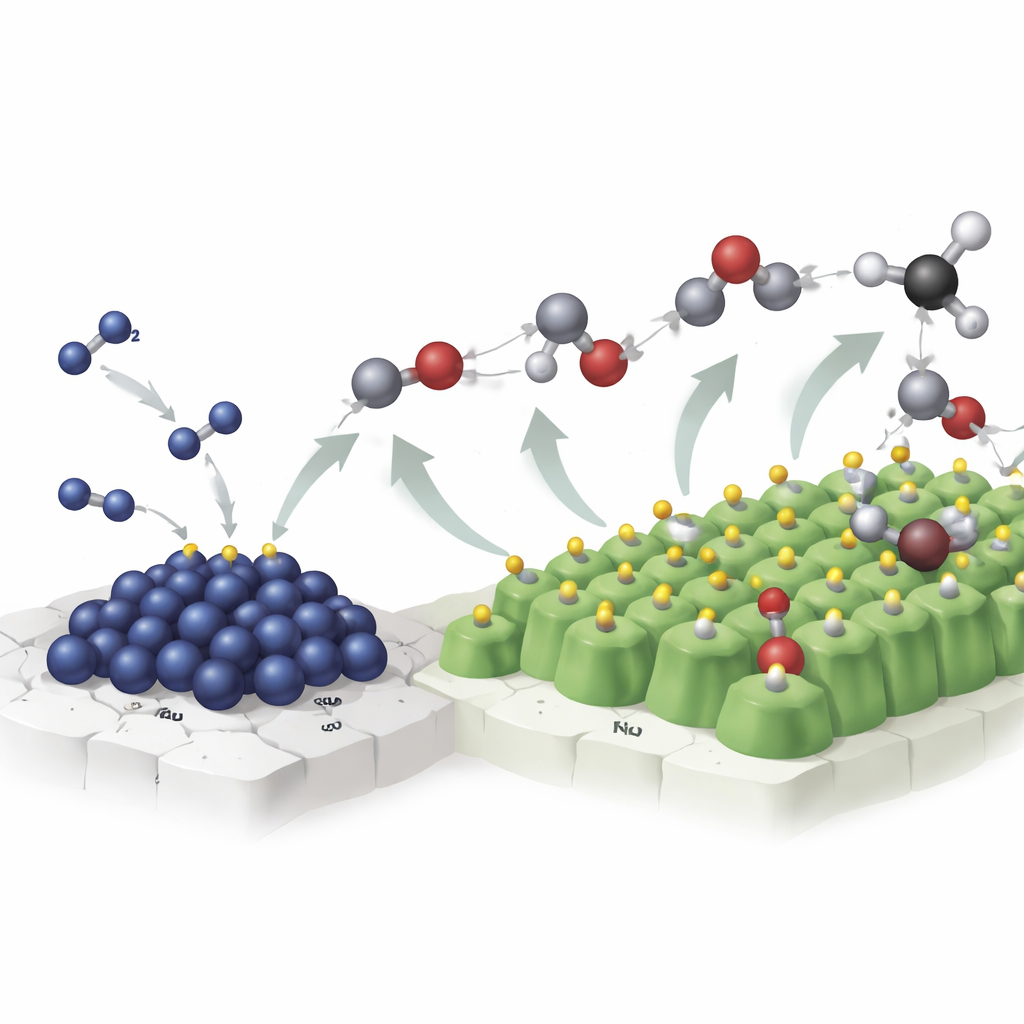
From Mechanism to Impact
By orchestrating where hydrogen is generated, where it migrates, and how CO2 attaches and transforms, the Ru–NiO–TiO2 catalyst achieves nearly 100% CO2 conversion and almost perfect methane selectivity under sunlight without extra heat or pressure. The work goes beyond reporting a high-performing material: it establishes a clear, experimentally backed picture of how hydrogen spillover can reshape reaction pathways and energy barriers in CO2 methanation. For non-specialists, the key message is that careful “architectural” design at the nanoscale—deciding which materials touch, and where—can make stubborn reactions far more efficient. This offers a powerful strategy for future catalysts that aim to recycle CO2 into useful fuels using renewable energy.
Citation: Nie, Y., Ren, G., Dou, X. et al. Photothermal CO2 methanation over (NiO/Ru0)/TiO2 catalysts via hydrogen spillover. Nat Commun 17, 3282 (2026). https://doi.org/10.1038/s41467-026-70102-1
Keywords: CO2 methanation, photothermal catalysis, hydrogen spillover, ruthenium nickel oxide catalyst, carbon dioxide to methane