Clear Sky Science · en
Universal cryogenic transfer of liquid metal particles in polymers for wafer-scale stretchable integrated electronics
Electronics That Move With You
Imagine a fitness tracker as thin and stretchy as a bandage, or a medical implant that bends and flexes like soft tissue without losing its electronic performance. This paper describes a new way to build such "rubber-like" electronics using tiny droplets of liquid metal embedded inside flexible plastics. The researchers have found a manufacturing method that works over full silicon wafers and with many different soft materials, bringing skin-like, body-friendly electronics closer to everyday reality.
Why Liquid Metals Are So Appealing
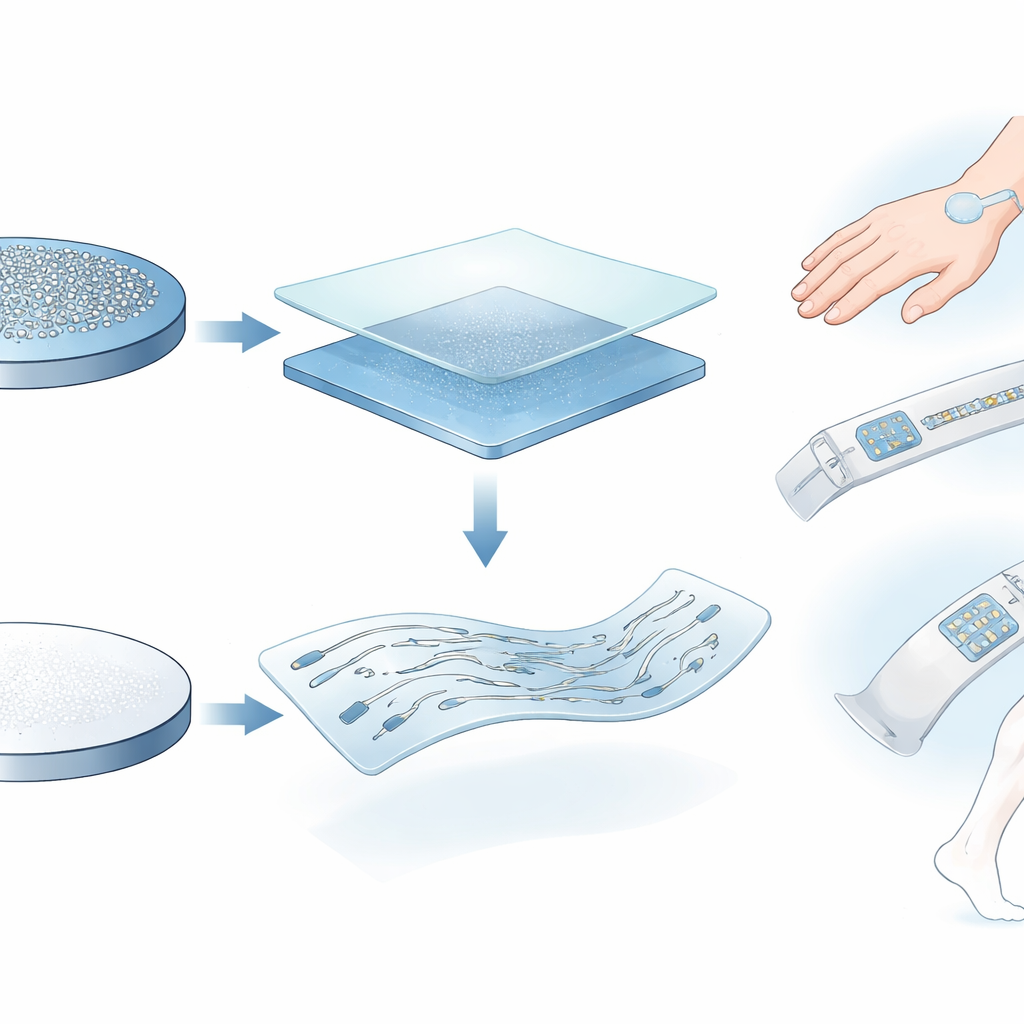
Most electronics rely on rigid metal wires that crack if bent too far. In contrast, gallium-based liquid metals behave like a metal and a fluid at the same time: they conduct electricity almost as well as solid metals but can deform dramatically without breaking. That makes them ideal for stretchable circuits that can wrap around joints or organs. Yet their very fluid nature also creates headaches in manufacturing. They bead up like water on a waxed car, they don’t stick well to many plastics, and they can leak or smear when the device is stretched. Previous patterning methods either lacked fine detail, worked only on certain plastics, or produced traces that failed under repeated motion.
A New Way to Draw Metal in Soft Materials
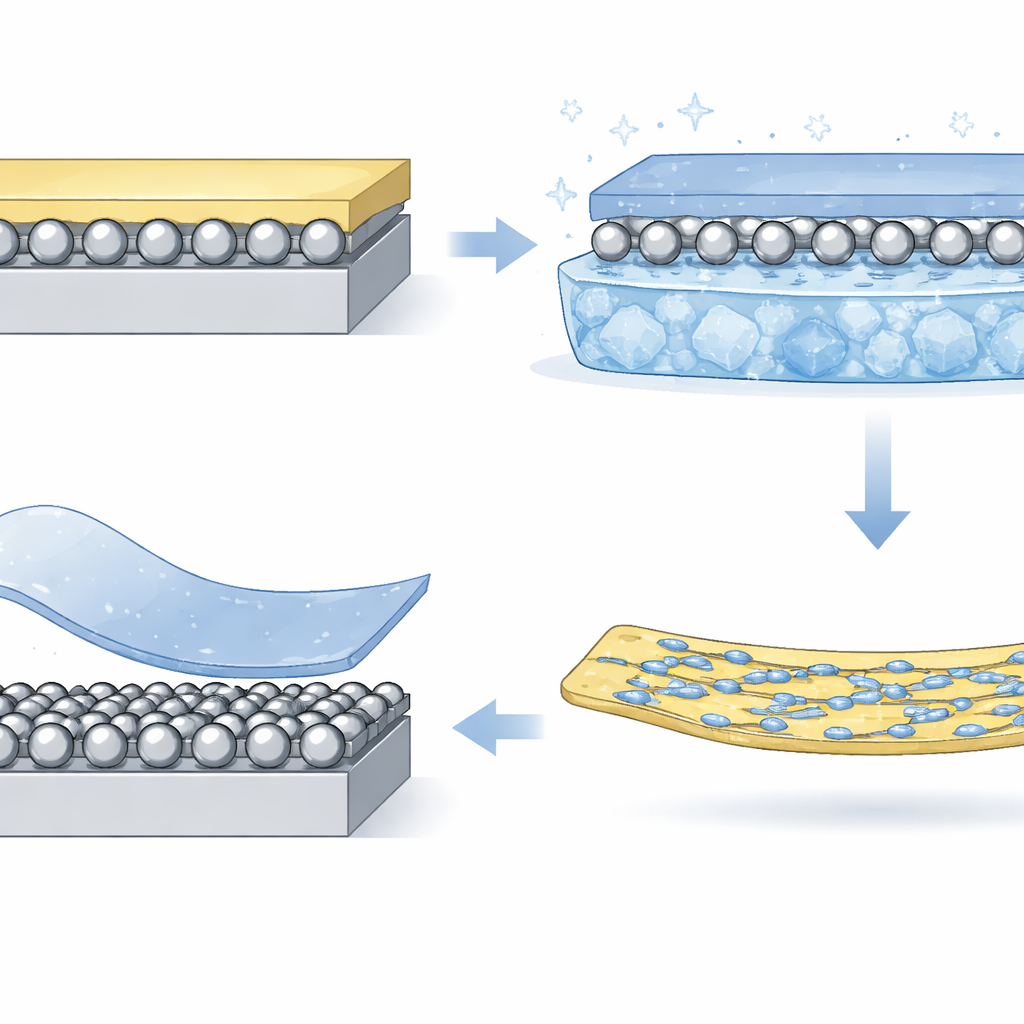
The team tackled this by first forming the liquid metal into microscopic particles and then arranging those particles into precise patterns on a rigid silicon wafer using standard photolithography—the same family of techniques used to make computer chips. They optimized an ink and etching process so that these particle lines can be drawn with widths down to a few micrometers across an entire wafer, while maintaining a highly conductive network. After patterning, they coat the wafer with a liquid polymer that seeps between the particles and is cured into a solid film, locking the particles into place without yet removing them from the rigid support.
Freezing to Let Go, Warming to Stretch
The key innovation is what happens next: a cryogenic transfer step carried out at the temperature of liquid nitrogen. When the whole stack is rapidly cooled, the soft plastic layer contracts and stiffens, while the liquid metal particles solidify and expand slightly. These combined changes strengthen the bond between the particles and the surrounding plastic but weaken their grip on the underlying silicon. Simulations and adhesion tests show that, at this low temperature, it becomes energetically favorable for the particle network to prefer the polymer rather than the silicon. As a result, the patterned film can be peeled off cleanly, leaving almost no residue on the wafer and transferring the entire network into the flexible substrate in one piece.
Soft Circuits That Keep Working Under Strain
Once transferred, the material becomes a liquid metal particle network embedded in polymer, or LNEP. When stretched, the thin, brittle oxide shells around neighboring particles crack and allow the metal cores to merge, forming more continuous pathways instead of breaking apart. This counterintuitive behavior actually improves electrical connectivity during an initial "activation" stretch, boosting conductivity to about half that of bulk liquid metal. After activation, the resistance of these soft traces changes only modestly even when they are doubled in length, twisted many turns, or compressed repeatedly. Crucially, this robust performance is seen across a variety of polymers—from skin-like elastomers to tough plastics and even soft hydrogels—demonstrating that the method is broadly compatible rather than tailored to a single specialty material.
From Wearable Patches to Smart Implants
Because the process starts on a wafer, the researchers can build complex layouts of interconnects, then transfer them into the soft material most suited to a particular task. They show large-area touch sensor arrays that conform to the back of a hand and can distinguish different objects through machine learning. They also build multifunctional on-skin patches that read heart and muscle signals and detect glucose using electrochemistry, all linked by stretchable LNEP wiring. By embedding rigid microchips into the polymer and transferring them along with the liquid metal wiring in one step, they even create stretchable neuromorphic circuits that continue to spike and process touch information while being stretched. Finally, by using hydrogels that match the softness of tissue, they demonstrate devices that can stimulate a rat’s nerve and record muscle activity, hinting at future implants that communicate smoothly with the body.
What This Means for Future Soft Electronics
In everyday terms, the work delivers a manufacturing recipe for electronic "nerves" that can be drawn with chip-level precision, then transplanted into almost any soft, stretchy material without losing their metallic performance. By exploiting how materials behave when frozen and rewarmed, the authors solve long-standing problems of adhesion, leakage, and substrate limitations that have held back liquid-metal-based circuits. This universal cryogenic transfer method could underpin a new generation of flexible health monitors, soft robots, and implantable devices that move as naturally as the skin and tissue they are designed to serve.
Citation: Lee, D.H., Lee, S., Park, M. et al. Universal cryogenic transfer of liquid metal particles in polymers for wafer-scale stretchable integrated electronics. Nat Commun 17, 3248 (2026). https://doi.org/10.1038/s41467-026-70101-2
Keywords: stretchable electronics, liquid metal, wearable sensors, soft robotics, implantable devices