Clear Sky Science · en
Rumor propagation on hypergraphs
Why group chats matter for rumors
Every day, millions of messages race through group chats on apps like WhatsApp and Telegram. A single link or screenshot can jump from group to group, quickly becoming a rumor that shapes people’s views about politics, health, or everyday events. Yet most scientific models of information spread still treat communication as happening in pairs—one person talking to another—rather than in groups. This article asks: what changes when we take groups seriously, and how does that alter our understanding of how rumors flare up or die out?
From simple links to complex group webs
In messaging platforms, people do not just talk one-on-one—they talk in many overlapping groups. To capture this, the authors use a mathematical structure called a hypergraph, where a single “edge” can connect many people at once, representing a chat group. In their model, each person can be in one of three states: unaware of a rumor, actively spreading it, or having heard it but no longer forwarding it. A rumor spreads inside a group only when enough members are already spreading it, reflecting the social pressure that builds when many contacts repeat the same story. At that point, everyone in the group who was unaware can suddenly become a spreader, mimicking real-life surges of activity in popular chats. 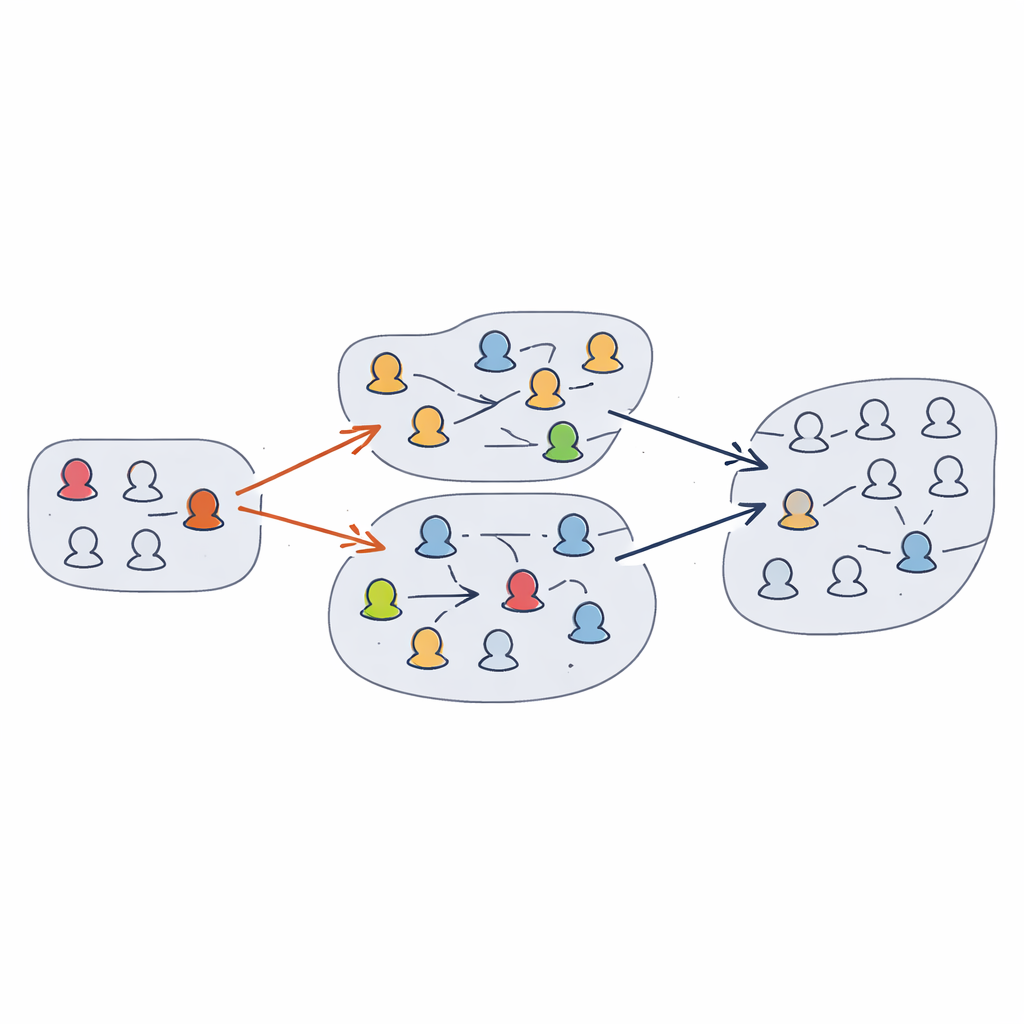
How rumors run out of steam
Rumors do not spread forever. People eventually lose interest or decide that “everyone already knows,” and stop forwarding messages. The key novelty of this work is how it treats that slowdown. Instead of assuming that people randomly stop spreading, the authors let this happen through group-based saturation. Once a person belongs to enough groups where the rumor has already circulated widely, they become a “stifler” who no longer passes it on. This simple rule gives rise to two very different ways rumors can fade. In some cases, the number of active spreaders falls off quickly in an exponential fashion, similar to many standard epidemic models. In others, the decline is much slower and follows a power law, meaning rare but very long-lasting rumor cascades become possible.
Critical tipping points in rumor cascades
By running large computer simulations, the researchers map out when rumors fizzle, when they blow up, and how they approach the tipping points between these behaviors. They show that the balance between how easily groups ignite (the spreading threshold) and how quickly people get saturated (the stopping threshold) determines which regime appears. Interestingly, across a wide range of network structures—from fairly uniform collections of groups to highly unequal ones with many tiny chats and a few huge channels—the transitions they observe are continuous. There is no sudden jump from “almost no rumors” to “everyone knows,” but rather a smooth shift where rumor cascades grow gradually larger and more persistent near the critical point. 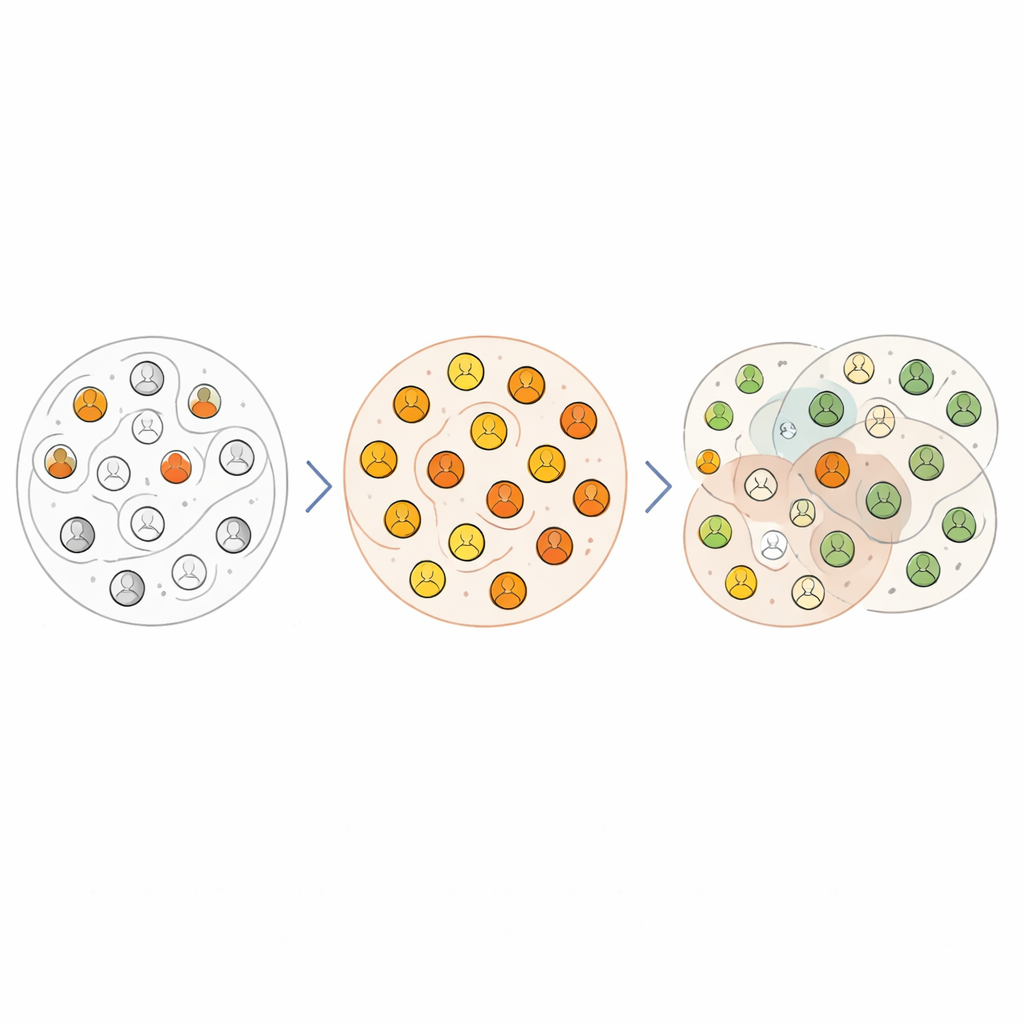
Matching theory with real Telegram data
To test whether their abstract model captures real behavior, the authors turn to a large dataset of public Telegram channels containing hundreds of millions of messages. They build a group-based network where users belong to one or more channels, then track cascades of messages that share the same web link, treating each link as a distinct rumor. For each cascade they measure how long the rumor survives and how often it is forwarded. When they simulate their model directly on this Telegram network, they find that the statistics of simulated cascades—how big they are and how long they last—match the real data best when the system is tuned close to the critical point. Similar results from an email communication dataset reinforce this picture.
What this means for online information
Put together, the study suggests that rumor spreading in real online group systems tends to operate near a delicate balance point: rumors are neither always exploding uncontrollably nor always dying out quickly, but instead sit close to a critical regime where both small and large cascades coexist. By explicitly modeling group conversations instead of just individual links, and by tying rumor extinction to how saturated a person’s groups are, the authors provide a more realistic framework for understanding viral content in messaging apps. For policymakers and platform designers, this work hints that even small changes to how groups form, overlap, or forward messages could push rumor dynamics away from this critical edge and help curb the spread of misinformation without needing to monitor every individual message.
Citation: Oliveira, K.A., Traversa, P., Ferraz de Arruda, G. et al. Rumor propagation on hypergraphs. Nat Commun 17, 3253 (2026). https://doi.org/10.1038/s41467-026-70096-w
Keywords: rumor spreading, social media groups, hypergraph networks, information cascades, criticality