Clear Sky Science · en
Ternary solvation sheath reconfiguration drives sustainable cryogenic Li||Cl2 batteries
Why Cold-Ready Batteries Matter
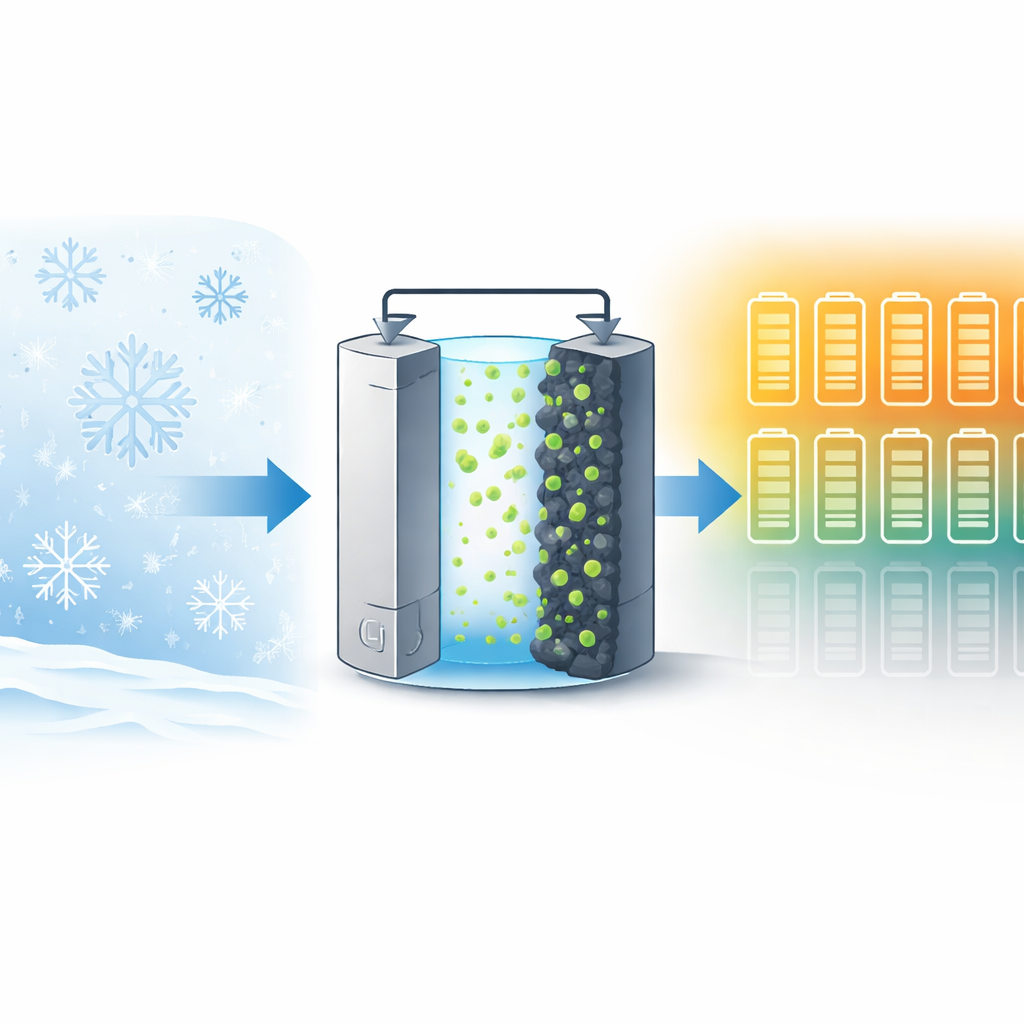
From polar research stations to high‑altitude drones and future electric aircraft, many technologies need batteries that keep working far below freezing. Today’s lithium batteries struggle in such deep cold, losing capacity and failing early. This study tackles that problem for a promising but delicate chemistry called the lithium–chlorine battery, showing how a clever redesign of the liquid around lithium ions can make these batteries run reliably even at temperatures as low as minus 80 degrees Celsius.
The Promise and Problem of Lithium–Chlorine Cells
Lithium–chlorine batteries are attractive because they can, in principle, store a great deal of energy using relatively common elements. They pair a lithium metal negative side with a porous carbon positive side that hosts chlorine, with a liquid based on thionyl chloride carrying the charge between them. In theory this setup should work especially well in the cold, where low temperatures slow self‑discharge. In practice, however, the liquid in these cells starts to break down, especially at low temperature and high voltage. That breakdown coats the positive side with fragile, cracked layers and random deposits that block lithium ions, waste active material, and cause the battery to fade quickly.
Looking Inside the Liquid Shell Around Lithium Ions
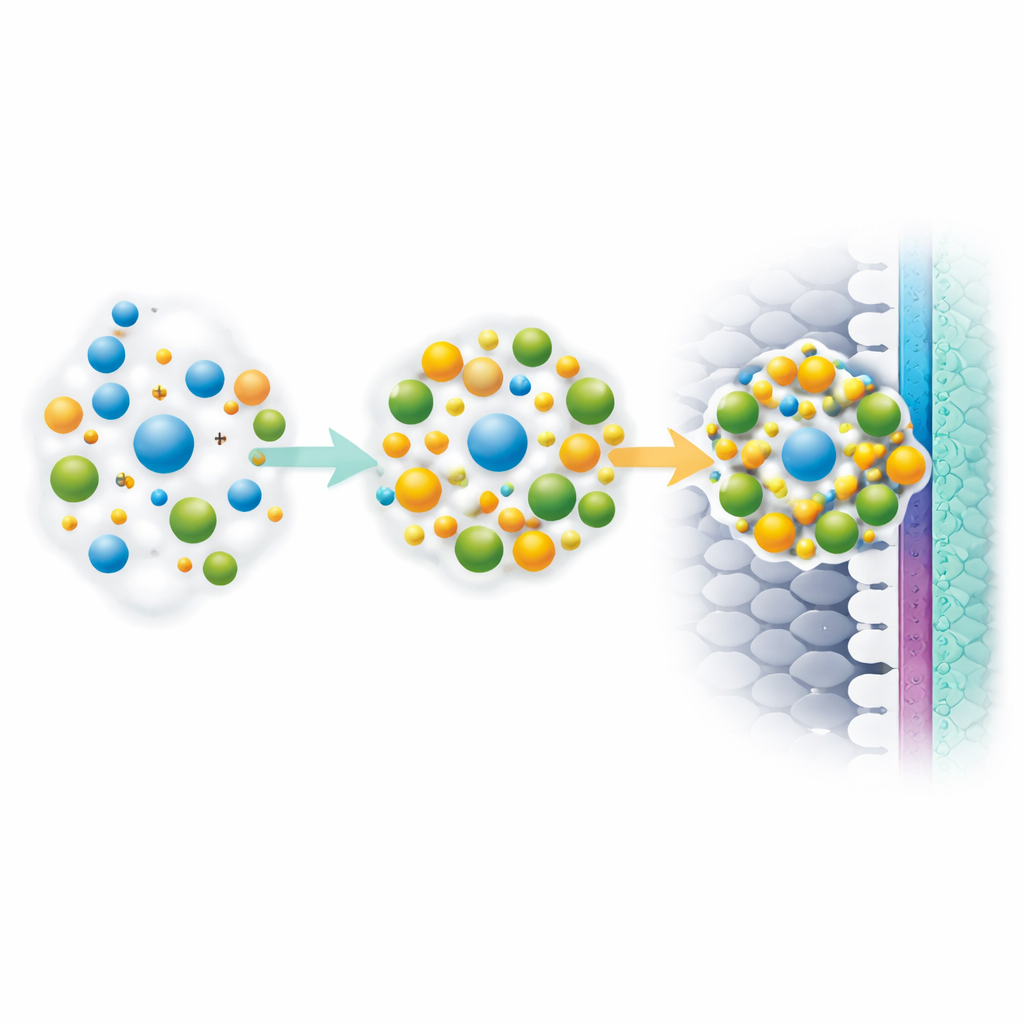
The authors trace this failure to the tiny environment immediately surrounding each lithium ion in the liquid. In the standard recipe, lithium is mainly surrounded by thionyl chloride molecules and chloroaluminate ions. This crowded “solvation sheath” not only makes it harder for lithium ions to shed their partners and move into the electrode, it also encourages the thionyl chloride solvent to react in unwanted ways at the positive side. Using computer simulations and a suite of spectroscopic tools, the team shows that this solvent‑heavy shell leads to sluggish ion motion and a messy mix of breakdown products at the interface where the liquid meets the porous carbon.
A Three‑Part Strategy to Tame the Interface
To fix this, the researchers introduce a third component, lithium trifluoromethanesulfonate (LiOTf), designed using simple molecular descriptors such as how strongly it donates electrons and how easily it is oxidized. When added to the electrolyte, its OTf⁻ anion strongly attracts both lithium and the chloroaluminate species. This rearranges the local environment into an anion‑rich shell that pushes some solvent molecules away from lithium. As a result, lithium ions can move and “desolvate” more easily, lowering the energy barrier for charge transfer. At the same time, OTf⁻ is preferentially broken down at the positive side, building a thin, two‑layer protective skin: an inner, inorganic layer rich in lithium fluoride, and an outer layer containing carbon–fluorine groups. This engineered coating is smoother, thinner, and more uniform than the rough, thick films formed in the original liquid.
From Fragile Films to Durable Performance in the Deep Cold
Advanced imaging and surface analysis reveal that, with the new additive, the positive electrode remains relatively clean and evenly covered after long use. The protective skin limits excess solvent breakdown, guides where lithium chloride forms and dissolves, and keeps the interface electrically and ionically open. Electrical measurements confirm that this lowers resistance and reduces the voltage penalty that normally grows as a battery ages, particularly in the cold. As a result, cells using the redesigned electrolyte can cycle more than 1100 times at minus 40 degrees Celsius under a high current while retaining 99.2 percent of their capacity and efficiency, and they still operate reliably for over 100 cycles even at minus 80 degrees Celsius—conditions that quickly cripple the standard formulation.
What This Means for Future Energy Storage
In plain terms, the study shows that the key to durable, cold‑tolerant lithium–chlorine batteries lies in controlling the microscopic liquid shell around lithium ions so that it naturally builds a good protective film where the liquid meets the positive electrode. By carefully choosing an additive that rearranges this shell and then sacrifice itself to form a robust coating, the researchers turn a fragile, short‑lived cell into one that can endure harsh, cryogenic conditions. The same design logic—engineering the local liquid structure to pre‑program the protective layer—could be applied to many other high‑energy battery chemistries, helping make future energy‑storage systems both more powerful and more reliable in extreme environments.
Citation: Liu, Q., Ma, G., Wei, L. et al. Ternary solvation sheath reconfiguration drives sustainable cryogenic Li||Cl2 batteries. Nat Commun 17, 3479 (2026). https://doi.org/10.1038/s41467-026-70092-0
Keywords: lithium–chlorine batteries, low-temperature energy storage, electrolyte engineering, interphase design, solvation structure