Clear Sky Science · en
Vertical nanodiamond dominated sheets possessing both high capacitance and high n-type Hall mobility
Diamonds That Power Our Electronics
Most people know diamond as a gemstone, but this study explores how diamond can help build faster, more efficient electronics and better energy storage devices. The researchers show how to turn delicate, upright sheets of carbon into vertical nanodiamond structures that can both store a lot of electrical charge and let electrons move quickly—two features rarely found together. These new materials could one day improve supercapacitors, sensors, and high‑frequency electronics that underpin everything from phones to power grids.
Why Better Electrodes Matter
Modern electronics and energy storage systems rely on electrodes—the parts that move and store electrical charge. Traditional electrode materials include forms of carbon, metal oxides, and conducting polymers, each trading off properties like surface area, stability, and speed of charge transport. Diamond is extremely robust and handles heat well, but in its natural form it barely conducts electricity. Over the years, scientists have learned to "activate" diamond by adding elements such as boron or nitrogen, or by mixing it with other carbon structures. These approaches improved either how much charge could be stored or how quickly electrons could move, but rarely both at the same time. The challenge has been to design a diamond‑based structure that combines a very large surface area with excellent electron mobility.
From Graphene Sheets to Nanodiamond Forests
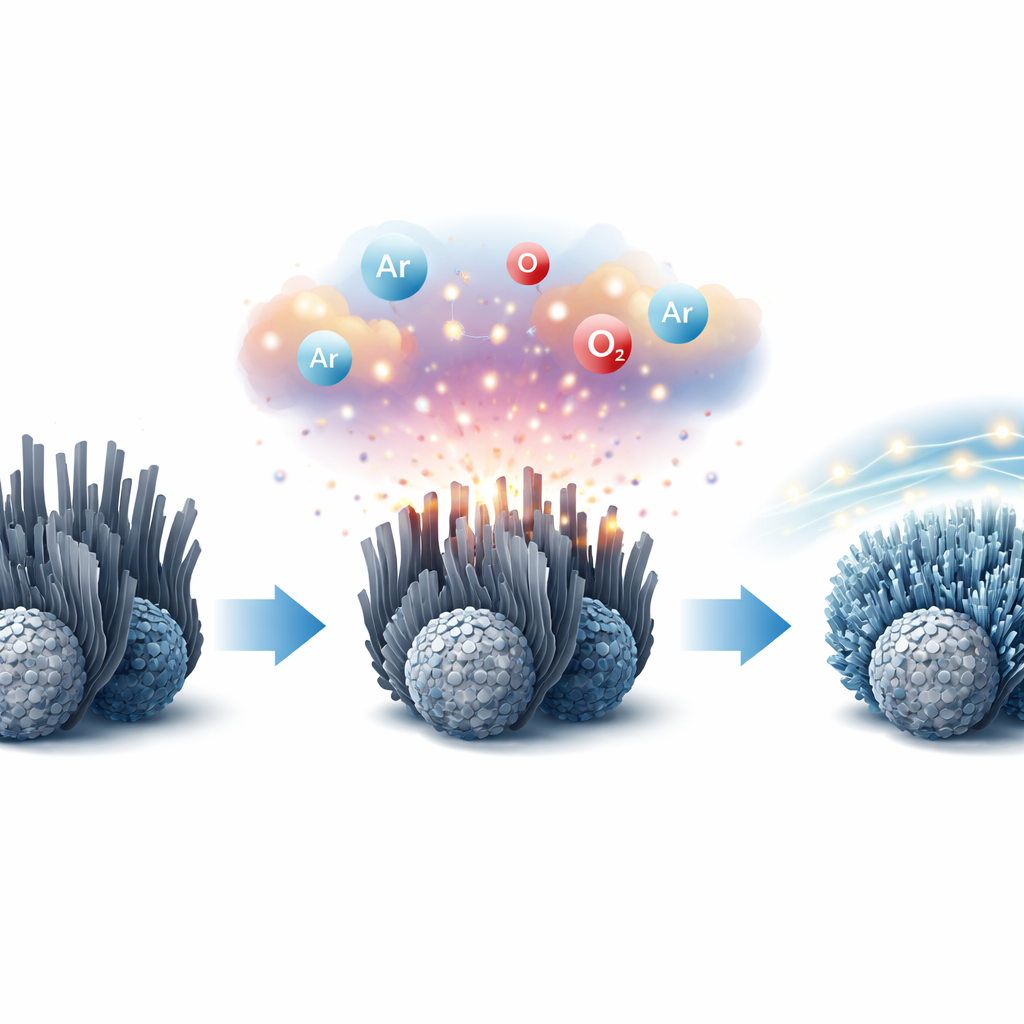
The team started with vertical graphene sheets—thin, upright carbon layers grown on tiny spherical particles using a specialized hot‑filament growth process. These structures already offer a high surface area, like a dense forest of flexible blades. The twist in this work was to load the system with individual tantalum atoms and then expose the graphene to a microwave plasma containing argon and a carefully controlled amount of oxygen. By tuning the oxygen fraction from 2% up to 20%, the researchers could gradually etch away graphene layers and encourage the carbon to reorganize into nanocrystalline diamond. At low oxygen levels, the sheets stayed mostly graphene with only trace nanodiamond particles. At higher oxygen, continuous vertical sheets of closely packed nanodiamond grains emerged, creating what the authors call vertical nanodiamond dominated sheets.
Finding the Sweet Spot for Performance
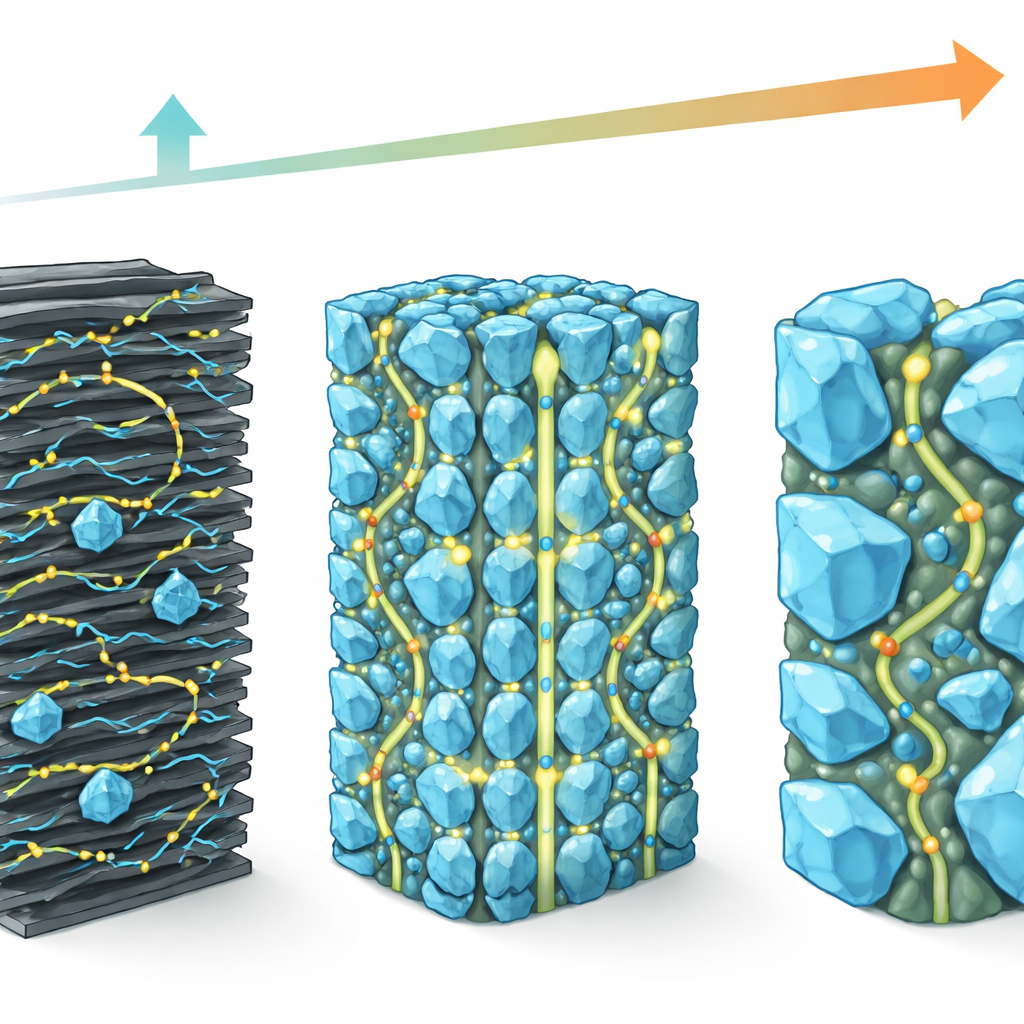
To see how structure affected performance, the researchers measured both charge storage (capacitance) and how easily electrons travel sideways through the sheet (Hall mobility). The untreated vertical graphene sample stored a large amount of charge but allowed electrons to move slowly. Gentle plasma treatment with a little oxygen thinned the graphene and introduced more nanodiamond grains, which reduced capacitance and, in one case, mobility as well. Strikingly, when the oxygen fraction reached about 10%, the material changed character: the vertical sheets were now made almost entirely of tiny diamond grains, threaded by chain‑like carbon segments at their grain boundaries. In this state, the electrodes showed both very high capacitance and exceptionally high n‑type Hall mobility, outperforming many previously reported carbon‑based electrodes that usually excel in only one of these measures.
What Happens Inside the Material
Microscopy and light‑scattering measurements revealed how these improvements arise. In the original graphene‑rich sheets, many stacked layers and defects scatter electrons, slowing them down even though there is plenty of surface area for charge storage. As oxygen plasma eats away graphene and helps tantalum atoms trigger a phase change, the structure turns into a densely packed array of nanodiamond grains. At an intermediate oxygen level, the grains stay very small and are separated by boundaries filled with trans‑polyacetylene‑like carbon chains. These boundaries act as both extra sites where ions can adsorb and as highways that allow electrons to move efficiently through the material. When the oxygen level is pushed beyond this optimum, the diamond grains grow larger and the boundary chains shrink in number, so there are fewer places to store charge even though electron mobility remains high.
Diamonds for Future Energy and Electronics
In everyday terms, the researchers discovered how to use a controlled plasma treatment to turn vertical graphene into a "diamond forest" that both stores charge densely and lets electrons race through. By dialing in just the right oxygen level, they created a structure where tiny diamond grains and carbon chains at their boundaries work together, rather than against each other. This optimized vertical nanodiamond material could become a promising building block for next‑generation supercapacitors, sensitive detectors, and high‑power electronics that demand both quick response and long‑term stability.
Citation: Gong, Y., Zhang, Z., Jiang, M. et al. Vertical nanodiamond dominated sheets possessing both high capacitance and high n-type Hall mobility. Nat Commun 17, 3296 (2026). https://doi.org/10.1038/s41467-026-70089-9
Keywords: nanodiamond electrodes, graphene to diamond transition, supercapacitor materials, high mobility carbon films, argon oxygen plasma processing