Clear Sky Science · en
Lyn governs the establishment and maintenance of B cell anergy by suppressing PI3K signaling
Why Quiet B Cells Matter
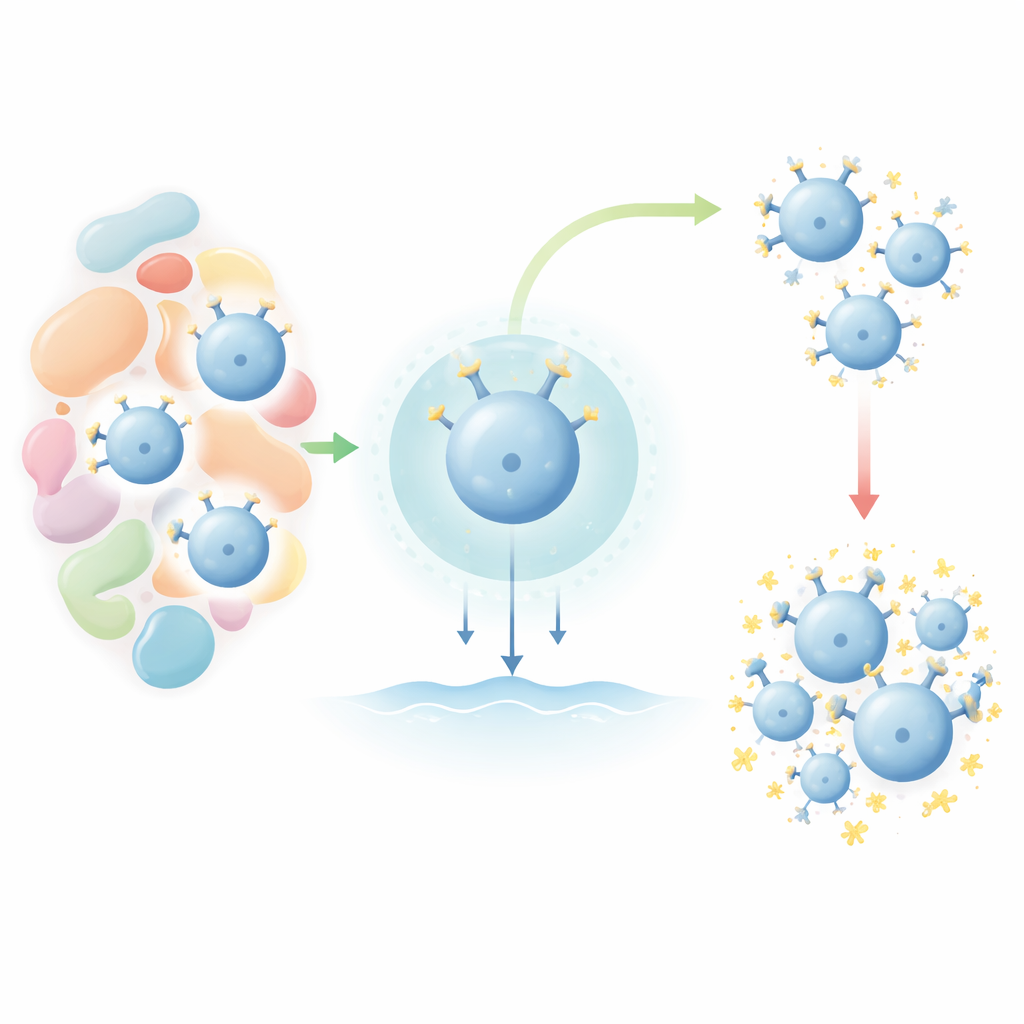
Our immune system walks a fine line: its defender cells must attack invading germs while ignoring the body’s own tissues. This article explores how a particular enzyme, called Lyn, helps keep certain antibody‑producing B cells in a safely “quiet” state so they do not trigger autoimmune diseases such as lupus. By dissecting Lyn’s role in mouse models that mimic self‑reactive B cells, the researchers uncover how failures in this control system can turn protective cells into a source of harmful self‑targeting antibodies.
Keeping Dangerous B Cells Asleep
B cells use surface receptors to recognize targets and, when properly activated, to make antibodies. Some B cells, however, are accidentally tuned to recognize the body’s own molecules. Many of these risky cells are held in a state called anergy: they remain alive but are functionally unresponsive. The team studied a well‑established mouse model (Ars/A1) in which most B cells react weakly to DNA‑containing self‑molecules and are normally kept anergic. Earlier work showed that constant “braking” signals inside these cells, provided by enzymes called SHIP‑1 and SHP‑1, are essential to maintain this quiet state. Because Lyn is a key trigger for such inhibitory circuits, the authors asked whether Lyn is also needed to switch these autoreactive B cells into, and keep them in, an anergic state.
What Happens When the Control Switch Is Removed
To isolate Lyn’s role in B cells, the researchers used genetic tools that delete Lyn only in B cells, either from early development or suddenly in adult mice. When Lyn was missing throughout B cell development in Ars/A1 mice, the number of mature B cells in the body’s circulation dropped, but the remaining B cells were abnormally active. They carried more activation markers on their surface, responded strongly to receptor stimulation by raising their internal calcium levels, and produced more self‑reactive antibodies. These changes show that, without Lyn, autoreactive B cells fail to become properly anergic and instead slip toward an autoimmune‑like state.
How Lyn Dials Down a Key Signaling Pathway
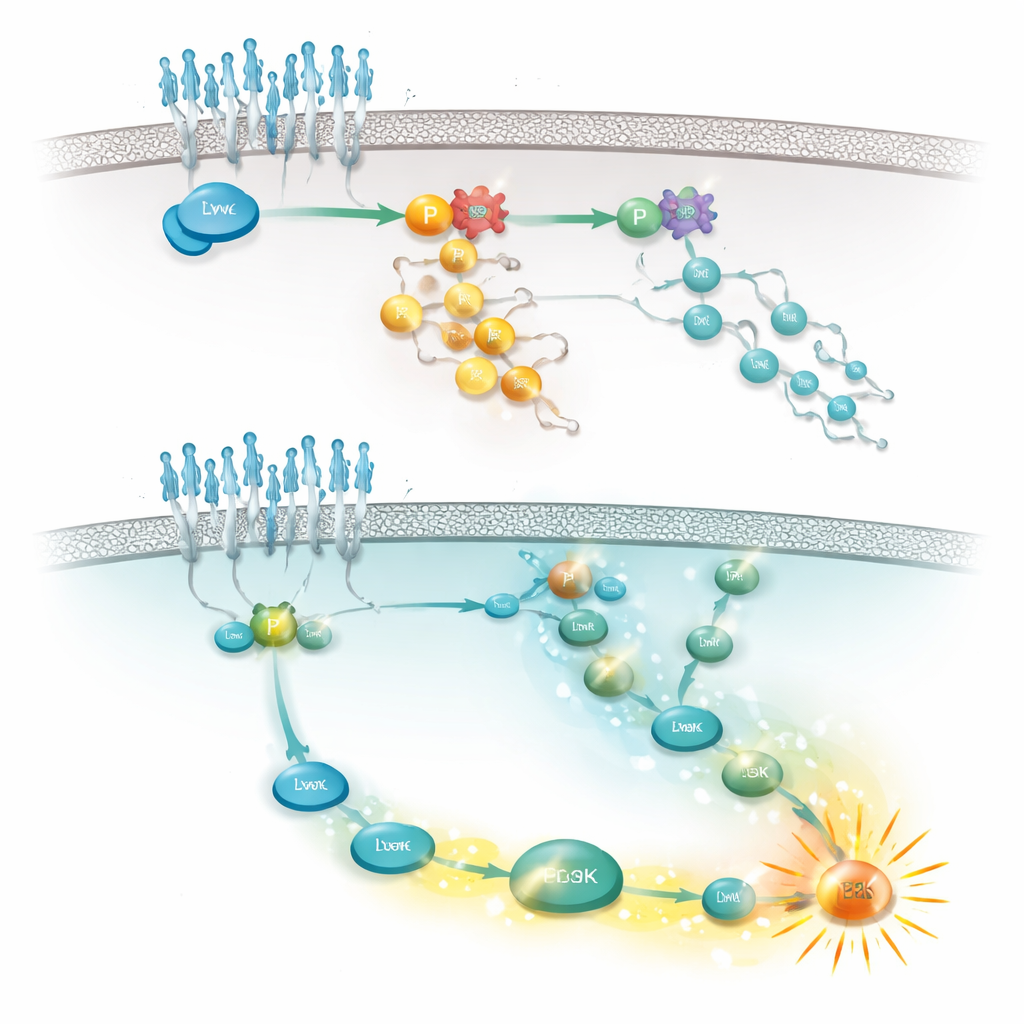
The authors then zoomed in on the internal wiring of B cells to learn exactly which signals Lyn controls. By deleting Lyn only in mature anergic Ars/A1 B cells, they avoided developmental side effects and compared signaling before and after Lyn loss. They found that some “early” events at the receptor—such as the first phosphorylation steps—remained weak and largely unchanged, in part because these self‑reactive cells naturally carry fewer IgM receptors on their surface. However, “downstream” events that depend on a pathway known as PI3K (including activation of Akt, S6, Erk, increases in calcium, and degradation of the inhibitor IκBα) were sharply boosted when Lyn was removed. Using a PI3K‑blocking drug, they showed that precisely these boosted signals required PI3K activity, confirming that Lyn’s main job in anergic B cells is to suppress PI3K‑dependent signaling. They also observed that, in the presence of Lyn, enzymes like SHIP‑1 and SHP‑1 are more active, supporting the idea that Lyn builds an inhibitory feedback loop that keeps PI3K in check.
Sharing the Work: Fewer Receptors and Stronger Brakes
The study further disentangled two cooperating safety features in anergic B cells: reducing receptor numbers and actively dampening signals. By experimentally comparing B cells that expressed similar amounts of surface receptor, the team showed that simply lowering IgM receptor levels explains much of the reduced early signaling in Ars/A1 cells. Yet even when receptor numbers were matched, PI3K‑related steps still remained unusually weak in anergic cells. Similar selective dampening of PI3K signals appeared when the researchers stimulated an alternate receptor type (IgD) on different B cell models. Together, these results indicate that anergy relies on a dual strategy: fewer “gas pedals” on the cell surface and a Lyn‑driven brake on internal PI3K signaling.
From Silent Cells to Autoimmune Risk
Finally, the team tested what happens in living animals when Lyn is abruptly removed from already anergic autoreactive B cells. These cells partially woke up: some began to divide and differentiate into antibody‑secreting cells, generating self‑reactive antibodies. However, their response was inconsistent and often inefficient, likely because Lyn is also involved in survival pathways, making these once‑anergic cells fragile when they become active. When Lyn function was only partially reduced and combined with a partial loss of SHIP‑1, autoreactive B cells more readily broke tolerance and produced autoantibodies, highlighting how small combined defects can topple the system.
What This Means for Autoimmune Disease
In everyday terms, this work shows that Lyn acts as a master safety switch that helps keep potentially dangerous B cells in a “do not fire” mode by limiting a powerful growth and activation route inside the cell, the PI3K pathway. Anergy is not enforced by a single mechanism: self‑reactive B cells both lower the number of their receptors and rely on Lyn‑driven inhibitory circuits to stay quiet. When Lyn or its partners are faulty, some of these cells can escape their restraints, survive, and begin producing antibodies against the body’s own tissues. This helps explain why changes in Lyn and related molecules are often linked to autoimmune diseases and suggests that carefully tuning PI3K‑related braking pathways in B cells could be a promising strategy for preventing or treating such conditions.
Citation: Fiske, B.E., Wemlinger, S.M., Crute, B.W. et al. Lyn governs the establishment and maintenance of B cell anergy by suppressing PI3K signaling. Nat Commun 17, 3660 (2026). https://doi.org/10.1038/s41467-026-70085-z
Keywords: B cell anergy, Lyn kinase, PI3K signaling, autoimmunity, immune tolerance