Clear Sky Science · en
The key role of nanoparticle concentration gradient in aerosol initial growth
Why tiny air particles matter to all of us
Every breath you take carries countless invisible particles that help shape clouds, influence climate, and affect the air you breathe. This study looks at the very first moments in the life of these particles—when they are only about a billionth of a meter across—and explains a long‑standing mystery: how so many of them manage to grow fast enough to survive in today’s often polluted air. Understanding this early growth helps scientists better predict future climate and air quality, and why hazy days are so common in big cities.
The birth and struggle of newborn particles
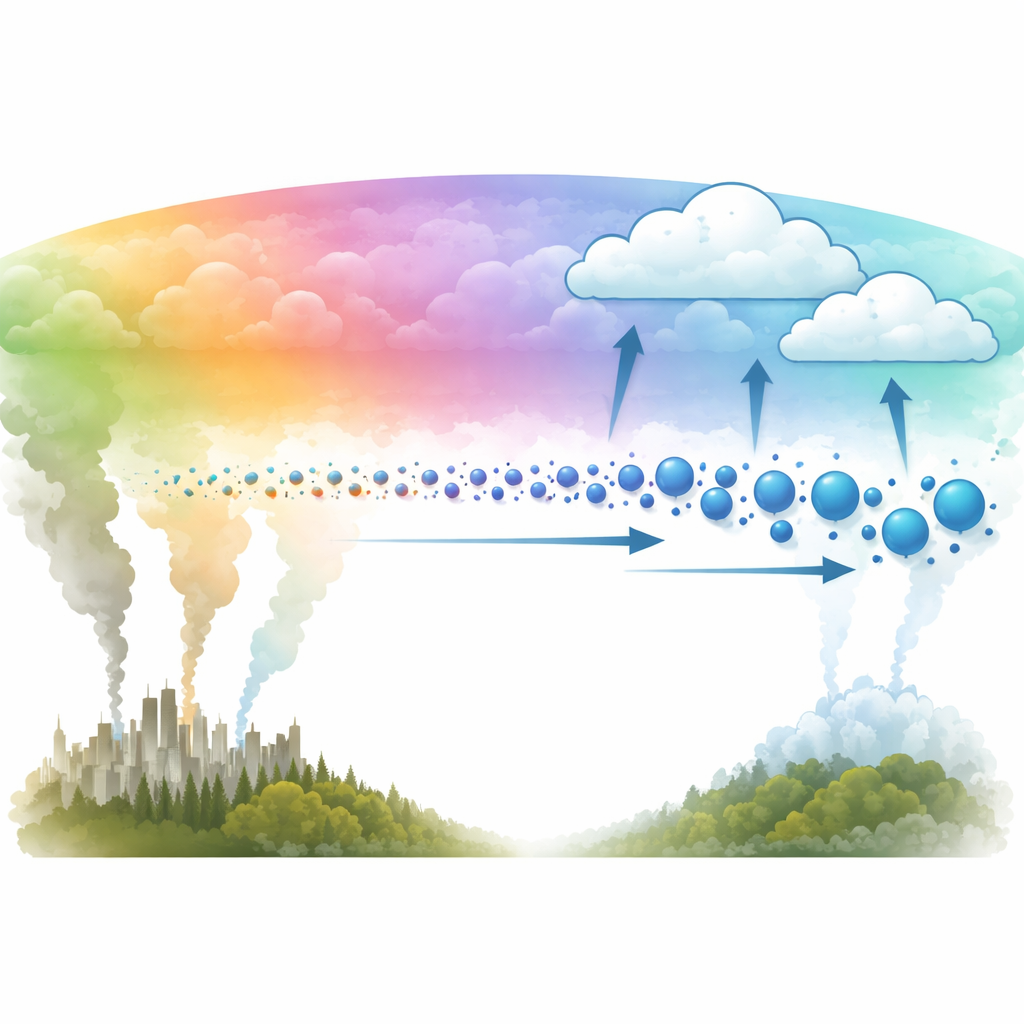
New atmospheric particles usually start as tiny clusters of just a few molecules, roughly one nanometer in size. To become large enough to act as cloud seeds or to affect health, they must grow to tens of nanometers across. The most perilous stage is the first step, from about 1 to 3 nanometers, sometimes called a “death zone.” In this size range, particles are so small that they can easily evaporate back into gas or be swept up by older, larger particles. For years, laboratory studies suggested that this early growth should be slow and mainly controlled by how much sticky gas—like sulfuric acid or certain organic vapors—is available. But in the real atmosphere, especially in cities, measurements showed that young particles often grow much faster than these lab‑based expectations.
A hidden push from crowded particles
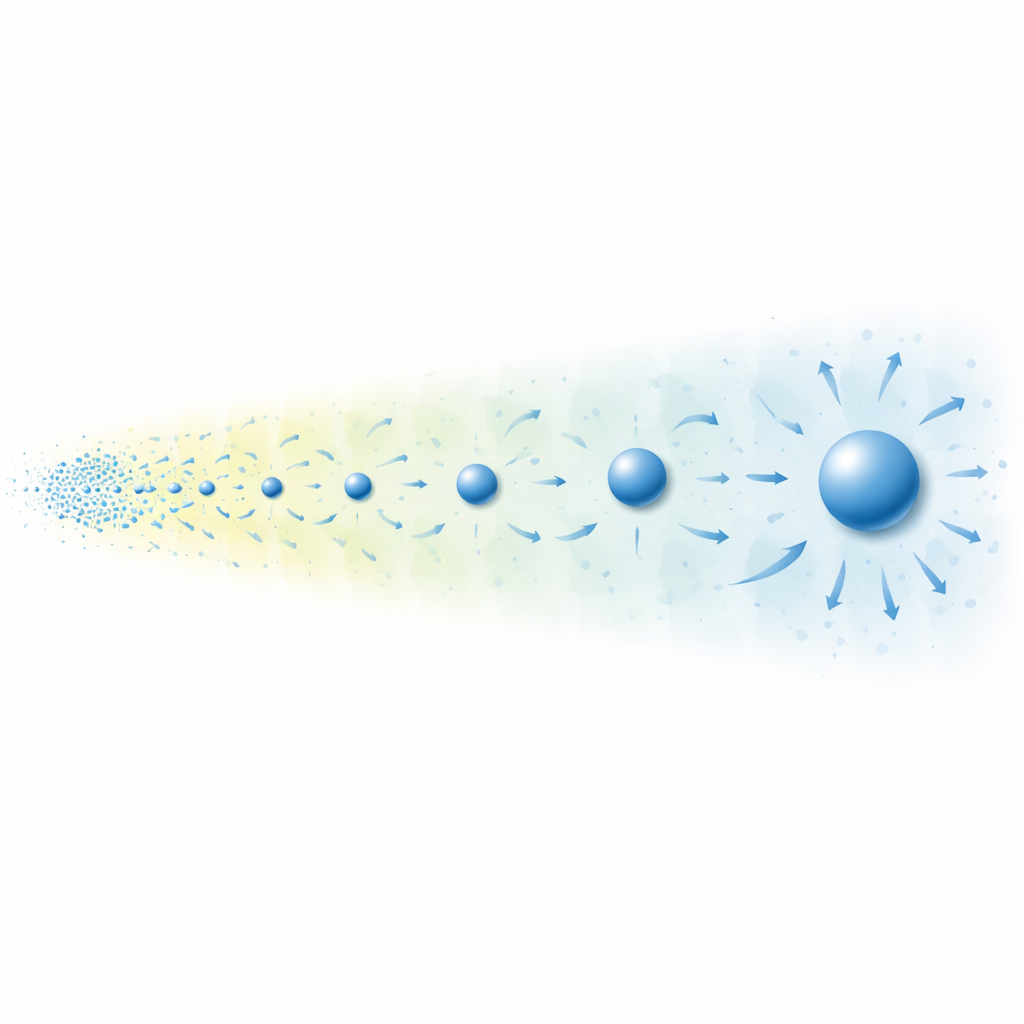
The authors propose that the missing piece is how unevenly these newborn particles are spread across sizes—a pattern they call a nanoparticle concentration gradient. Instead of having the same number of particles at each size, there are usually many more at the very smallest sizes and far fewer as size increases. This steep drop‑off means that, as particles compete for gaseous molecules that help them grow, the balance between gaining and losing material changes compared with the usual “single‑particle” view. Because there are so few slightly larger particles, there are fewer ways for material to escape back into the gas phase from that size range, effectively tilting the odds in favor of net growth for the population as a whole.
Organic vapors take the lead
By combining detailed measurements from a Finnish forest and from urban Beijing with computer models, the team shows that oxygen‑rich organic vapors, formed when natural and human‑made gases react in the air, are the main drivers of this rapid early growth. On their own, typical levels of sulfuric acid explain only slow growth, far too weak to match observations. When the researchers accounted for both these organic vapors and the strong concentration gradient of particles, the predicted growth rates lined up with what was actually measured. This effect was most important for the very smallest particles, where traditional physics says growth should be hardest.
Survival through the "death zone"
This hidden boost in growth has a dramatic impact on how many newborn particles survive long enough to matter for climate and pollution. The study finds that including the concentration gradient can double the effective growth rate driven by organic vapors and reduce particle losses by factors of two up to many thousands, depending on how polluted the air is. In megacities with lots of background particles that can scavenge newcomers, this boost can mean the difference between almost all new particles disappearing and a substantial fraction surviving to become cloud‑seeding droplets or contributors to haze.
What this means for climate and city air
Looking at data from seven locations worldwide, from clean mountain sites to heavily polluted urban areas, the authors show that this gradient‑driven boost to early growth is common, not rare. It helps explain why new particle formation events are so frequent in cities despite intense scavenging by existing pollution, and it suggests that new particles may play an even larger role in cloud formation and climate than current models assume. For everyday life, this means that the complex mix of gases we emit—and the way newborn particles crowd and thin out across sizes—quietly shapes the clouds above us and the quality of the air we breathe.
Citation: Cai, R., Li, X., Li, Y. et al. The key role of nanoparticle concentration gradient in aerosol initial growth. Nat Commun 17, 3338 (2026). https://doi.org/10.1038/s41467-026-70082-2
Keywords: new particle formation, atmospheric aerosols, urban air pollution, cloud condensation nuclei, organic vapors