Clear Sky Science · en
Fast response of satellite fluorescence-derived plant physiology to drought stress
Why early plant warning signs from space matter
Droughts are becoming longer and more frequent as the planet warms, threatening harvests, forests, and the carbon balance of the Earth. Yet by the time we see brown fields or thinning tree canopies, plants have already been struggling for days or weeks. This study shows that satellites can detect those early, invisible warning signs in plant function within just a few days of drought onset, long before the landscape visibly fades. That extra lead time could be crucial for managing food security, wildfire risk, and climate projections.
Watching plant stress from orbit
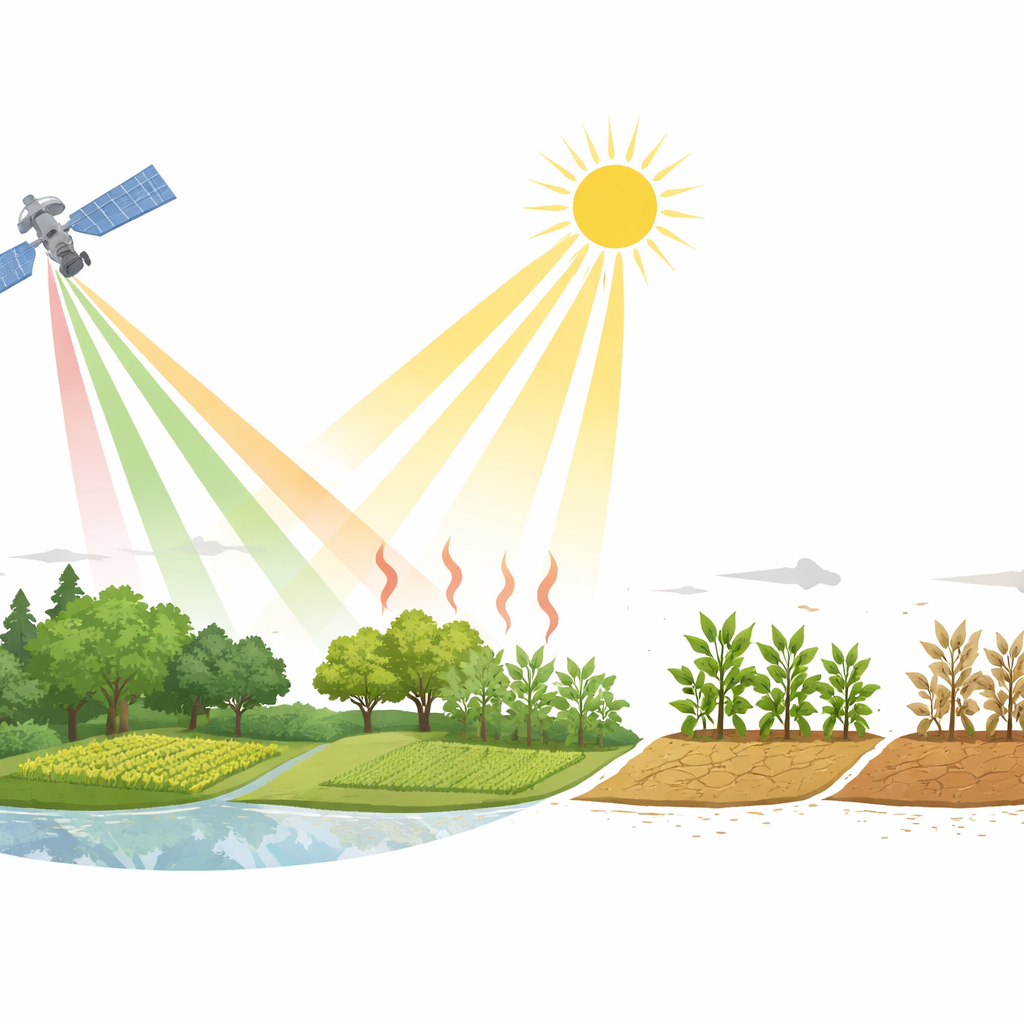
The researchers combined several kinds of satellite data to track how plants around the world respond when water becomes scarce. Traditional satellite measures focus on how green and dense vegetation appears at the surface, using indices that respond mainly to slow changes in leaves and canopy structure. In contrast, this study harnesses a subtler signal: a faint glow called solar-induced chlorophyll fluorescence, emitted by chlorophyll as it uses sunlight for photosynthesis. By carefully separating the effects of sunlight and leaf cover from this glow, the team extracted a measure that reflects how efficiently plants are photosynthesizing, providing a global view of plant "health" at the level of internal function rather than outward appearance.
Timing the hidden stages of drought damage
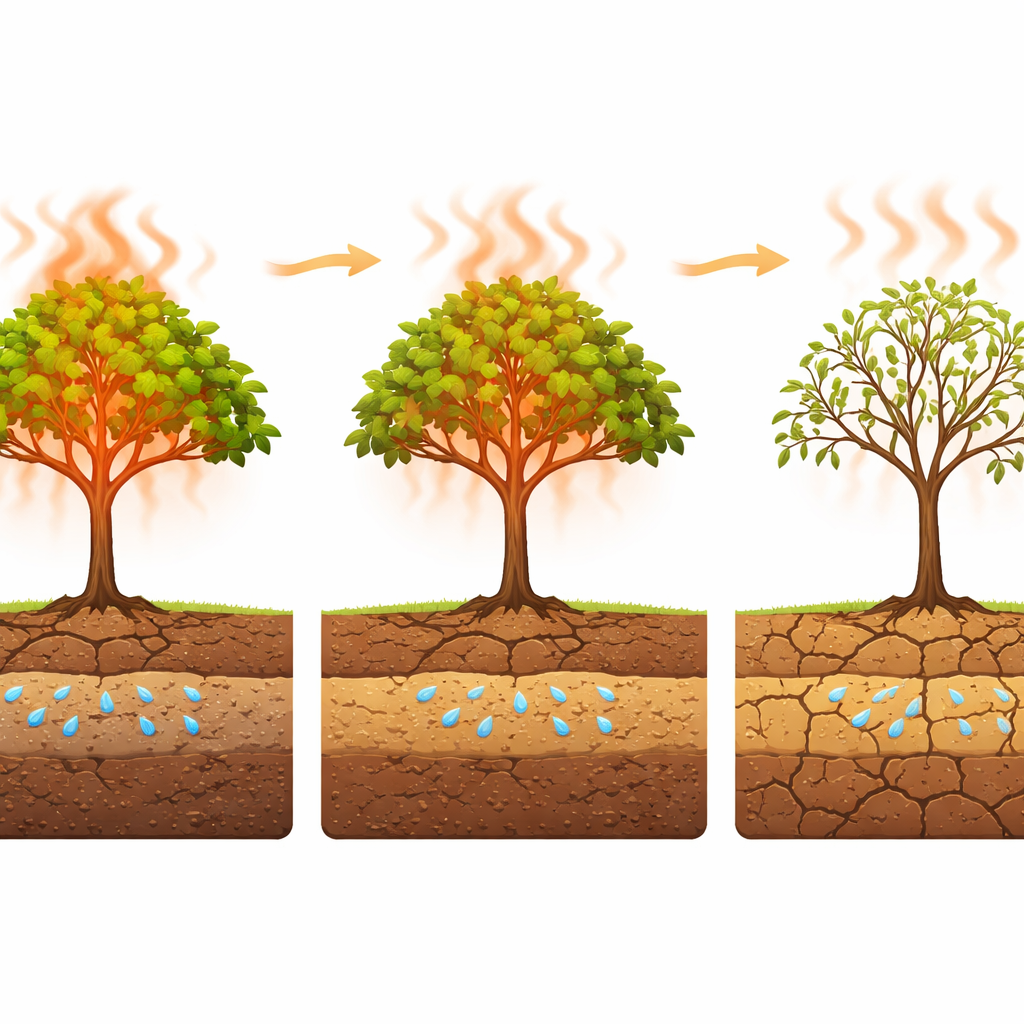
Using daily data from 2018 to 2022, the authors identified the most severe drought event at each vegetated location on Earth. They then compared how quickly different satellite indicators changed relative to two aspects of dryness: lack of water in the soil and dryness of the air. They found a clear sequence. The fluorescence-based physiology signal typically reacted to worsening drought in only about three days when linked to atmospheric dryness, and roughly five days when tied to soil moisture. Measures of canopy greenness responded later, and structural metrics such as leaf area lagged the most, changing after roughly twelve to thirteen days. In other words, plants adjusted their internal machinery almost immediately, while visible decline unfolded over weeks.
Air versus soil: which kind of drought hits first?
An important insight from the study is that the earliest plant responses line up more closely with the dryness of the air than with the drying of the soil. As heat, sunlight, and wind increase, the air can pull more moisture from leaves, raising what scientists call vapor pressure deficit. Plants counter this by quickly tightening their microscopic leaf pores to conserve water, which also slows photosynthesis and lowers the fluorescence efficiency captured by satellites. Soil moisture, by contrast, often declines more slowly, in step with the gradual loss of biomass and leaf area. This mismatch in timing means that if we only track soil dryness or visible greenness, we may underestimate how fast drought is already undermining plant function.
Different landscapes, different sensitivities
The team also explored how these patterns vary across climates and ecosystems. In humid tropical forests, where water is usually plentiful, plant physiology responded almost instantly to spikes in atmospheric dryness, revealing a high sensitivity to heat and evaporative demand. In drier regions, plants often evolved stronger drought tolerance, so the physiological signal changed more slowly along a gradient from arid to wet areas. Croplands in some semi-arid zones showed delayed responses compared with grasslands and savannas, likely because irrigation can temporarily buffer both soil and air stress. Despite these differences, one robust theme emerged: internal physiological adjustments consistently preceded changes in greenness and structure across biomes.
What this means for people and the planet
By showing that satellite-detected plant physiology reacts to drought within days, this work offers a powerful early-warning system for ecosystems under stress. It clarifies that the first stage of drought damage is largely driven by atmospheric dryness, with visible leaf yellowing and canopy thinning following later as soil water is exhausted. Incorporating this fast physiological signal into climate models, crop monitoring, and wildfire prediction could improve estimates of how much carbon plants take up, how vulnerable forests are to dieback, and when landscapes are approaching critical thresholds. For decision-makers, the message is simple: the planet’s vegetation whispers its distress long before it screams, and new satellite tools are finally sensitive enough to hear it.
Citation: Tang, Z., Miralles, D.G., Guo, Z. et al. Fast response of satellite fluorescence-derived plant physiology to drought stress. Nat Commun 17, 2886 (2026). https://doi.org/10.1038/s41467-026-70076-0
Keywords: drought stress, plant physiology, satellite fluorescence, vapor pressure deficit, vegetation monitoring