Clear Sky Science · en
Continental-scale drivers of soil microbial extracellular polymeric substances
Sticky helpers hidden in the dirt
Every handful of soil is held together by an invisible glue made by microbes. This study asks a simple but far-reaching question: how much of this microbial glue is out there across an entire continent, and what controls it? The answer matters because these sticky substances help soils hold water, resist erosion, and lock away carbon that would otherwise end up in the atmosphere.
What makes soil microbes so sticky?
Soil microbes—bacteria and fungi—release a mix of sugary and protein-rich compounds around themselves, known as extracellular polymeric substances, or EPS. You can think of EPS as a gel-like coating and scaffolding that helps microbes cling to soil particles, form protective clusters, and cope with stress such as drought or lack of nutrients. While scientists have long studied other microbial leftovers in soil, this sticky fraction has been largely overlooked, even though it likely plays a central role in building soil structure and stabilizing carbon.
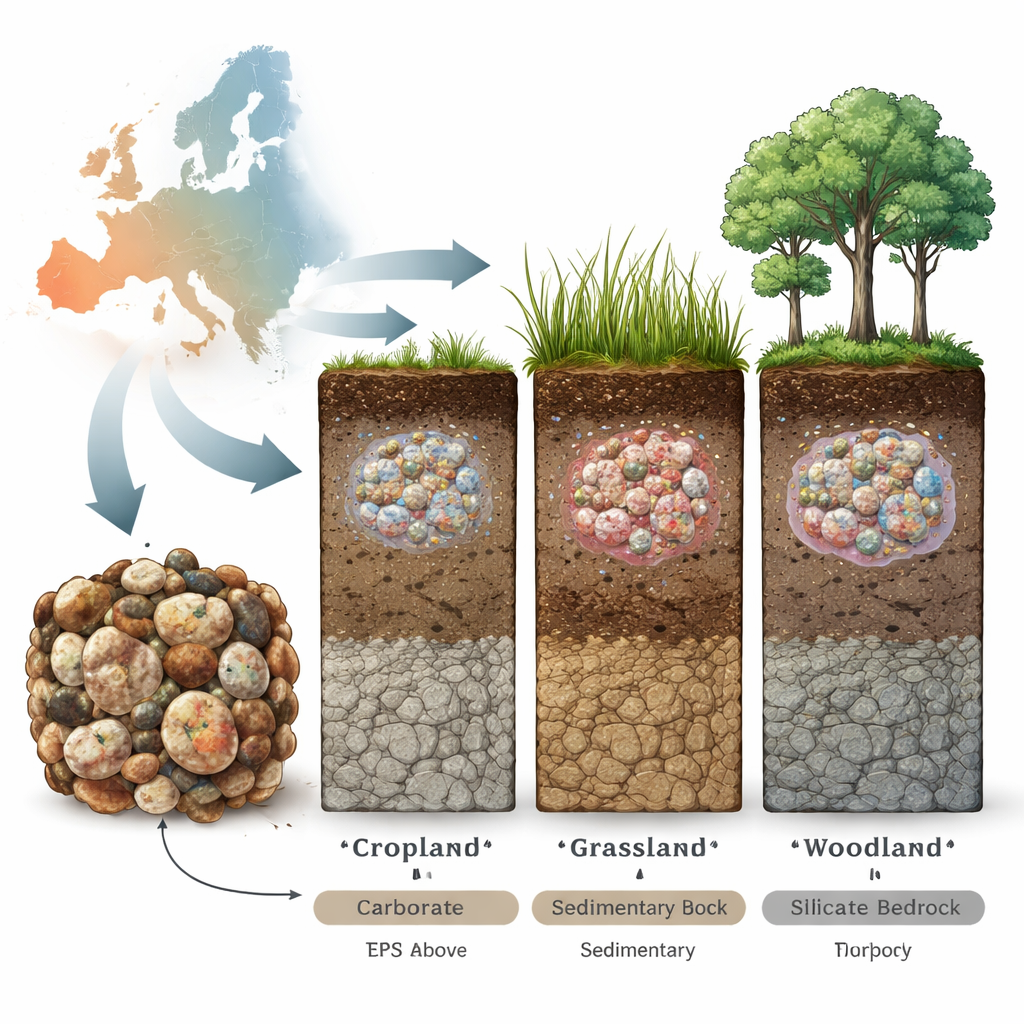
A continent-wide look beneath our feet
To understand how this microbial glue behaves at large scales, the researchers collected topsoil from 92 sites along a 5,500-kilometer transect across Europe, spanning Mediterranean drylands, temperate forests, and cool northern landscapes. They sampled soils developed on three main kinds of underlying rock—carbonate, sedimentary, and silicate—and from three major land uses: cropland, grassland, and woodland. For each soil, they measured how much EPS it contained, separated its sugary and protein components, estimated how much carbon these substances hold, and compared them with many other features, including climate, minerals, plant roots, and microbial activity.
How much microbial glue is in European soils?
The team found that EPS is widespread and abundant, but highly variable. Across all sites, the amount of EPS per gram of soil differed by a factor of sixteen. On average, EPS-carbon made up about 1.6 percent of total soil organic carbon, a relatively small share but one that is likely underestimated because the extraction method recovers only a fraction of all EPS. Sugary polymers accounted for roughly two-thirds of the measured EPS, while proteins made up about one-third. Importantly, soils richer in microbial biomass, clay, and calcium tended to hold more EPS, and wetter climates favored higher EPS contents. This means that both living microbes and the mineral framework of the soil work together to build and preserve this sticky carbon pool.
Rock, roots, and land use all leave a fingerprint
Bedrock type turned out to be a major underlying control. Soils formed on carbonate rocks generally contained more EPS and EPS-carbon than those on silicate or sedimentary rocks, likely because they had more clay, higher capacity to hold charged nutrients, and more calcium to bridge EPS onto mineral surfaces. Land use shaped other aspects: grasslands had especially high EPS protein levels, and croplands and grasslands showed a larger share of EPS-carbon relative to living microbial biomass than woodlands. The study also compared EPS with microbial “necromass” (cell fragments that remain after microbes die) and found that, while necromass holds roughly ten times more carbon than the measured EPS fraction, both pools are tightly linked to each other and to total soil carbon.
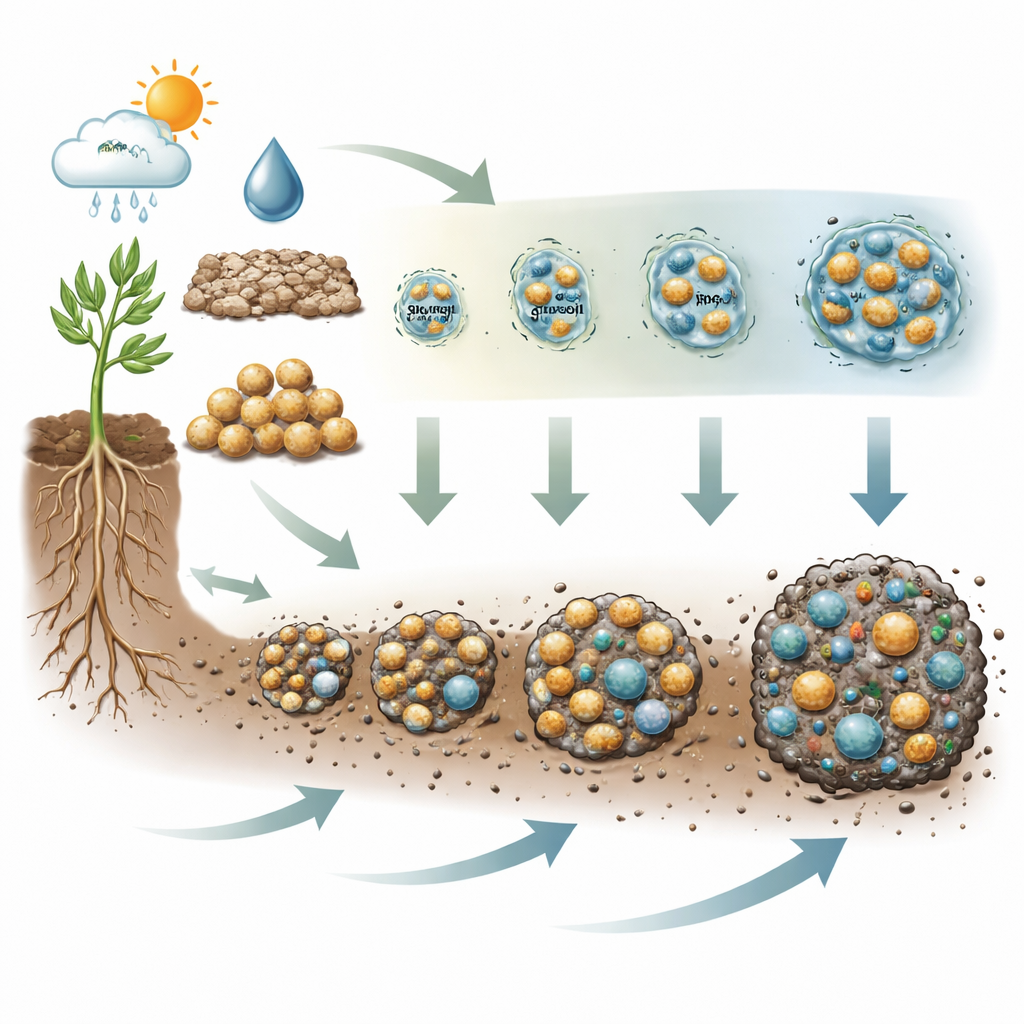
Stress, survival, and carbon storage
By looking at how EPS-carbon compared with the carbon in living microbes, the researchers inferred how microbes allocate their resources. In drier, more water-limited soils—often on sedimentary bedrock—microbes invested proportionally more in EPS relative to their biomass, even though overall microbial abundance was lower. This pattern suggests a survival strategy: under stress, microbes shift carbon from growth into building protective coatings and glue. Where conditions are milder and growth is easier, microbes devote more carbon to building new cells and relatively less to EPS, even if the absolute amount of EPS can still be high. Climate, plant roots, soil chemistry, and microbial traits all fed into a network of direct and indirect effects that together shaped how much EPS-carbon accumulated and how it was balanced against living biomass.
Why this hidden glue matters for the future
In plain terms, the study shows that microbial glue is a small but powerful part of soil carbon. Even though EPS-carbon is only a few percent of the total, it helps knit soil particles into stable aggregates and anchors other forms of microbial residues onto minerals, boosting the long-term storage of carbon. Because EPS responds to water stress, land use, and rock type, it forms a sensitive link between climate change, farming choices, and the stability of carbon in soils. Understanding and eventually managing this invisible glue could help keep soils fertile, better buffered against drought, and more capable of storing carbon over the long haul.
Citation: Shi, K., Zheng, Q., Wang, B. et al. Continental-scale drivers of soil microbial extracellular polymeric substances. Nat Commun 17, 3334 (2026). https://doi.org/10.1038/s41467-026-70068-0
Keywords: soil carbon, microbial biofilms, extracellular polymeric substances, land use change, climate–soil interactions