Clear Sky Science · en
Structure and energy transfer of a far-red–absorbing euglenophyte PSI–LhcE–LhcbM supercomplex
How a Shape-Shifting Alga Squeezes More From Weak Light
Euglena gracilis is a tiny, flexible alga that can both photosynthesize like a plant and feed like an animal. It often lives in dim, filtered ponds and puddles where much of the bright visible light has already been used up by other organisms. This study reveals how Euglena has rewired one of its main solar panels so it can tap into far‑red light—colors just beyond what most green plants can use—offering clues for boosting the efficiency of crops and bioengineered photosynthetic systems.
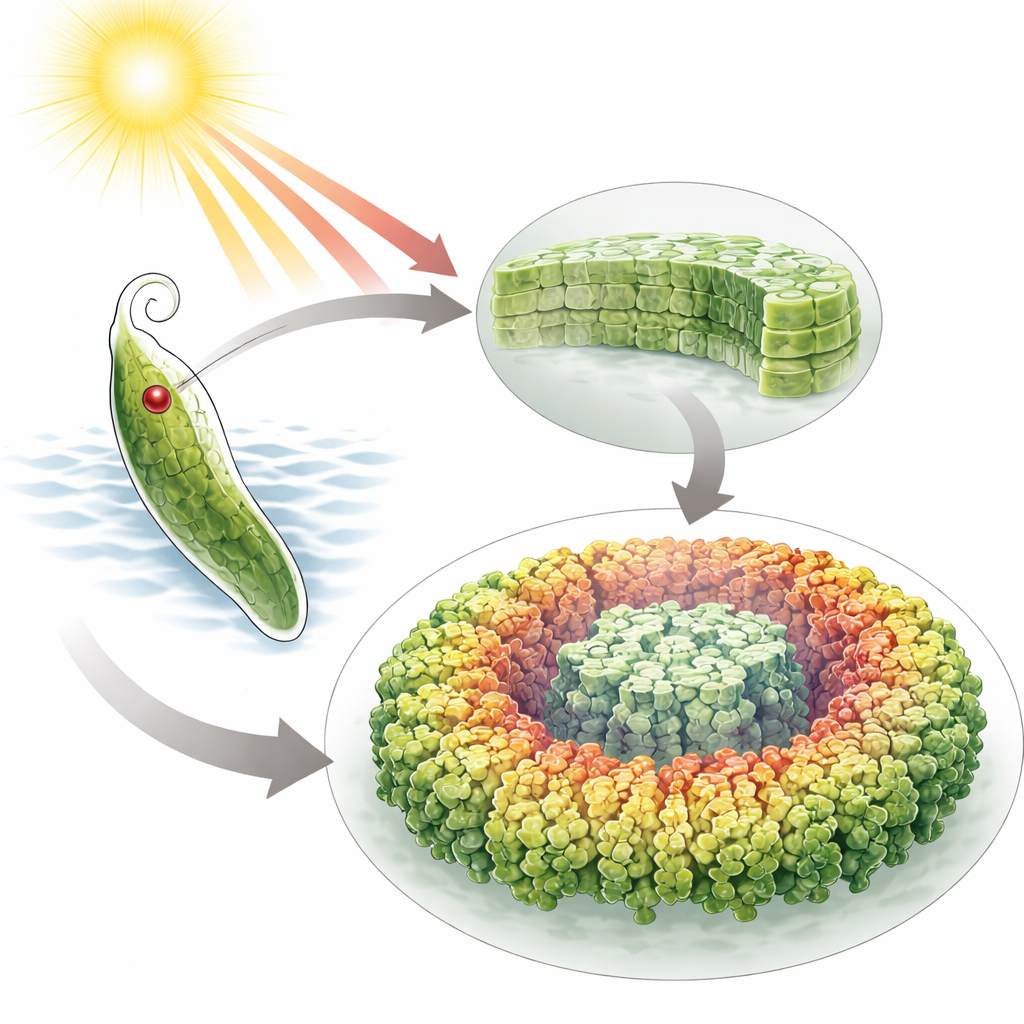
A Special Solar Panel Built From Two Lineages
The authors focus on one of Euglena’s key light‑harvesting machines, known as photosystem I (PSI). In plants and algae, PSI sits in internal membranes and channels light energy into the cell’s power‑producing chemistry. Using high‑resolution cryo‑electron microscopy, the team solved the three‑dimensional structure of a huge PSI supercomplex from Euglena. This supercomplex pairs a stripped‑down PSI "core" with an oversized ring of light‑collecting proteins called LhcE and LhcbM. The arrangement reflects Euglena’s unusual history: it gained its chloroplast through swallowing a green alga long ago, and later picked up additional genes from red‑lineage algae. The result is a chimeric machine whose layout and pigments differ sharply from those of familiar green plants.
An Extra‑Large Antenna Around a Minimal Core
Compared with PSI in other green algae, Euglena’s PSI core has lost several outer subunits, making it the smallest known core of its kind at the gene level. Around this lean center, however, sits an unusually large antenna system: 15 light‑harvesting complexes arranged as three single units and six paired units. Most of these antenna proteins are of a family called LhcE, with a single tightly bound pair of LhcbM units on one side. The antennae form nearly symmetrical pairs that curve around the core in two layers, creating a dense shell of pigments. This architecture is unlike the more regular "belt" of antenna proteins found in green plants and many algae, and it appears finely tuned to pack in pigments while still maintaining efficient connections to the core.
Custom Pigments and Red‑Shifted Chlorophyll Pairs
Inside this ring, the team cataloged hundreds of chlorophyll molecules and dozens of carotenoid pigments. Euglena’s antenna proteins use an unusual carotenoid, diadinoxanthin, which is common in red‑lineage algae but missing from typical green plants. Even more striking, many antenna units host special pairs and clusters of chlorophyll a molecules whose surroundings subtly distort their shape and spacing. These microscopic tweaks push their absorption into the far‑red region, beyond the reach of most plant antennae. In paired LhcE units, two such red‑shifted chlorophyll pairs sit close together at the interfaces between partners, and additional pigments are positioned precisely where the antenna touches the core. Together, these features create low‑energy "sink" sites that are especially good at capturing and holding far‑red light.
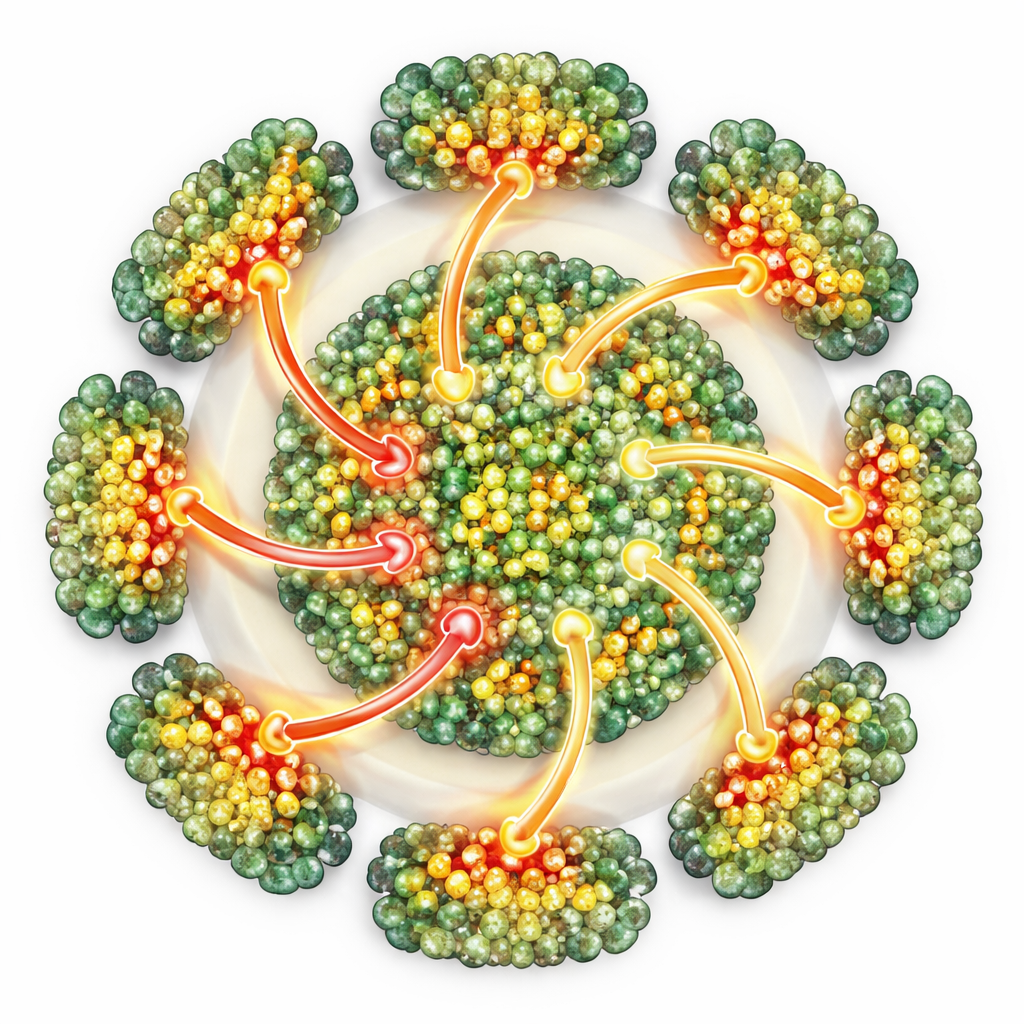
Fast Energy Highways Through a Giant Pigment Network
To find out how energy actually flows, the researchers used computer simulations based on the detailed structure. They modeled the rates at which excited pigments hand off energy to their neighbors throughout the supercomplex. The network acts like a multi‑lane highway: energy absorbed in outer antenna units is quickly funneled through key chlorophyll pairs and bridging pigments toward the PSI core, typically within trillionths of a second. Different groups of antenna modules feed the core through partially separate routes, but all rely on a small set of strategically placed chlorophylls that form tight couplings at the antenna–core interfaces. This design allows Euglena to maintain very rapid, low‑loss energy transfer even while using far‑red forms of chlorophyll that sit close to the edge of useful sunlight.
Evolutionary Shortcuts and Future Possibilities
The study paints a picture of PSI in Euglena as an evolutionary experiment in light harvesting. By trimming down the core, rearranging antenna proteins, recruiting a carotenoid normally confined to red algae, and reshaping chlorophyll binding sites, Euglena has built a compact but powerful collector for far‑red light. For non‑specialists, the key takeaway is that photosynthetic machines are more plastic than once thought: their scaffolds, pigments, and energy pathways can be re‑engineered by evolution to tap new slices of the solar spectrum. Understanding these tricks could guide future efforts to design crops, algae, or artificial systems that make better use of dim or red‑shifted light, expanding where and how efficiently we can harvest energy from the sun.
Citation: Li, K., Qin, BY., Zhang, YZ. et al. Structure and energy transfer of a far-red–absorbing euglenophyte PSI–LhcE–LhcbM supercomplex. Nat Commun 17, 3273 (2026). https://doi.org/10.1038/s41467-026-70067-1
Keywords: photosystem I, Euglena gracilis, far-red light, light-harvesting complexes, plastid evolution