Clear Sky Science · en
Local lateral connectivity is sufficient for replicating cortex-like topographical organization in deep neural networks
Why brain-like maps in AI matter
Our brains arrange neurons with similar jobs next to each other, forming orderly maps for things like edges, faces, and places. This layout shows up across many species and brain areas, yet scientists still debate why it exists and how it forms. This study asks whether a simple wiring rule—letting nearby neurons talk to each other—can make artificial networks grow similar maps on their own, and whether that organization gives computers any practical advantage, such as seeing more robustly in a noisy world.
Patterns on the brain’s surface
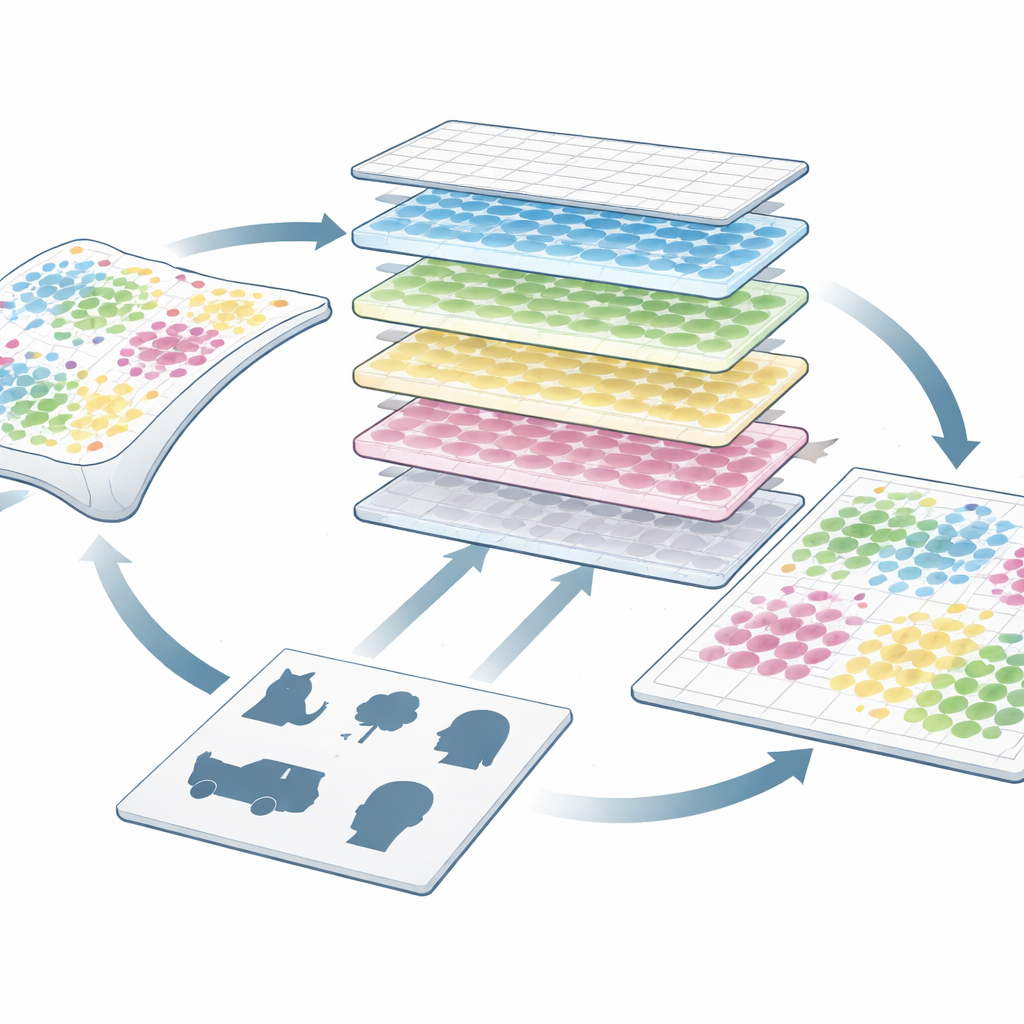
In primates, the visual cortex is not a jumble of cells. Instead, it is laid out like a patchwork quilt where neighboring neurons tend to prefer similar image features. Early regions carry maps of line orientation and color; later regions contain pockets tuned to faces, bodies, scenes, or everyday objects. Classic theories propose that this order evolved to keep wiring short and efficient, but they usually assume special learning rules or added objectives that are hard to justify biologically. The authors instead focus on a more basic anatomical feature seen widely in cortex: short, sideways connections linking nearby neurons, often stronger between cells that already respond similarly.
Building a virtual cortex sheet
The researchers start from a standard deep vision model, ResNet18, and reorganize its units so that each one sits at a fixed position on a two‑dimensional “cortical sheet.” Within each layer, they add local lateral connections whose strength declines with distance, mimicking how nearby cortical neurons influence each other more than distant ones. These sideways links are not trained by gradient descent; only the usual feedforward weights are. The model then learns a single task—object recognition on a large image dataset—using standard backpropagation, without any extra term that directly rewards smooth maps or short wiring.
Brain-like maps from edges to faces
Even under this simple setup, rich topography emerges. In early layers, units form smooth maps for orientation, spatial frequency, and color that resemble those recorded in primary visual cortex. Neighboring units respond more similarly than distant ones, and the directions along which orientation and spatial frequency change tend to cross at right angles, echoing fine-grained animal data. When the first layer is made more biologically detailed by removing weight sharing, the model also recovers hallmark features such as pinwheel patterns in orientation maps. In deeper layers, clusters tuned to categories like faces, bodies, and scenes appear in elongated bands across the simulated sheet, closely paralleling known layouts in human ventral temporal cortex. The model even reproduces broader divisions, such as separate streams for animate versus inanimate things and for small versus large real‑world objects.

Unseen brain areas and wiring economy
The study goes beyond familiar hot spots to probe regions whose function is less clearly defined. Using high‑resolution brain imaging data, the authors identify an intermediate patch of human cortex located between face‑ and place‑selective areas. In their model, the units whose activity best matches this patch sit at intermediate positions between the corresponding face‑ and scene‑selective clusters, suggesting that the artificial topography generalizes to unexplored territories. They also estimate effective wiring length between strongly active units across layers. Surprisingly, the laterally connected networks end up with far shorter overall connection length than both the original non‑topographic network and a previous model explicitly optimized to minimize wiring, implying that realistic learning alone can favor economical layouts when the architecture includes local lateral structure.
Robust vision through local teamwork
One of the most intriguing findings is functional: the clustered maps make the model harder to fool. When images are deliberately perturbed by strong adversarial attacks—tiny pixel changes designed to mislead the classifier—networks with local lateral connections retain higher accuracy than the baseline model, especially when the sideways connections span a larger neighborhood. The authors interpret the clusters as ensembles of similar units that average out noise, much like ensemble methods in machine learning. This suggests that topography may be more than tidy wiring: it may also support stable, reliable perception by letting groups of nearby neurons cooperate.
What this means for brains and machines
The work shows that simply adding realistic local lateral connections to a deep network is enough to produce cortex‑like maps at multiple scales, without special learning rules that neurons are unlikely to implement. At the same time, this organization improves robustness and reduces total wiring, hinting that evolution may have favored topography for both efficiency and dependable sensing. For neuroscience, the model offers a unified circuit recipe that can explain diverse visual maps; for artificial intelligence, it points toward architectures that are not only more brain‑like but also more resilient in the face of noisy or adversarial inputs.
Citation: Qian, X., Dehghani, A.O., Farahani, A.B. et al. Local lateral connectivity is sufficient for replicating cortex-like topographical organization in deep neural networks. Nat Commun 17, 4042 (2026). https://doi.org/10.1038/s41467-026-70065-3
Keywords: cortical topography, lateral connectivity, deep neural networks, visual cortex, adversarial robustness