Clear Sky Science · en
Discovery of van Hove singularities: electronic fingerprints of 3Q magnetic order in a van der Waals quantum magnet
Why twisting magnets in flat crystals matters
Stacked, atomically thin crystals known as van der Waals materials are at the heart of many of today’s most exciting quantum discoveries, from unconventional superconductors to exotic topological phases. This study explores a member of that family, CoxTaS2, where cobalt atoms are slipped between layers of tantalum disulfide. By carefully tuning how many cobalt atoms are inserted, the authors uncover a subtle magnetic pattern and its direct imprint on how electrons move—revealing a new way to engineer quantum behavior in ultra-thin magnets.
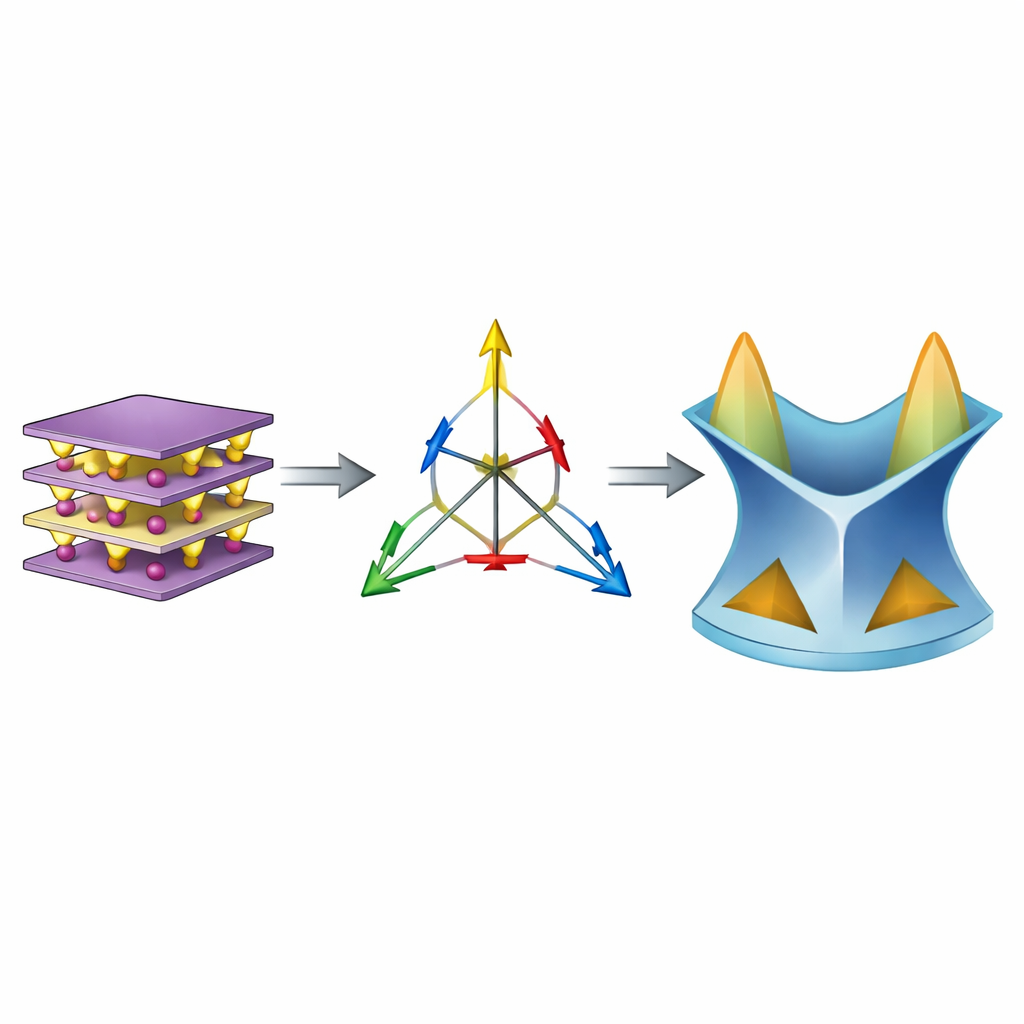
Building a quantum playground from stacked sheets
The base material, 2H-TaS2, is a layered crystal whose sheets are weakly bound, like a stack of cards held together by a light adhesive. When cobalt ions are inserted into the gaps, they form an orderly triangular lattice in every third layer, turning the material into a van der Waals magnet. Depending on the cobalt concentration, the spins of these cobalt atoms can arrange in very different patterns: in some regimes they align in simpler, mostly coplanar ways, while near a critical cobalt content of about one-third they form a more intricate, three-direction ("3Q") non-coplanar order. This tangled spin texture is known to generate an unusual electrical response called the topological Hall effect, but until now its direct signature in the electronic structure had not been clearly seen.
Looking at electrons with a quantum camera
To probe how the cobalt doping and magnetic order reshape electron motion, the researchers used angle-resolved photoemission spectroscopy (ARPES), a technique that measures the energies and momenta of electrons emitted when the crystal is illuminated with ultraviolet light. Comparing undoped 2H-TaS2 with Co-doped samples, they observed that cobalt donates electrons into the original TaS2 bands, shifting them to higher binding energy and subtly distorting their shapes. More strikingly, new, shallow electronic bands appear very close to the Fermi level—where conduction happens—forming small triangular pockets in momentum space. These pockets are tied to cobalt-derived electronic states, while the original tantalum-based bands evolve in a way consistent with simple electron doping. The authors further confirmed, using controlled potassium deposition on the surface, that the cobalt-derived states sit in a region of unusually high electronic density of states and respond differently to added charge than the TaS2 bands.
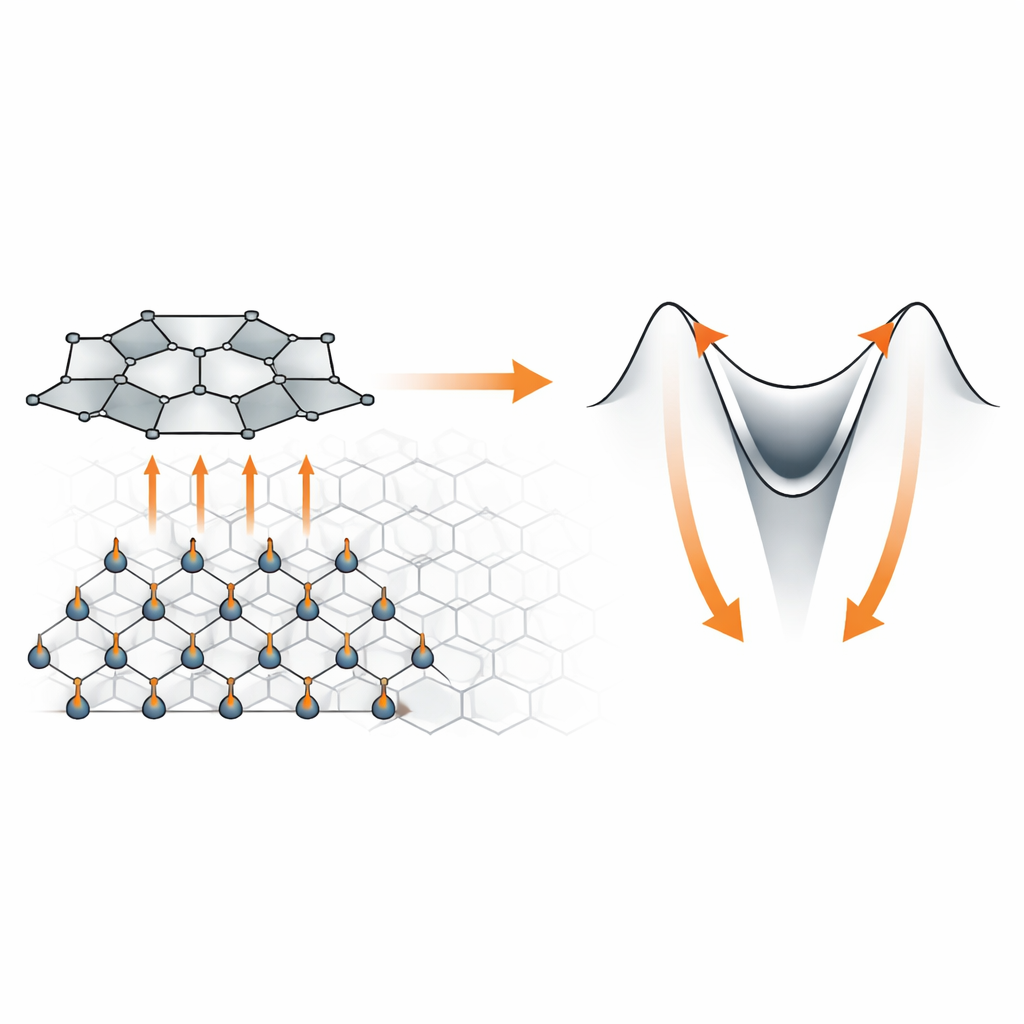
Hidden peaks in the electron landscape
A key theoretical concept in this work is the van Hove singularity, a kind of peak in the electronic density of states that occurs when the band structure flattens or turns over at specific points in momentum space. Using a simplified model of electrons moving on the cobalt triangular lattice, the authors show that when the relevant band is three-quarters filled and there is no complex magnetic pattern, the Fermi surface features touching triangular pockets and a single van Hove singularity at a high-symmetry point. When the 3Q magnetic order sets in, it effectively enlarges the unit cell and folds the electronic structure, splitting this single peak into two and reshaping the band into an "inverse Mexican-hat" profile: a shallow central dip flanked by two nearby maxima. ARPES measurements along the critical momentum direction indeed reveal this unusual dispersion, with enhanced spectral weight at the flanking peaks, providing an electronic fingerprint of the 3Q magnetic state.
Tuning magnetism with chemistry and temperature
By systematically varying the cobalt concentration across the critical value and tracking changes in the triangular Fermi pockets and near-Fermi bands, the team observes a clear evolution that aligns with a transition from the 3Q state to a more conventional helical magnetic order at higher cobalt content. Below the critical composition, the inverse Mexican-hat dispersion and the associated twin van Hove singularities are evident; above it, they fade into a simpler, hole-like band shape. Temperature-dependent measurements reinforce this picture: the distinctive band reshaping only appears in the low-temperature 3Q phase and disappears in the higher-temperature single-Q and paramagnetic states. This combination of doping and temperature control ties the electronic fingerprints directly to the underlying magnetic texture.
What this means for future quantum devices
For a non-specialist, the main message is that by inserting magnetic atoms into a layered crystal and tuning their concentration, one can not only switch between different magnetic patterns but also sculpt the landscape in which electrons move, creating sharp peaks (van Hove singularities) that strongly influence transport and topological responses. The discovery of these electronic fingerprints of 3Q magnetic order in a tunable van der Waals magnet suggests a promising route toward materials where magnetism and topology can be engineered hand-in-hand. In particular, the authors highlight that such systems may be able to host robust, potentially quantized versions of the quantum anomalous Hall effect when the cobalt-derived band is tuned to exactly three-quarters filling—a tantalizing prospect for low-power, dissipationless electronic technologies.
Citation: Luo, HL., Rodriguez, J., Dutta, D. et al. Discovery of van Hove singularities: electronic fingerprints of 3Q magnetic order in a van der Waals quantum magnet. Nat Commun 17, 3610 (2026). https://doi.org/10.1038/s41467-026-70063-5
Keywords: van der Waals magnets, topological Hall effect, van Hove singularity, transition metal dichalcogenides, magnetic order