Clear Sky Science · en
Spatio-spectral light-by-light moulding in multimode fibre
Shaping Light with Light
We are used to controlling light with lenses, mirrors, and filters. This study shows that light can also be used to sculpt other light directly, inside a special optical fibre. By sending a strong laser beam and a much weaker “messy” beam together through the same fibre, the authors demonstrate that the strong beam can either tidy up or scramble the weaker one on demand. This kind of light-by-light control could lead to sharper imaging deep inside tissue, more flexible laser sources, and new ways to route signals in optical networks.
Why Speckled Beams Matter
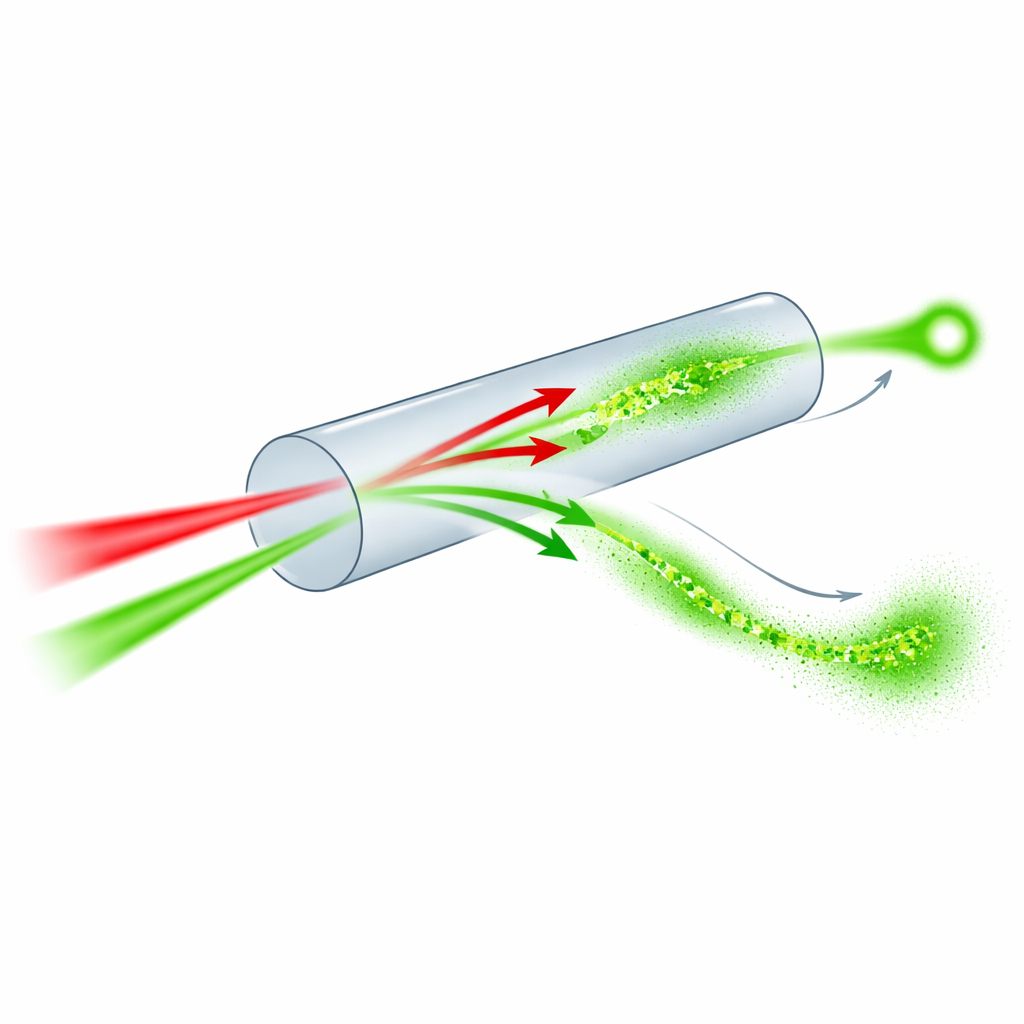
When a laser beam travels through a thick, multimode optical fibre, it does not stay as a single smooth spot. Instead, it breaks into a complicated grainy pattern called speckle, made of many overlapping paths of light. Speckled beams are bad news for applications that need a tight focus, such as high-precision cutting, medical imaging, or sending many data channels down the same fibre. In recent years, researchers learned that under the right conditions, the natural response of the fibre’s glass can “self-clean” a messy beam into a smoother shape. But until now, this effect mainly applied to a single colour of light and did not allow a second, weaker beam at a different colour to be controlled in a fine-tuned way.
Two Colours Team Up in One Fibre
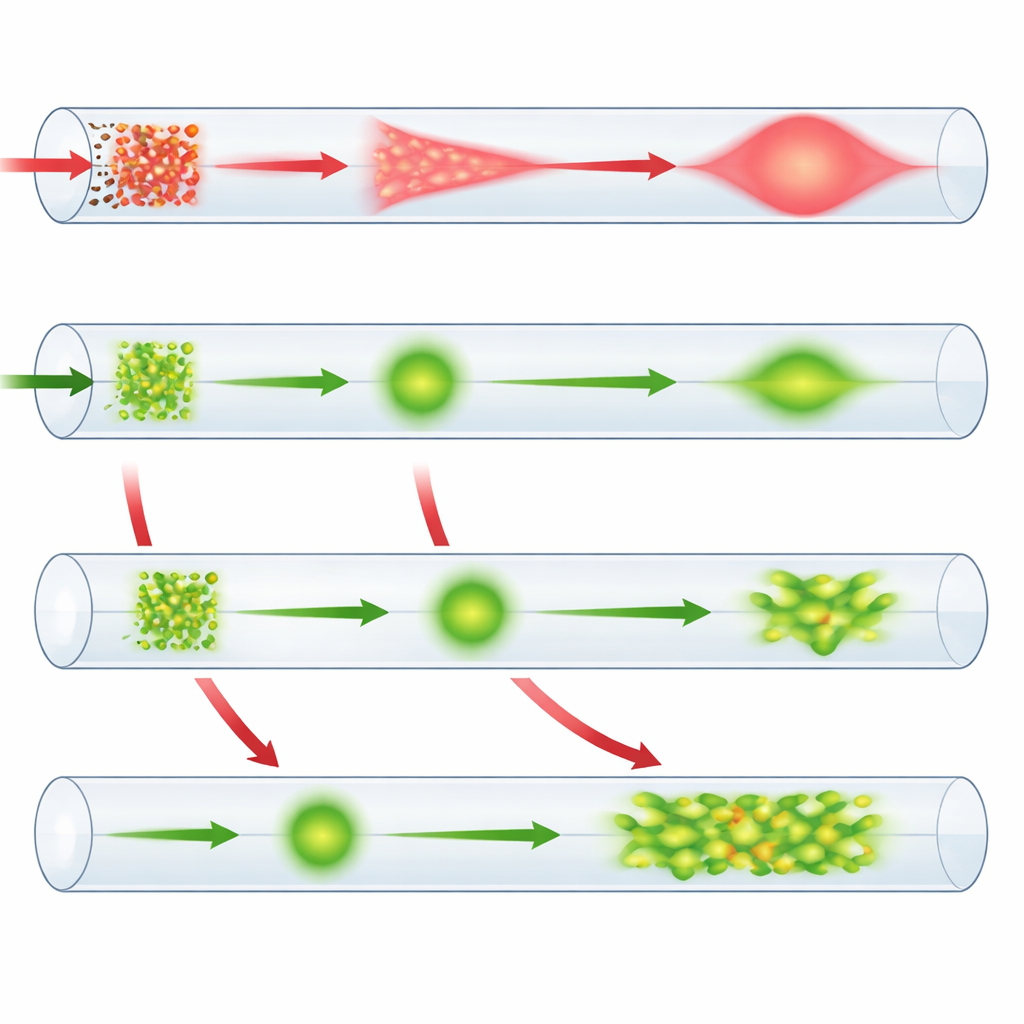
The authors launch two laser beams together into a graded-index multimode fibre: a powerful infrared beam and a much weaker green beam, created as the second harmonic of the infrared light. Both beams travel side by side through the same glass core, but the green one is so weak that, on its own, it would simply maintain its speckled structure. The key twist is that the intense infrared beam reshapes itself as it propagates, thanks to the glass’s nonlinear response. This reshaping imprints a kind of moving pattern in the fibre’s refractive index, which the green beam “feels.” As a result, energy within the green beam is shuffled between its many spatial patterns, without exchanging power between colours. By changing the power and exact input shape of the infrared pump, the team can steer this internal shuffling process.
Cleaning or Spoiling the Weak Beam
The experiments reveal two opposite regimes, which the authors call beam cross-cleaning and beam cross-spoiling. In cross-cleaning, the strong infrared beam encourages the green beam to concentrate its energy into lower-order patterns that look like a single bright spot, reducing its spread and improving its quality. In cross-spoiling, a slight change in how the infrared light enters the fibre or in its power reverses the effect: now the green beam is pushed into higher-order, more complicated patterns, becoming more speckled and divergent. Importantly, both behaviours arise from the same overall mechanism of light-by-light interaction inside the fibre, with no energy being transferred between colours—only between the internal patterns of the weaker beam.
Guiding Cascades of New Colours
To probe the limits of this control, the authors also use longer fibres and longer laser pulses, pushing both colours into a strongly nonlinear regime where they generate cascades of new wavelengths through Raman scattering. In this case, the structure of the green beam governs how efficiently these extra colours grow. Because the infrared beam can pre-shape the green beam’s pattern through cross-cleaning or cross-spoiling, it indirectly boosts or suppresses the entire chain of new green-side wavelengths. The team shows that they can switch which transverse pattern carries most of the power and even cut down the number of generated lines, all by tuning the infrared pump’s conditions. Numerical simulations that solve coupled propagation equations support the observed behaviour and underline the importance of how long the pulses overlap in time.
New Knobs for Future Light Tools
In simple terms, this work adds a new “knob” for controlling light: instead of relying only on glass design or static optics, one beam can act as a dynamic internal diffuser or cleaner for another beam travelling in the same fibre. The authors show that a strong infrared beam can brighten or blur a weak green beam and regulate how it spawns additional colours, all without amplifying or absorbing it. Such controllable light-by-light moulding in multimode fibres could underpin brighter and more compact fibre lasers, reconfigurable optical switches, and improved endoscopic imaging where many colours and patterns must coexist in the same strand of glass.
Citation: Arosa, Y., Mansuryan, T., Poisson, A. et al. Spatio-spectral light-by-light moulding in multimode fibre. Nat Commun 17, 3647 (2026). https://doi.org/10.1038/s41467-026-70057-3
Keywords: multimode optical fibre, beam self-cleaning, nonlinear optics, Raman scattering, spatial light control