Clear Sky Science · en
Dual-responsive coloration of Janus droplets via total internal reflection and interference applied as single-use freezing indicators
Color-changing beads that reveal a cold secret
Many vaccines and other medicines must never be frozen, but current labels often struggle to show clearly if a vial has dipped below safe temperatures. This study introduces tiny oil droplets that change their vivid color with temperature and solution chemistry, turning them into simple visual tags that can reveal whether a medicine has been kept within the right cold range or accidentally frozen.
How light makes these droplets glow with color
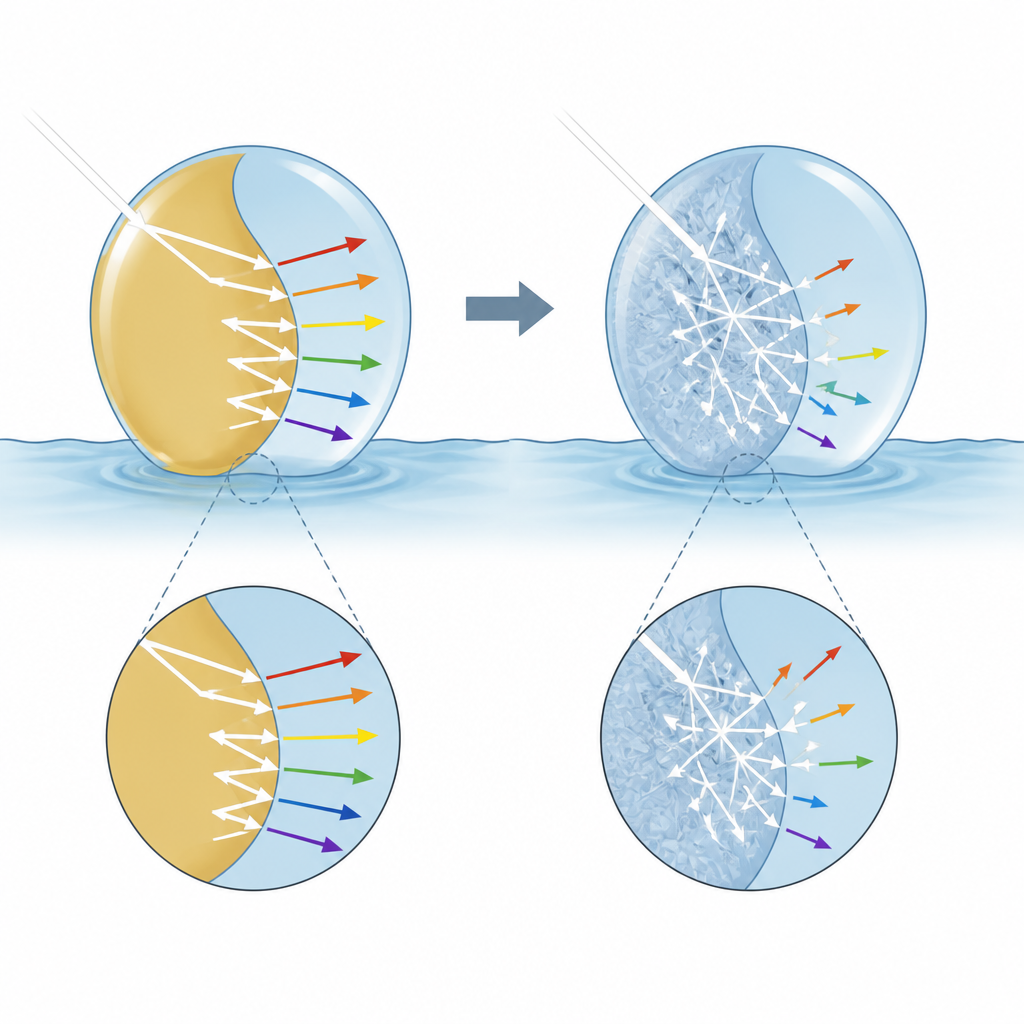
The key players are so-called Janus droplets, tiny beads made from two different liquids that sit side by side inside each droplet. When white light enters a droplet, it hits the curved boundary between the two liquids at such an angle that the light is trapped and bounces around inside before leaving. These repeated reflections cause different colors in the light to interfere with each other, so that only certain colors emerge strongly, forming a bright ring around each droplet. By changing the droplet size, the path that light travels changes, which shifts the observed color smoothly across the rainbow.
Switching color on and off with additives
The researchers show that these droplets can be turned between a colorless and a colorful state simply by adjusting the mix of detergents, or surfactants, in the surrounding water. These surfactants tug differently on the surfaces between the two oils and the water, reshaping each droplet from a two-faced Janus form into a core shell structure and back again. When the shape no longer has a sharply curved internal boundary, the special reflections vanish and the ring of color disappears. Restoring the original surfactant balance brings back the Janus shape and the vivid color, and this process can be repeated many times without noticeable fading.
Temperature turns the color into a freeze alarm
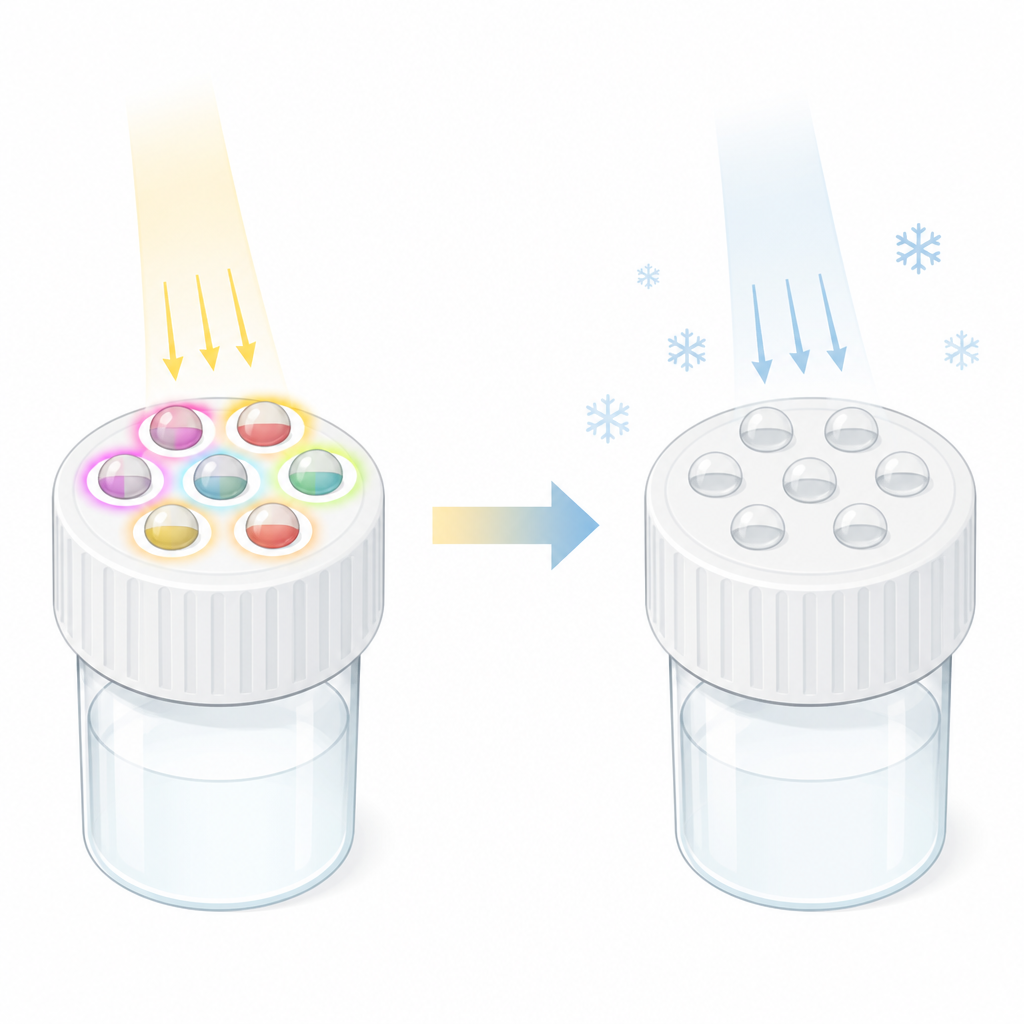
Temperature offers a second, independent way to control the color. One of the oils used in the droplets solidifies just below room temperature, while the other stays liquid. At warm conditions, the oil remains transparent, so light still reflects neatly along the curved boundary and produces a bright blue or orange ring. When cooled to refrigerator temperatures, that oil crystallizes, becoming cloudy and shrinking slightly. The once orderly light paths now scatter inside the solid region, so the droplet stops showing its clear structural color. Warming the sample melts the oil back to a liquid and the color reappears, a change that remains reliable over many heating and cooling cycles.
From lab trick to practical vial-top label
To demonstrate real-world use, the team filled shallow grooves in drug vial caps with these Janus droplets, creating circular patches that glow with color under directed light. One design reacts reversibly near standard refrigerator temperatures: it turns colorless when the vial is cooled to around 4 degrees Celsius and recovers its color on warming, enabling repeated checks that storage stays in the desired cool range. A second design experiences permanent structural damage when cooled just below freezing, so its color vanishes for good after a freeze event. This irreversible loss acts like a simple memory that the vial has been frozen at some point, even if it later warms back up.
Why this matters for everyday health
By combining surfactant tuning and temperature driven phase changes, these droplets provide two clear and easily read signals about the thermal history of a product. The labels need only light and a quick glance, with no electronics or batteries, and they can record both safe cooling and harmful freezing in one small patch. For medicines that lose effectiveness once frozen, such as certain vaccines and insulin, this droplet-based color system could offer a straightforward way for pharmacists and patients to see whether a vial has remained within a safe cold chain from factory to clinic.
Citation: Xu, Y., Tian, M., Zhang, M. et al. Dual-responsive coloration of Janus droplets via total internal reflection and interference applied as single-use freezing indicators. Nat Commun 17, 4313 (2026). https://doi.org/10.1038/s41467-026-70055-5
Keywords: structural color, Janus droplets, temperature indicator, cold chain, freeze sensitive pharmaceuticals