Clear Sky Science · en
Upcycling of atmospheric CO2 to self-healing recyclable polymers under ambient conditions
Turning Air into Everyday Plastics
Plastic waste and rising carbon dioxide in the atmosphere are usually seen as two separate problems. This study shows they can be tackled together: the authors have found a way to pull carbon dioxide directly from the air and turn it into tough, long‑lasting plastics that can heal themselves when damaged and be recycled over and over under gentle conditions. For readers, this hints at a future where many common plastic products could be made from captured air rather than from oil, and where broken or discarded items no longer have to end up in landfills.
Why Rethinking Plastics Matters
Modern life depends on plastics because they are light, cheap, and versatile, but their success has created a “sustainability trilemma.” First, plastic waste is piling up in oceans and ecosystems. Second, making plastics generates large amounts of carbon dioxide. Third, they are mostly made from fossil fuels, which are finite resources. Recycling helps, but most strong, durable plastics are “thermosets” that are hard to melt and reshape, so they are rarely recycled efficiently. Scientists have begun designing special networks called “dynamic” polymers that can rearrange their internal links, allowing them to be reprocessed or repaired, but these usually still rely on fossil‑based ingredients and energy‑intensive manufacturing.
Capturing Carbon from Ambient Air
The team set out to treat carbon dioxide itself as a raw ingredient for plastics. Instead of using concentrated streams of the gas under high pressure, they worked with ordinary outdoor air, which contains only about 0.04 percent carbon dioxide. They bubbled this air through a mild alkaline solution, converting the gas into carbonate ions dissolved in the liquid. These ions then act as bridges between specially designed building blocks in the polymer. Crucially, this entire process happens at room temperature and normal pressure without the help of metal catalysts or high energy input, offering a low‑energy approach to harvesting carbon from the atmosphere.
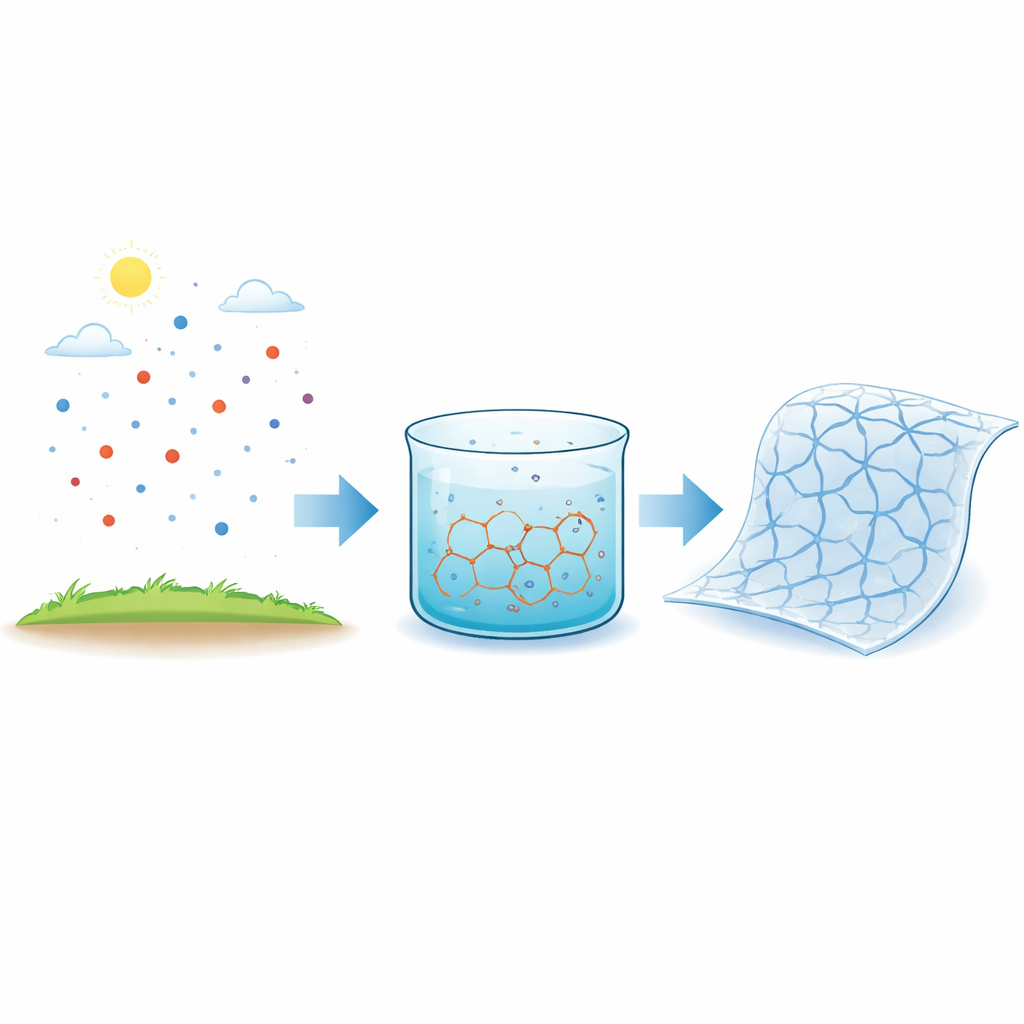
Building a New Kind of Plastic Network
At the heart of the work is a new reversible link that joins polymer chains: the carbonate bridge between the captured ions and a fluorinated chemical group on the polymer backbone. These bridges form quickly and completely in solution, cross‑linking the chains into a solid network once the solvent is removed. The resulting materials span a wide range of textures, from rubber‑like sheets that stretch to nine times their length, to rigid plastics as stiff as some commercial engineering materials. By swapping the positive ions that accompany the carbonate, or by altering the side groups on the polymer chains, the researchers can finely tune strength, stiffness, and stretchiness. Computer simulations suggest that bulky, mobile ions act a bit like internal lubricants, softening and toughening the network while the carbonate bridges supply strength.
Plastics that Heal and Can Be Remade
Because the carbonate bridges can break and reform, the material behaves in an unusual way when warmed: the network does not simply melt, but it flows slowly as bonds exchange partners. This gives it remarkable self‑healing ability. When a strip is cut in two and pressed together at moderate warmth, the cut nearly disappears within minutes, and the repaired strip can hold a weight thousands of times heavier than itself. The same bond swapping allows shredded pieces to be pressed or injected into new shapes several times without losing performance. Under slightly acidic conditions at room temperature, the bridges fall apart completely, returning the polymer chains and the small ionic component. These ingredients can then be recombined with air‑derived carbonate to rebuild fresh material, closing the loop chemically.
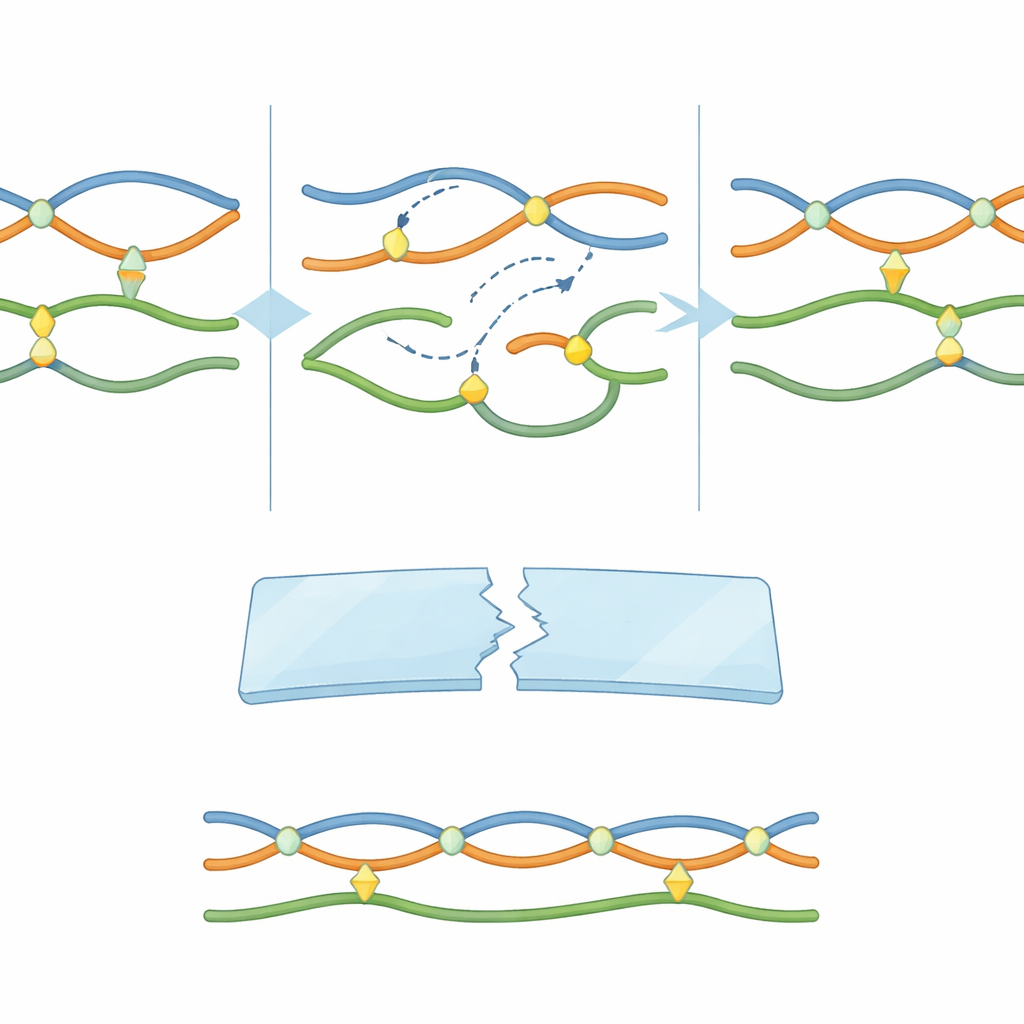
From Waste Streams to Stronger Materials
The gentle recycling chemistry proves selective even in complex mixtures. When the new plastic is mixed with common packaging plastics or woven together with carbon fiber, only the air‑derived network dissolves under mild acid treatment; the other materials emerge intact and reusable. The recovered ingredients can be used to recreate the original material or blended to form new hybrids that outperform the starting plastics in strength and toughness. This upcycling ability hints at future recycling plants where mixed plastic waste streams are upgraded into high‑value products instead of being down‑cycled or burned.
What This Means for Everyday Life
To a non‑specialist, the key message is that it is now possible to make strong, repairable, and fully recyclable plastics using carbon drawn from the air under ordinary conditions. While the current materials contain only a modest fraction of captured carbon by weight, the approach establishes a flexible platform that can be refined to store more carbon and to match or exceed the performance of today’s fossil‑based plastics. If scaled up, such self‑healing and truly recyclable materials could help cut plastic waste, reduce reliance on oil, and turn part of the carbon dioxide problem into a practical resource.
Citation: Zeng, X., Zhang, S., Li, H. et al. Upcycling of atmospheric CO2 to self-healing recyclable polymers under ambient conditions. Nat Commun 17, 3349 (2026). https://doi.org/10.1038/s41467-026-70046-6
Keywords: carbon dioxide plastics, self-healing polymers, recyclable thermosets, direct air capture materials, sustainable polymers