Clear Sky Science · en
Simulating the Photochemical Birth of the Hydrated Electron in Liquid Water
Why light in water matters
Shining energetic ultraviolet light into plain liquid water kicks off some of the fastest chemical events in nature. One of the most important products is the “hydrated electron” – a free electron briefly trapped and protected by nearby water molecules. This fleeting species helps drive radiation damage, medical therapies, and key reactions in chemistry and biology, yet its exact birth in water has remained mysterious. This study uses state-of-the-art computer simulations to watch, step by step, how a single flash of light reshapes the water network and gives rise to the hydrated electron.
Hidden weak spots in liquid water
Water is often pictured as a neat three-dimensional network where each molecule forms four hydrogen bonds with its neighbors. In reality, at room temperature this network constantly fluctuates and contains many “defects,” where molecules are missing one or more bonds. The authors first asked: when light is absorbed, does it excite a single water molecule or a larger patch of the liquid? By carefully analyzing the simulated electronic density, they found that most excitations are centered on one molecule, but a significant fraction spread across up to five waters arranged in short chains. Crucially, the molecules that get excited are not the perfectly bonded ones; they tend to sit at these weak spots in the network, particularly where a molecule is missing a bond it would normally accept. Because the electrons on such defective molecules are less stabilized, they require slightly less energy to excite, helping explain fine details of water’s ultraviolet absorption spectrum.
Two ultrafast fates after absorbing light
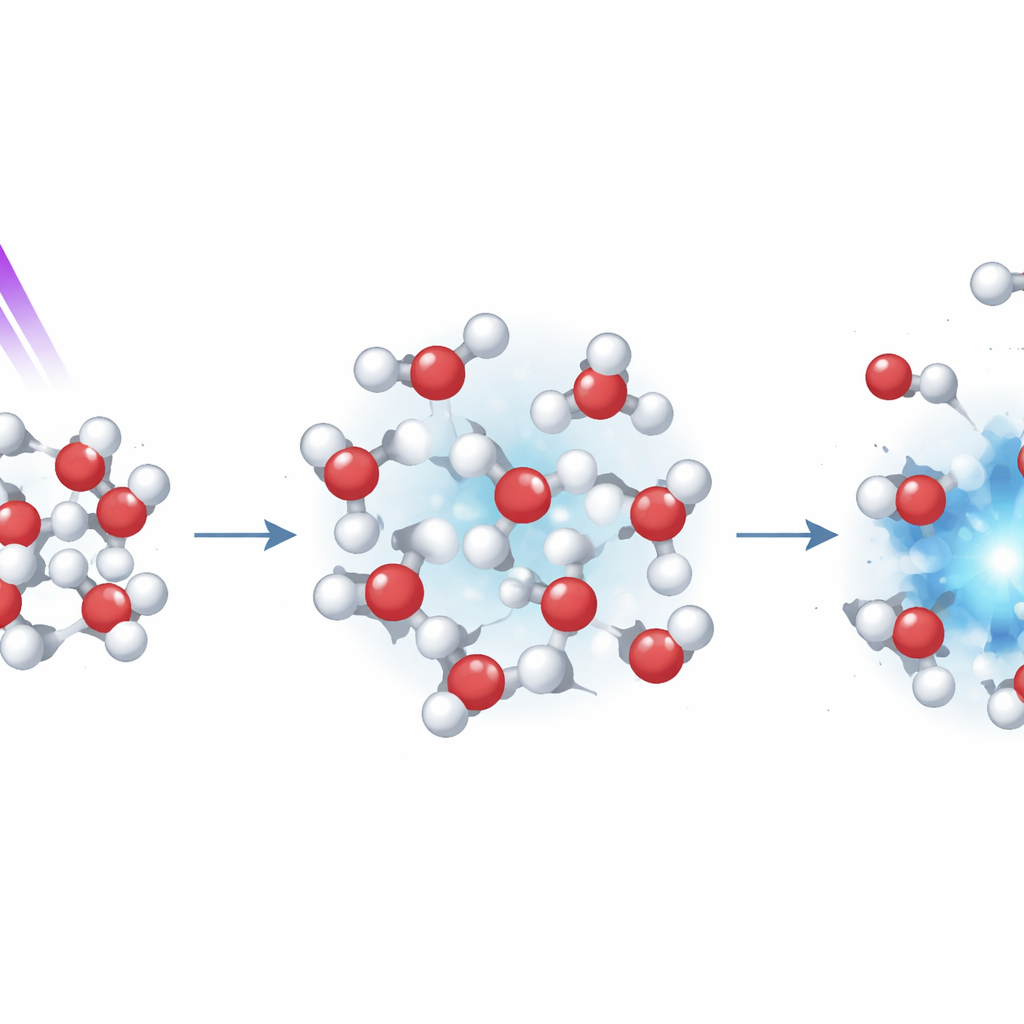
After a water molecule absorbs a high-energy photon, the system follows one of two main pathways, both unfolding in less than a trillionth of a second. In the first pathway, called hydrogen-atom transfer, one O–H bond in the excited molecule promptly breaks and the departing hydrogen carries the electron with it, forming a neutral hydrogen atom. Sometimes this atom flies into a small empty pocket in the liquid; other times it briefly forms a rare “hydronium radical,” a water molecule with three hydrogens and an unpaired electron. In either case, the system then quickly relaxes back to its lowest-energy electronic state without producing a hydrated electron. The simulations show this route is actually more common than the alternative, in line with earlier experiments that could measure products but not follow the microscopic steps.
How a free electron is born and trapped
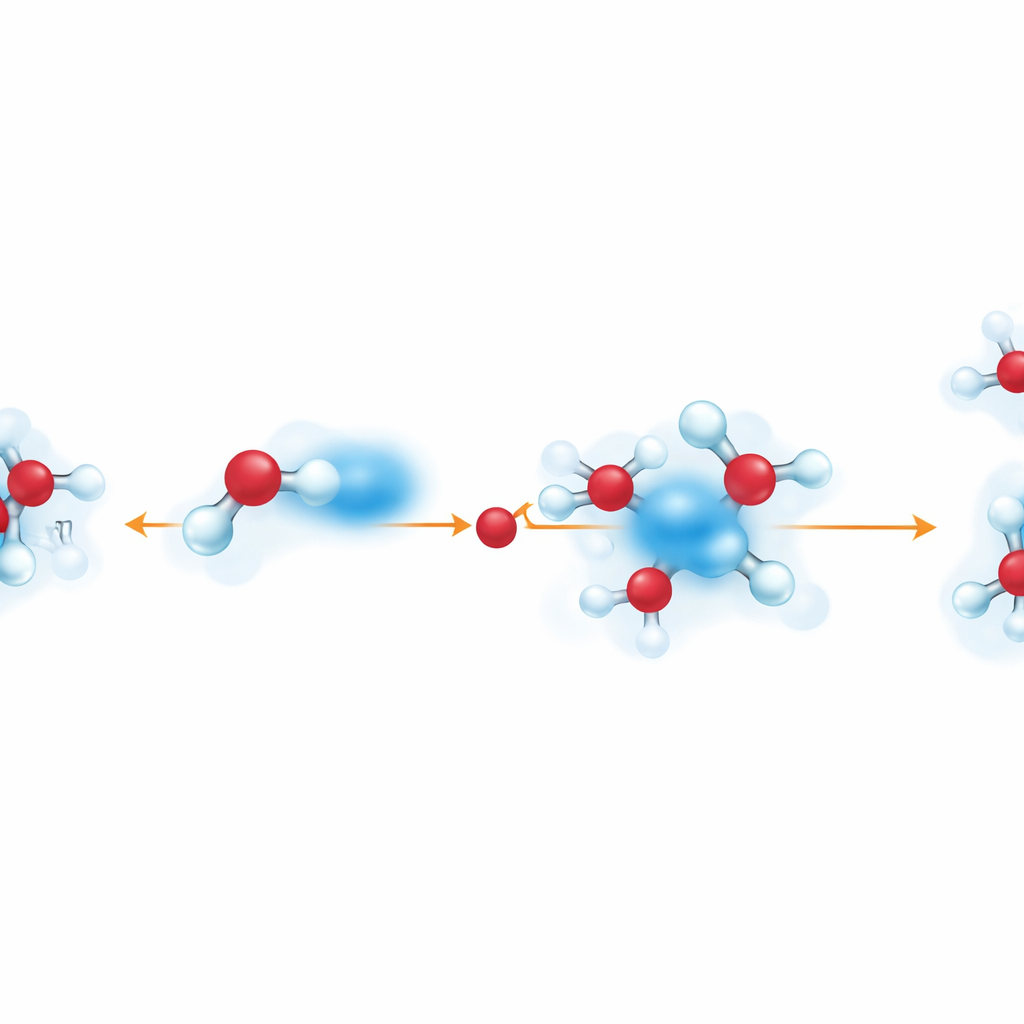
The second pathway, proton-coupled electron transfer, is the one that leads to the hydrated electron. Here, when the excited O–H bond breaks, the proton (a bare hydrogen nucleus) separates from the electron instead of dragging it along. The proton hops to a neighboring water molecule, creating a hydronium ion and leaving behind a hydroxyl radical. The freed electron initially spreads over several waters, but then rapidly collapses into a more compact cloud surrounded by four to five molecules that twist and shuffle into a favorable arrangement. The simulations track this collapse using the electron’s “gyration radius,” a measure of how spread out it is, which shrinks from several ångströms to a value close to that measured for the fully relaxed hydrated electron. At the same time, the hydroxyl and hydronium move apart through the liquid, with preferred distances that closely match recent ultrafast electron diffraction experiments. These findings show that the basic solvation cage of the hydrated electron is already assembled while the system is still electronically excited.
Water in motion: a collective reshaping
Creating a hydrated electron is not just a single bond snapping; it is a collective response of many water molecules. The simulations reveal that the waters that will eventually surround the electron rotate their molecular dipoles by tens of degrees and shift by more than an ångström, carving out a cavity while breaking and reforming hydrogen bonds. These concerted rotations and translations distort the broader network, echoing patterns seen in other reactions where excess electrons are stabilized in water, such as the reduction of carbon dioxide. As the ion–radical pair (hydroxyl plus hydronium) moves from direct contact to being separated by one or more intervening waters, the energy gap that controls the electron’s color shifts, linking microscopic structure to the observed spectrum.
What the glow of the electron tells us
Hydrated electrons in water fluoresce—they briefly glow as they drop from an excited state back toward lower energy. By sampling many geometries from their trajectories, the authors computed how this emission energy depends on how localized the electron is. They found that as the electron tightens its spatial extent, the emitted light shifts to lower energy (redder colors), and the overall distribution of energies matches measured fluorescence spectra remarkably well. This supports the picture that emission does not come from one rigid structure, but from a whole family of short-lived arrangements of water and electron. It also suggests that, by subtly tuning how water and other solutes organize around the electron, one could control the color of this glow.
Why this matters beyond pure water
Taken together, the work provides a unified microscopic picture of how a single ultraviolet photon can reorganize liquid water, split bonds, and carve out a niche for a free electron. It clarifies when hydrated electrons do and do not form, identifies previously elusive intermediates such as the hydronium radical and solvent-separated ion–radical pairs, and ties their motions to the electron’s spectrum and fluorescence. Beyond satisfying a long-standing scientific curiosity, this understanding lays the groundwork for predicting and eventually steering hydrated-electron chemistry in more complex settings—from salty solutions and interfaces to radiation damage in DNA and advanced photocatalytic processes.
Citation: Díaz Mirón, G., Malosso, C., Di Pino, S. et al. Simulating the Photochemical Birth of the Hydrated Electron in Liquid Water. Nat Commun 17, 3764 (2026). https://doi.org/10.1038/s41467-026-70045-7
Keywords: hydrated electron, water photochemistry, ultrafast dynamics, proton coupled electron transfer, radiation chemistry