Clear Sky Science · en
UV-activated assisted electrochemical process for mine water deep mineralization and resource recovery
Turning Dirty Mine Water into Useful Resources
Coal mining leaves behind enormous volumes of salty, contaminated water. Traditionally this waste has been seen as a costly liability: hard to clean, expensive to dispose of, and a missed opportunity in water‑scarce regions. This study shows how ultraviolet light and electricity can work together to not only scrub stubborn pollution from high‑salinity mine water, but also transform what is left into valuable chemicals and reusable water, pointing toward cleaner mining and a more circular use of resources.
Why Salty Mine Water Is So Hard to Clean
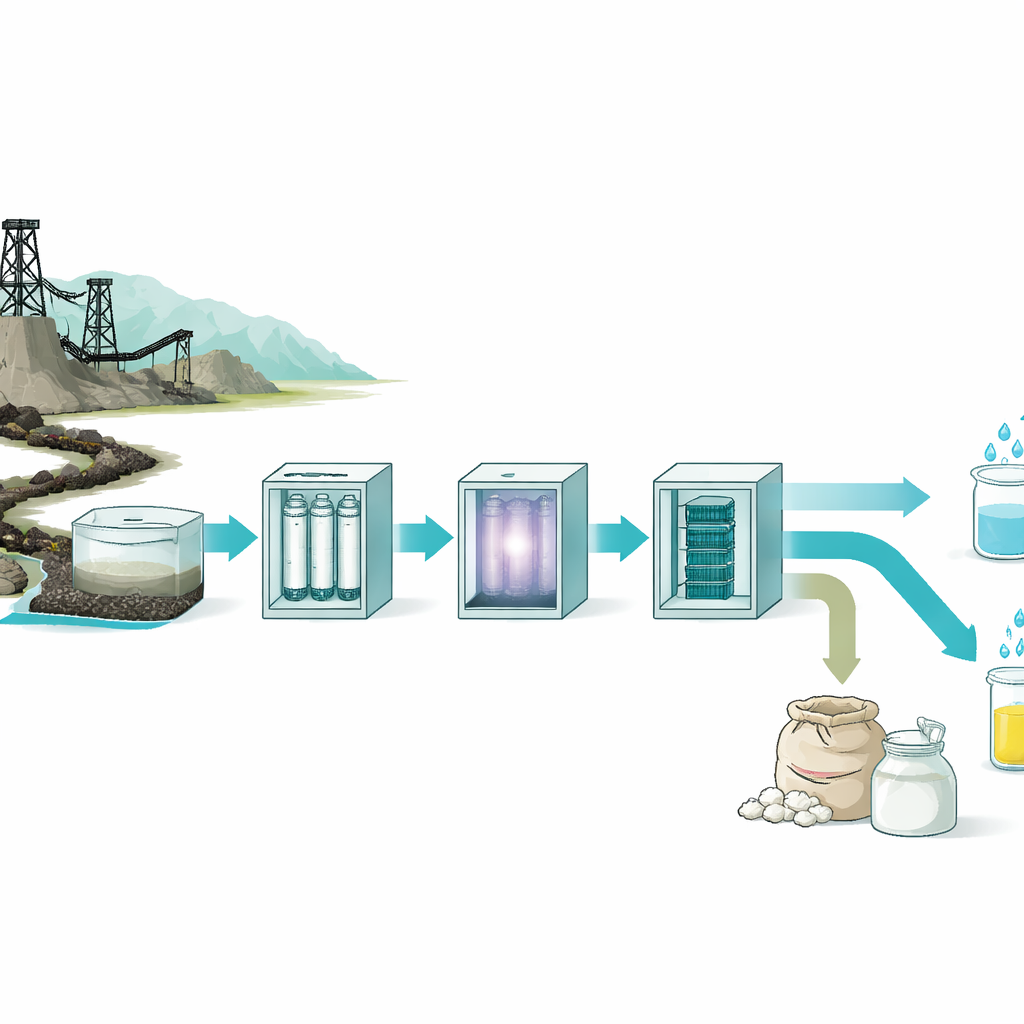
Every ton of coal mined can produce nearly two tons of mine water. After partial treatment with membranes, what remains is a concentrated brine loaded with complex organic molecules, salts, and other contaminants. These organics originate from underground dissolved matter, machinery lubricants and rubber particles. They are chemically stable, repel water, and do not break down easily, so standard advanced oxidation methods such as ozone or conventional electrochemical treatment struggle to fully destroy them. Existing crystallization approaches can recover water and salt, but mainly yield low‑value sodium sulfate and depend heavily on added chemicals, limiting their economic appeal.
Harnessing Light and Electricity Together
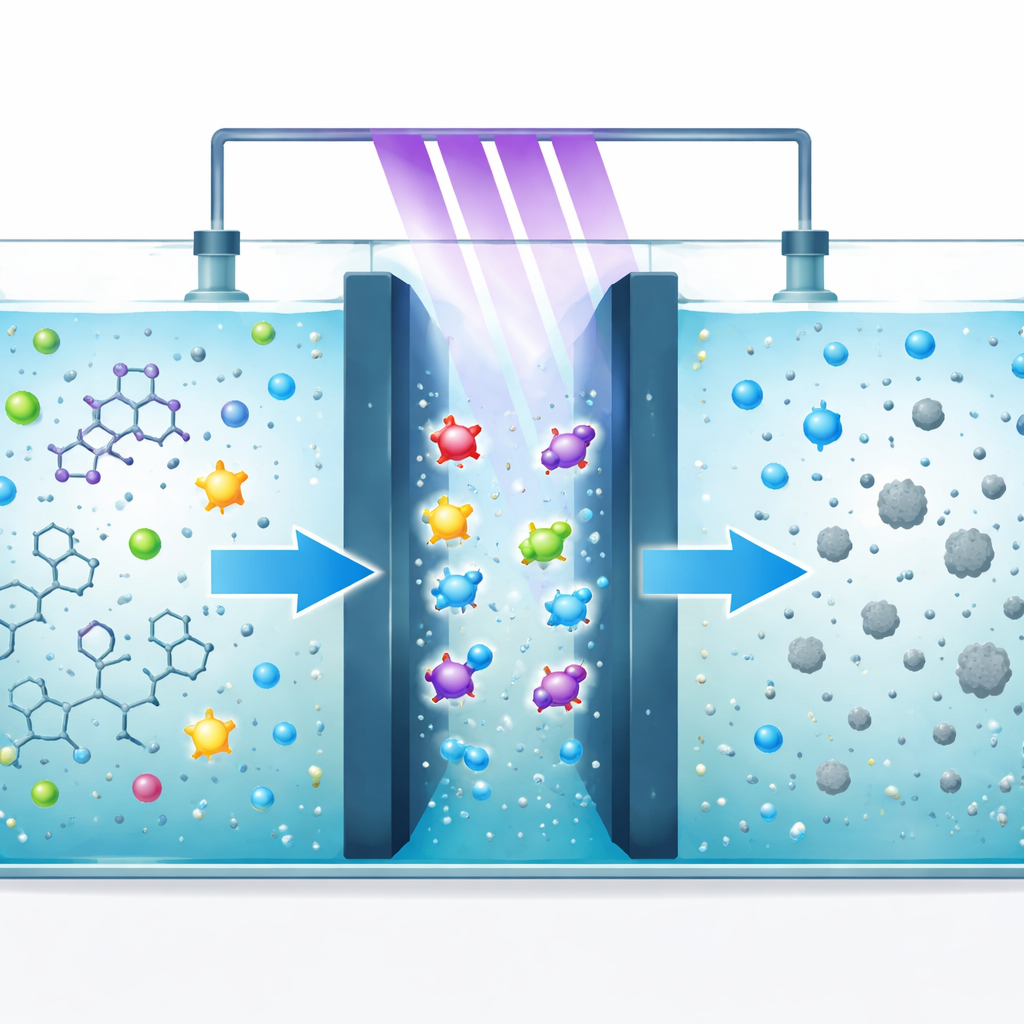
The researchers designed a “UV‑activated assisted electrochemical process” (UAEP) that combines ultraviolet light with a carefully tuned electrochemical cell. The mine water flows between a metal anode and a palladium‑coated cathode while it is illuminated with UV light. Many of the stubborn organic molecules in mine water contain light‑sensitive ring structures and special chemical groups that absorb UV energy. When excited by this light, these molecules become more reactive and easier targets for attack by short‑lived radicals—highly reactive forms of oxygen and hydrogen—generated at the electrodes. In tests with real high‑salinity mine water, UAEP removed about 90% of total organic carbon and nearly 60% of total nitrogen, clearly outperforming ozone, Fenton chemistry, and several common electrochemical setups.
Following the Molecules as They Break Down
To see in detail what happens to thousands of different organic species during treatment, the team used advanced tools such as fluorescence mapping and ultra‑high‑resolution mass spectrometry. These techniques revealed that UV light and electrochemistry act on different parts of the molecular “population.” UV light tends to crack apart larger, ring‑rich molecules and break bonds to sulfur and chlorine, turning them into smaller fragments and less toxic forms. The electrochemical part, by contrast, pushes many organics toward more highly oxidized, carboxylic‑acid‑like structures on their way to carbon dioxide and simple ions. When both are combined in UAEP, the system covers a much wider range of starting compounds and steers them along deeper breakdown pathways than either approach alone.
A Radical Dance That Favors Cleaner Outcomes
Experiments with a representative pollutant called caprolactam shed light on the underlying chemistry. On its own, UV light barely affected this molecule at realistic concentrations, and electrochemistry alone struggled to finish the job. When merged in UAEP, however, caprolactam was almost completely removed, along with most of its carbon and nitrogen content. Tests that selectively blocked different reactive species showed that atomic hydrogen and hydroxyl radicals are central players. Ultraviolet light shifts the balance of radicals, reducing the formation of chlorinated oxidants that can lead to unwanted by‑products, while boosting the more desirable hydroxyl radicals. In effect, the process builds a dynamic network of oxidation and mild reduction reactions that work together to chop up and mineralize even stubborn organics.
Closing the Loop with Valuable Products
Cleaning the organics is only part of the story. After UAEP treatment, the now‑clarified salty water is sent through electrodialysis, which separates and concentrates the remaining salts without clogging problems, thanks to the earlier removal of foul‑forming organics. This concentrated brine then enters a bipolar membrane electrodialysis unit, which splits the salt into acid and alkali streams while also producing fresh water. In long‑term trials over 1000 hours, the system consistently delivered high removal of organic and nitrogen pollution, nearly pure sodium hydroxide suitable for reuse, industrially useful acid, and clean water fit for recycling. Instead of ending as contaminated waste and low‑value salt, mine water becomes a source of both clean water and valuable chemicals.
What This Means for Mining and Water Scarcity
For non‑specialists, the key message is that stubborn, salty mine water need not remain a costly environmental burden. By cleverly combining ultraviolet light with electrochemistry, and then pairing this with modern membrane separation, the authors show a way to break down complex pollution molecules and turn leftover salts into useful products. With further optimization of light wavelength and electrical conditions, such systems could help coal‑producing regions conserve water, cut treatment costs, and recover chemicals, moving mining operations closer to true “zero liquid discharge” with real economic value.
Citation: Liu, X., Chai, Y., Gu, Y. et al. UV-activated assisted electrochemical process for mine water deep mineralization and resource recovery. Nat Commun 17, 3369 (2026). https://doi.org/10.1038/s41467-026-70043-9
Keywords: mine water treatment, UV electrochemical processes, high-salinity wastewater, resource recovery, bipolar membrane electrodialysis