Clear Sky Science · en
Canonical BAF chromatin remodeling complex specifies stem cell fate via cell-type-specific co-factor recruitment
How Cells Decide What to Become
Every day, stem cells quietly repair and renew our tissues, from our skin to our teeth. But how does a single stem cell know whether to stay in reserve, divide rapidly, or mature into a specialized cell? This study digs into that decision-making machinery in a surprisingly handy model—the ever-growing mouse incisor—and uncovers how a powerful DNA-organizing complex helps steer stem cells toward the right fates, with implications for regeneration, cancer, and developmental disorders.
A Hidden Control Panel in Our DNA
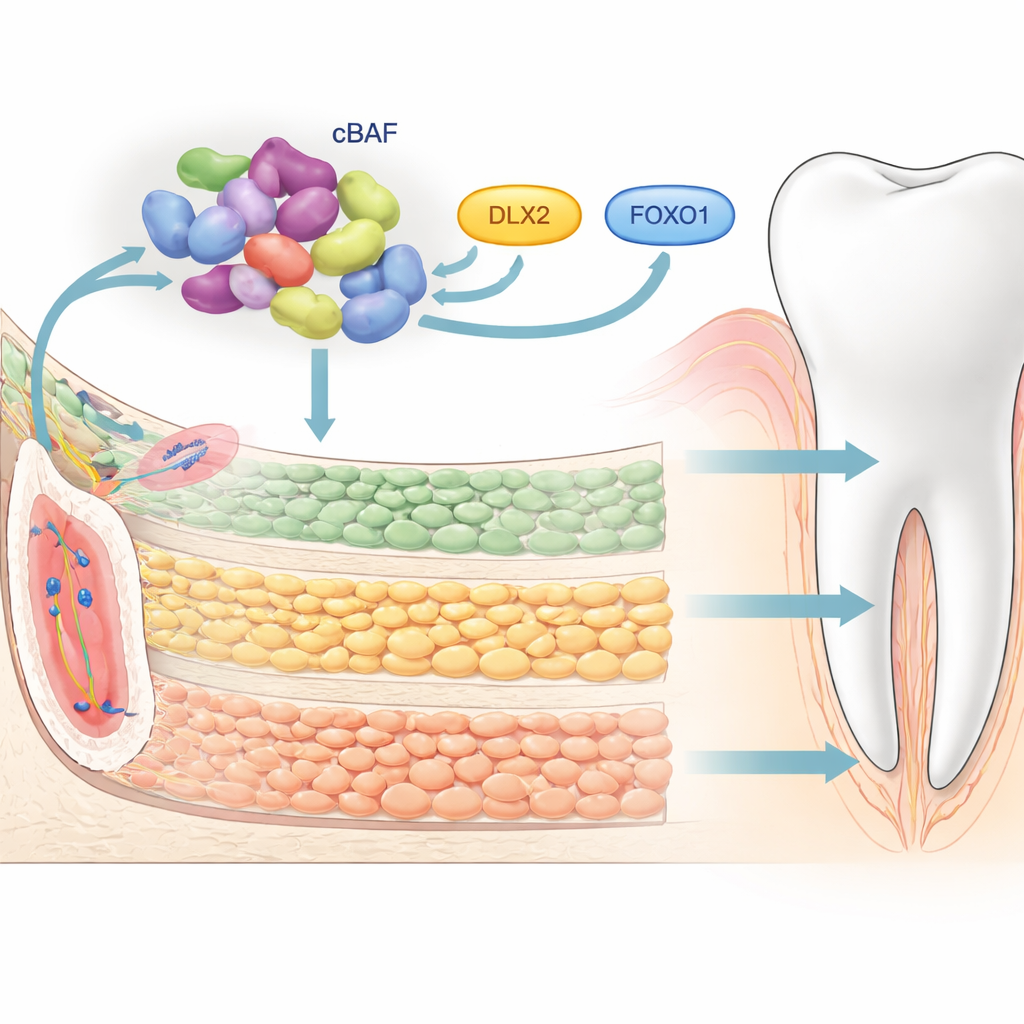
Inside each cell, DNA is wrapped around proteins and folded into structures that can hide or reveal genes, much like files stored deep in a computer. The canonical BAF (cBAF) complex is a molecular "organizer" that slides and reshapes this packaging so certain genes become easier or harder to read. Mutations in its parts are common in human cancers and in conditions such as Coffin-Siris syndrome and some forms of autism, underscoring its importance. Yet scientists have not fully understood how this complex, which exists in many tissues, manages to act in highly specific ways in different cell types, especially in adult stem cells.
Why a Mouse Tooth Makes a Good Test Case
Mouse incisors grow continuously throughout life, powered by mesenchymal stem cells that generate rapidly dividing transit-amplifying cells and then fully differentiated tooth cells. These stem cells live in a carefully organized neighborhood, or niche, that includes supportive niche cells, blood vessels, and nerves. Earlier work showed that two interchangeable cBAF components, ARID1A and ARID1B, are active in different zones of this system, hinting that the full cBAF complex might be crucial for keeping this miniature ecosystem in balance. The authors set out to see what happens when they remove both components at once, effectively disabling cBAF in this stem cell lineage.
What Happens When the Organizer Fails
When the researchers knocked out both ARID1A and ARID1B specifically in incisor mesenchymal stem cells, tooth growth slowed dramatically and the teeth could not properly repair after injury. Microscopic examination revealed disorganized layers of tooth-forming cells and thinner dentin and enamel. Single-cell RNA and chromatin accessibility analyses showed that the normal progression from stem cell to progenitor to mature tooth cell was derailed: transit-amplifying cells initially over-accumulated, then many underwent cell death, and differentiated cell types were depleted. At the DNA level, regions that normally act as control switches—especially enhancers far from gene start sites—lost or gained accessibility in a cell-type-specific way, confirming that cBAF is a key regulator of the gene "switchboard" in this tissue.
Special Partners Shape Stem Cell Neighborhoods
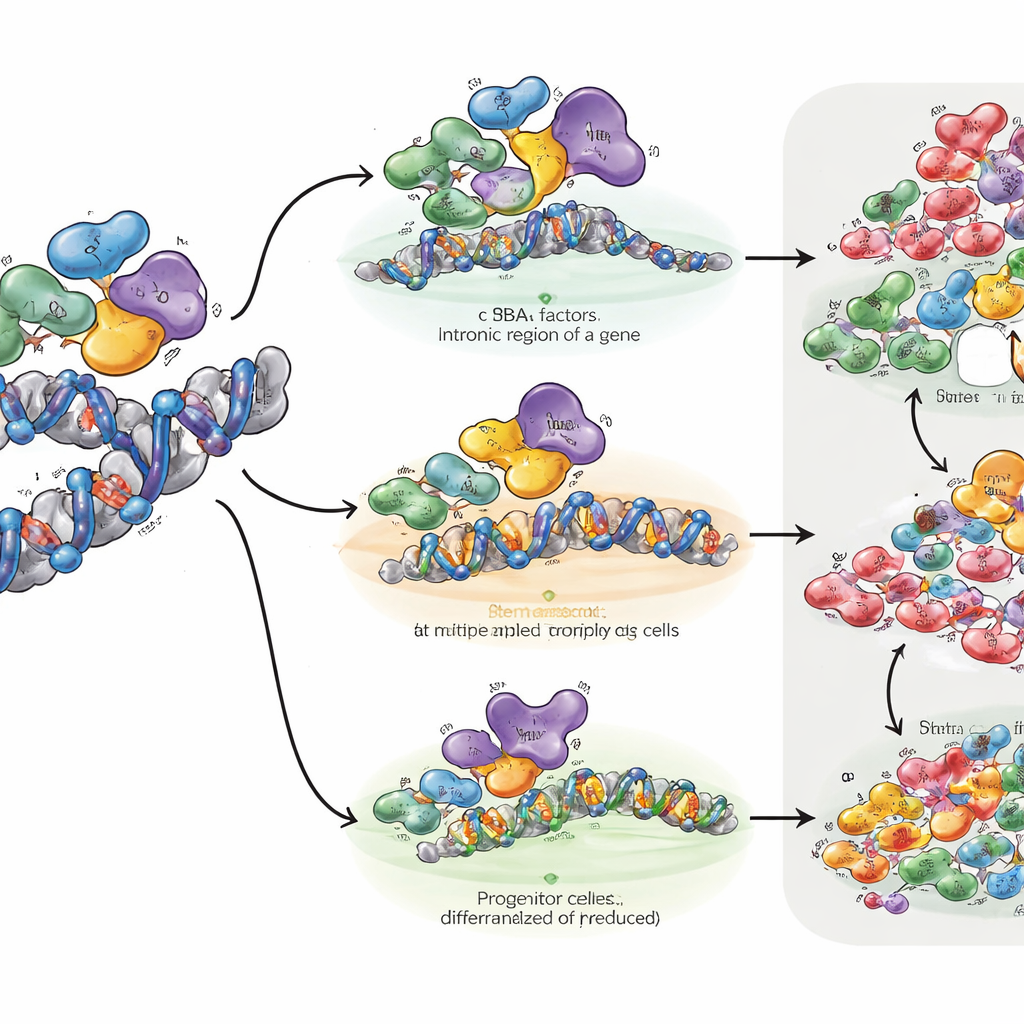
To understand how cBAF knows which switches to flip in which cells, the team searched for transcription factors—DNA-binding proteins—that could act as co-pilots. They found that two such factors, DLX2 and FOXO1, physically interact with cBAF components and occupy many of the same DNA sites. In niche cells and nearby stem cells, cBAF teams up with DLX2 to bind an internal regulatory region of the Runx2 gene, a marker that helps define niche identity. This partnership suppresses excess Runx2 activity and keeps the niche population in check. When cBAF is lost, this control is lifted: the Runx2 region becomes more accessible, Runx2 is overexpressed, and niche-like cells expand at the expense of properly behaving stem cells and progenitors. Knocking down Runx2 in the knockout mice partially restored the normal organization of stem and progenitor cells, confirming that this pathway is a key lever in niche maintenance.
Balancing Growth and Maturation in Progenitor Cells
The story is different, but connected, in the rapidly dividing transit-amplifying cells. Here, cBAF works mainly with FOXO1 at gene promoters—the launch pads where transcription starts—for several master regulators including Stat3 and Trp53 (the mouse version of the well-known p53). Under normal conditions, cBAF–FOXO1 keeps these genes under tight control, preventing runaway proliferation or premature stress responses. Without cBAF, the promoters of these genes become more open and active, leading to elevated STAT3, TRP53, and other factors that disrupt the delicate balance between cell division, differentiation, and death. Reducing Trp53 levels in the knockout background partly rescued progenitor proliferation, differentiation into odontoblasts, and reduced excessive cell death, emphasizing that these transcription factors act downstream of cBAF to shape cell fate.
What This Means for Health and Disease
Together, these findings show that the cBAF chromatin remodeling complex acts as a central hub that integrates context—through different co-factors like DLX2 in niche cells and FOXO1 in progenitors—to sculpt the DNA landscape in a cell-type-specific way. In the mouse incisor, this hub keeps stem cell neighborhoods properly composed and ensures that progenitor cells divide, mature, or die at the right times, enabling continuous growth and repair. Because similar complexes and co-factor networks operate in many tissues, and because cBAF mutations are common in cancer and developmental disorders, this cofactor-guided framework offers a roadmap for understanding how epigenetic misregulation can derail stem cell behavior—and points to new, more precise targets for therapies that aim to restore healthy tissue regeneration or curb tumor growth.
Citation: Zhang, M., Feng, J., Guo, T. et al. Canonical BAF chromatin remodeling complex specifies stem cell fate via cell-type-specific co-factor recruitment. Nat Commun 17, 3361 (2026). https://doi.org/10.1038/s41467-026-70038-6
Keywords: chromatin remodeling, stem cell niche, mesenchymal stem cells, transcription factors, tissue regeneration