Clear Sky Science · en
Lossy phononic metamaterials for valley nonreciprocity
Guiding Sound with Carefully Tamed Loss
Engineers usually struggle to avoid energy loss in devices that guide light, sound, or electrons. This study turns that idea on its head. The authors show that, by deliberately adding and shaping loss in a special sound-guiding structure, they can make sound waves travel in one direction, cling to specific edges, and follow selected paths at junctions. These tricks could inspire a new generation of signal routers and filters for acoustics and other wave-based technologies.
A Playground for Valley Degrees of Freedom
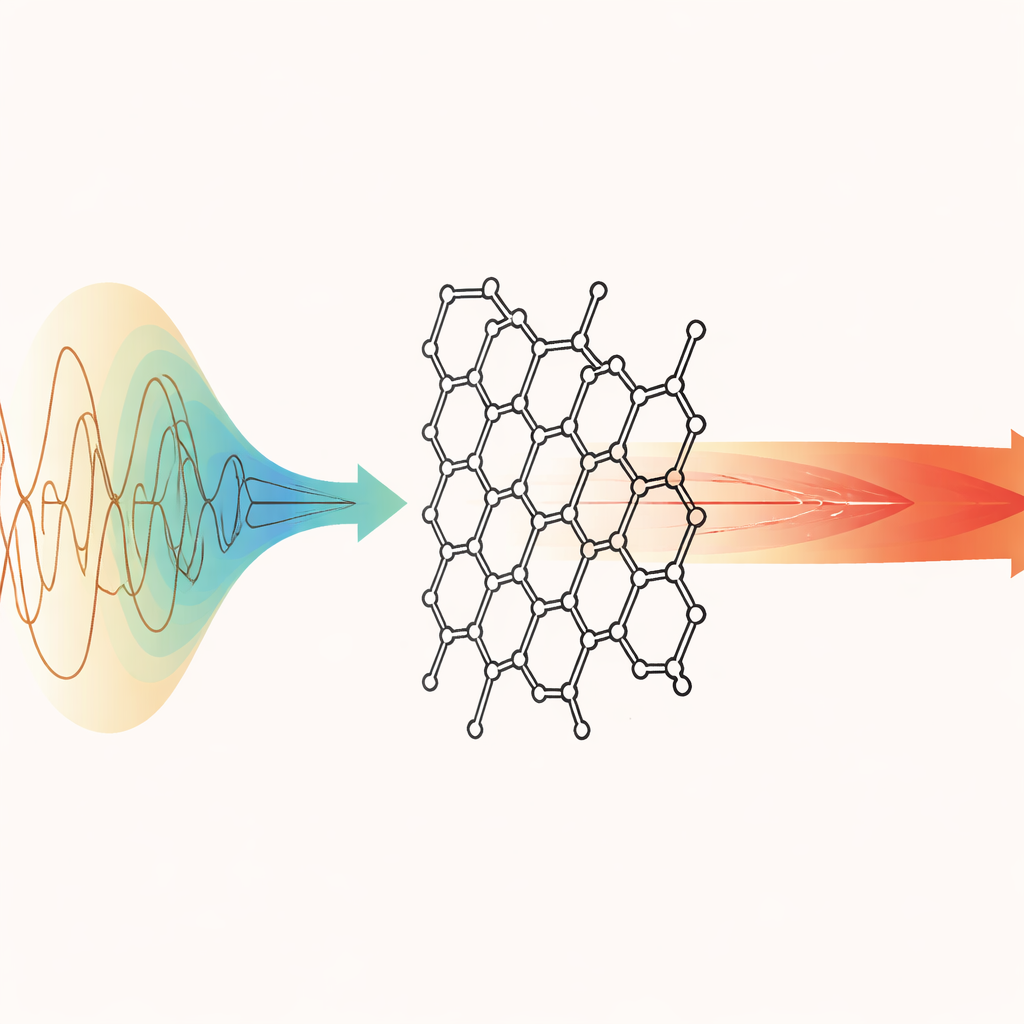
The work builds on the concept of “valleys,” a way of labeling waves by which of two mirror-related points in their energy landscape they occupy. Valleys have already been used to route light and electrons much like different lanes on a highway. Here, the team explores valleys for sound waves in a patterned solid—known as a phononic metamaterial—built from air-filled cavities linked by narrow tubes in a honeycomb arrangement. Instead of adding electronic amplifiers or other active elements, they introduce only simple, passive loss by drilling small holes in some of the tubes and plugging them with sound-absorbing sponges.
Turning Loss into One-Way Sound Traffic
In this tailored honeycomb, sound waves organized around each valley experience different lifetimes depending on which way they move. Within one valley, left-moving sound survives longer than right-moving sound; in the other valley, the preference is reversed. Over time, this imbalance wipes out the disfavored waves, leaving only those that travel in the preferred direction. The researchers exploit this effect to build a valley filter: a sandwich structure in which a lossless region is placed between two lossy regions. When they inject a mix of valley types on one side, only waves associated with one valley emerge clearly at the far side, proving that the device passes sound in a selective, one-way fashion.
Sound Piled Up at Opposite Edges
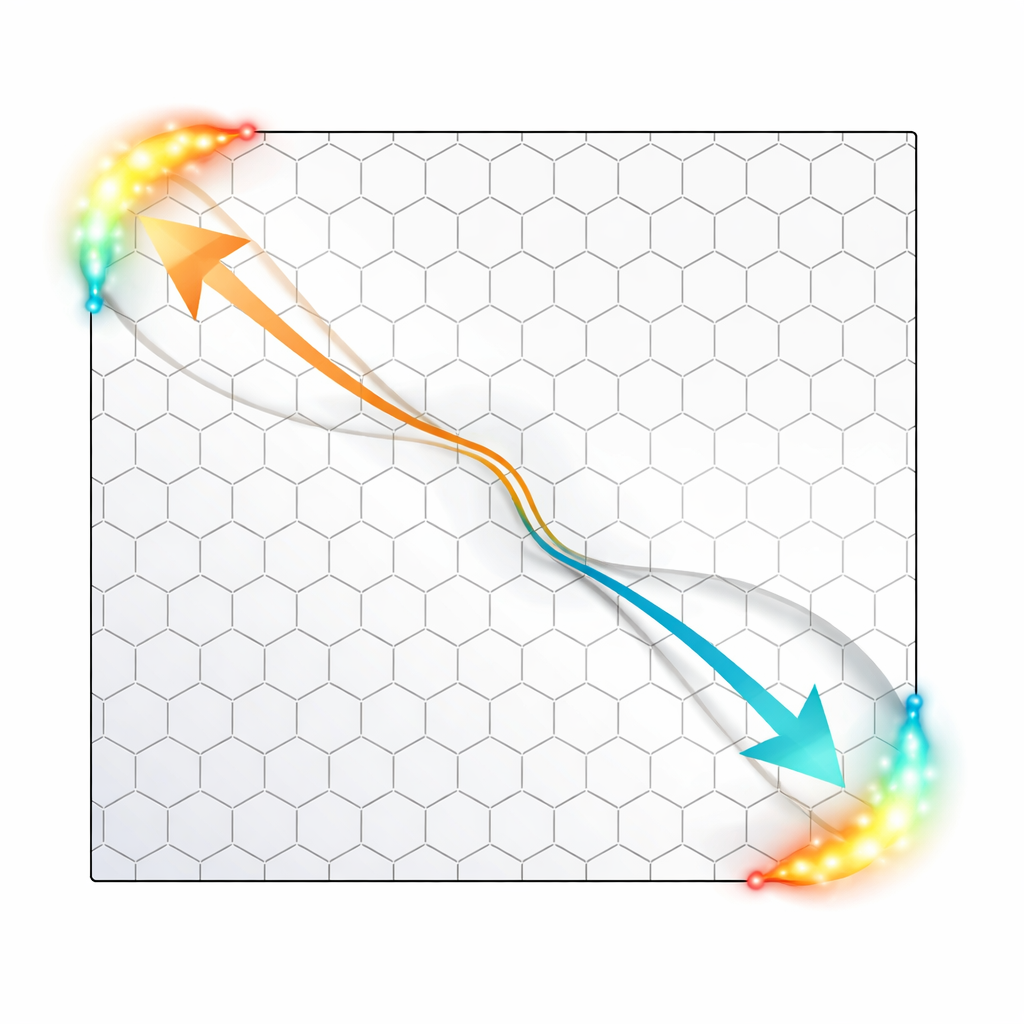
The same use of loss reshapes how sound spreads through the sample. Instead of filling the interior evenly, many wave patterns become “skin modes,” bunching up along the outer boundaries. Remarkably, the preferred edge depends on the valley: waves near one valley accumulate along the upper-left side of the sample, while those near the other valley gather at the lower-right side. Measurements of the pressure field in a finite sample confirm this valley-dependent skin effect. By placing sound sources near different boundaries and analyzing how the wave patterns break into valley components, the team shows that each edge is associated with a particular valley channel.
Asymmetric Highways Along Interfaces
The authors then design boundaries inside the metamaterial where two regions with opposite valley properties meet. Along these internal interfaces, special edge waves appear that are confined to the boundary and linked to a specific valley. Even though both sides of the interface are built from passive materials, loss in the overall structure makes edge waves on one type of interface live much longer than those on the opposite type. Experiments on straight interfaces show that the long-lived edge waves travel readily in both directions, while their short-lived counterparts barely propagate at all. At a four-way junction shaped like an arrow, this contrast produces “anomalous beam routing”: edge waves entering from one port overwhelmingly exit through a single chosen port, with almost no signal detected at the other outlets.
New Tools for Steering Waves with Simplicity
To a non-specialist, the main message is that loss—normally a nuisance—can be turned into a design tool. By putting small absorbers in the right places, the researchers control which sound waves survive, which edges they hug, and which paths they take at intersections, all without complex electronics or moving parts. This strategy links two once-separate ideas: valley-based control of waves and non-Hermitian effects that rely on gain and loss. The resulting devices suggest simple, robust ways to sort, route, and protect signals in acoustic systems, and similar concepts may carry over to technologies based on light and electronics.
Citation: Yin, S., Zhou, Q., Xi, Y. et al. Lossy phononic metamaterials for valley nonreciprocity. Nat Commun 17, 3428 (2026). https://doi.org/10.1038/s41467-026-70037-7
Keywords: phononic metamaterials, valleytronics, non-Hermitian physics, acoustic wave control, topological edge states