Clear Sky Science · en
Population genomics reveals association of transposable elements variants with climatic adaptation in wild Amur grape
Why a Wild Grape Matters for Future Wine
Grapevines are more than the source of wine and table grapes; they are also a test case for how our crops will cope with a rapidly changing climate. The wild Amur grape, native to the cold and often harsh regions of East Asia, can shrug off freezing winters and summer droughts that would devastate most cultivated vines. This study explores what makes Amur grape so tough at the genetic level and asks a forward-looking question: can the same genetic tricks help vineyards survive the hotter, drier, and less predictable climates of the coming decades? 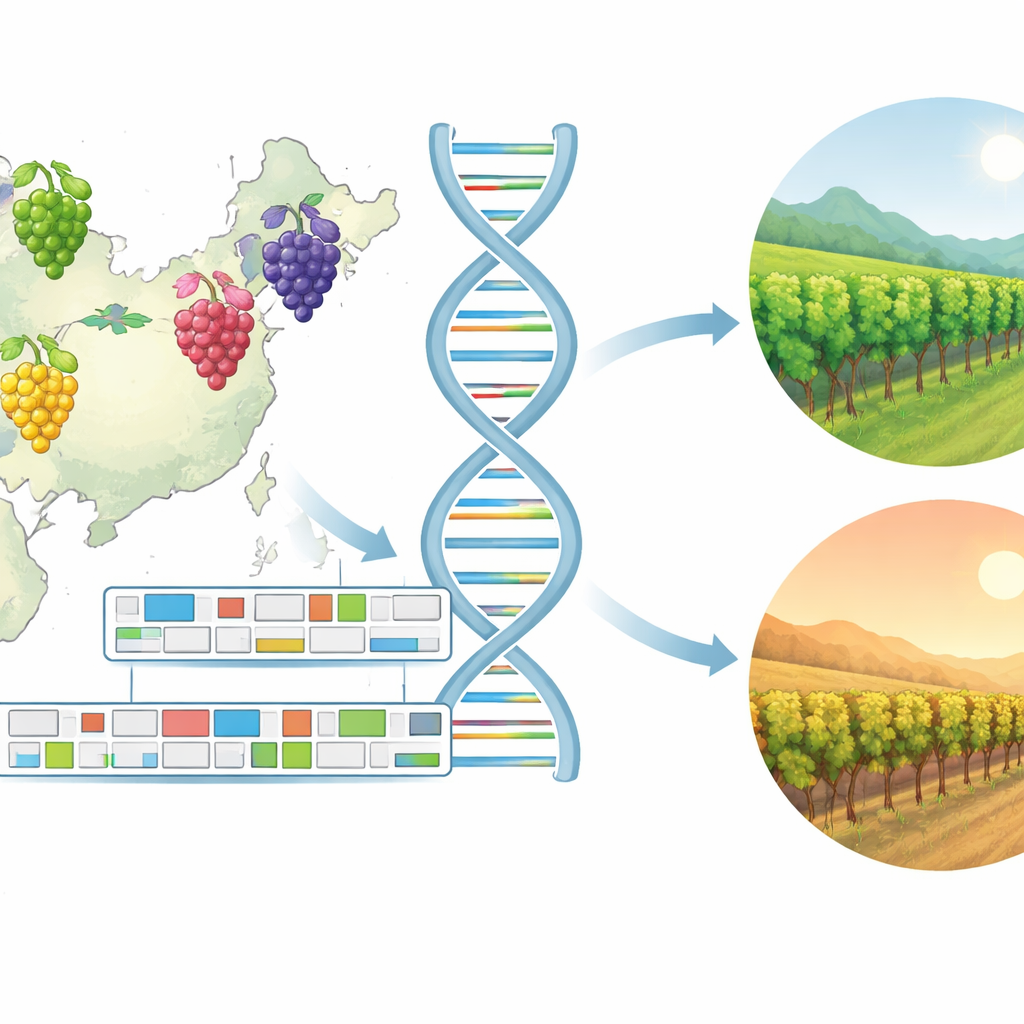
Hidden Passengers in the Grape Genome
Inside every grape cell, the DNA is crowded with “jumping genes,” also known as transposable elements. These are stretches of genetic material that can copy or move themselves around the genome. Long seen as genomic clutter, they are now recognized as powerful agents of change: they can switch nearby genes on or off, change how plants respond to stress, and help create new traits. The authors focused on structural changes caused by these elements—insertions and rearrangements known as transposable-element variants—to see how they might shape the Amur grape’s ability to live in very different climates across its range.
Building a Panoramic View of Grape DNA
To capture the full genetic diversity of the species, the researchers first built a “pangenome” for Amur grape—a combined reference that stitches together eight complete chromosome sets from four plants collected across China. This graph-based reference lets them see complex variations that a single standard genome would miss, especially big insertions and deletions created by mobile elements. They then resequenced the genomes of 330 wild vines from 31 natural populations, spanning cold northeastern forests, central regions, and milder southern habitats. The result was an extremely detailed catalog: over 48 million small DNA changes and more than 127,000 structural changes tied to transposable elements.
Climate Signals Written in DNA
Next, the authors asked whether any of these DNA differences track with local climate—temperature swings, seasonal rainfall, or elevation. Using statistical models that link genetic variants to environmental conditions, they found more than 22,000 candidate “adaptive” variants, including about 1,100 involving transposable elements, near 823 genes. Many of these genes are already known in other plants for roles in coping with cold, drought, and heat. For example, one mobile element insertion landed just upstream of a stress-related gene called TLP3, in a region likely to control how strongly the gene is turned on. This particular insertion is common in populations that experience more extreme swings in rainfall and rarer where conditions are more stable, suggesting it may help plants handle erratic moisture. Similar patterns emerged for cold-response genes in regions with strong seasonal temperature shifts. 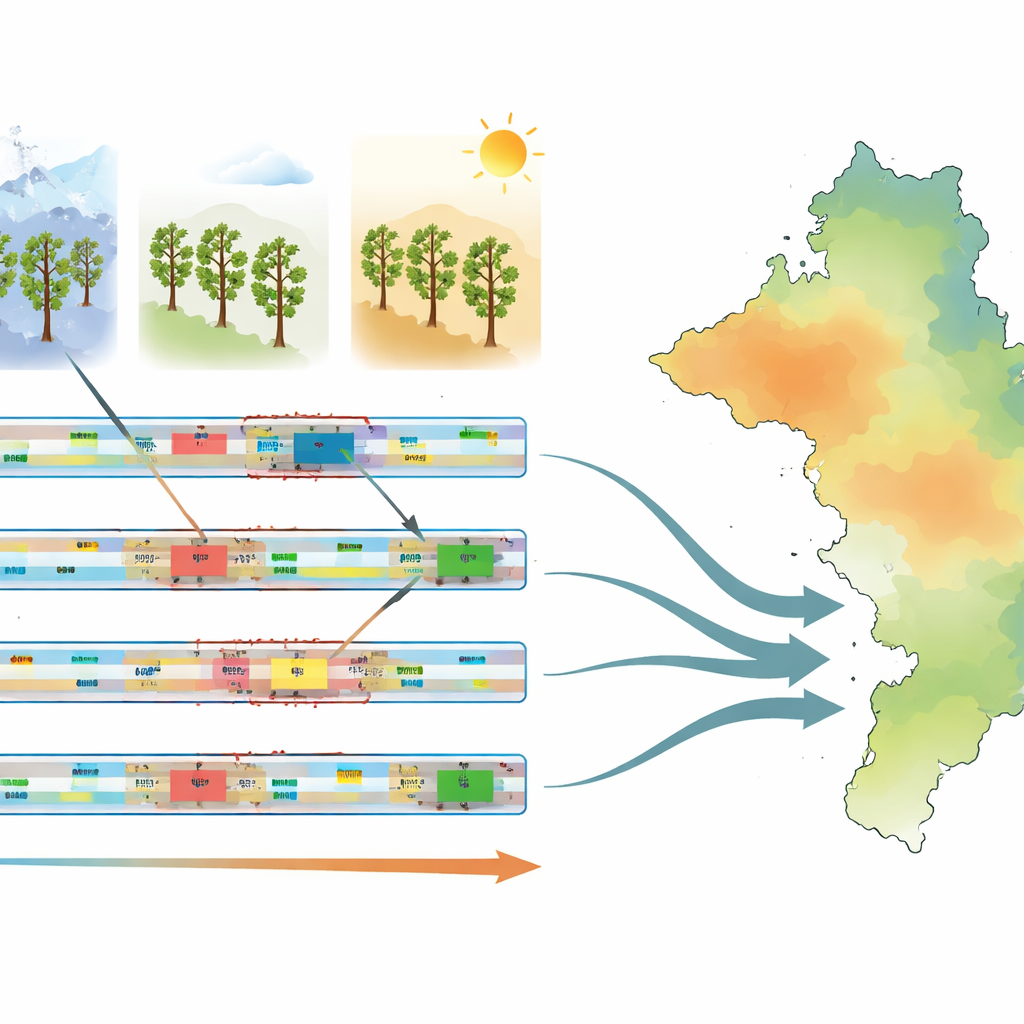
Testing Tomorrow’s Climate on Today’s Grapes
Finding climate-linked variants is one thing; asking how well they will serve under future conditions is another. To tackle this, the team trained machine-learning models to predict how the frequencies of adaptive variants would need to change for populations to remain well matched to their environment under mid- and late-century climate scenarios. They used this to compute a “genetic offset” for each population—a measure of how far its current genetic makeup is from what future climates will likely demand. When they built models using only conventional small DNA changes, many populations, especially in the northeastern part of the range, showed high offsets, meaning they would need substantial genetic shifts to keep up. But when the researchers added the adaptive transposable-element variants into the models, the predicted offsets dropped by roughly 7–8 percent across scenarios, indicating that these large genetic changes provide extra adaptive leeway.
What This Means for Grapes and Beyond
For non-specialists, the take-home message is that “jumping genes” are not just genomic junk; they can act as built-in innovation engines that help wild plants cope with harsh and shifting environments. In Amur grape, these elements cluster nearby ordinary mutations and appear to fine-tune genes involved in enduring cold, drought, and other stresses. By easing the genetic adjustment needed under future climates, they may make some wild populations more resilient than they would otherwise be. For breeders and conservationists, this work highlights wild relatives like Amur grape as vital reservoirs of climate-ready traits and shows that looking beyond simple DNA letters to include structural changes will be important for designing future-proof crops and for deciding which wild populations most urgently need protection or assisted migration.
Citation: Ma, Z., Xu, X., Peng, W. et al. Population genomics reveals association of transposable elements variants with climatic adaptation in wild Amur grape. Nat Commun 17, 3213 (2026). https://doi.org/10.1038/s41467-026-70026-w
Keywords: Amur grape, climate adaptation, transposable elements, pangenome, crop resilience