Clear Sky Science · en
A testis-specific E3 ubiquitin ligase complex governs spermiogenesis and male fertility
Why this study matters for men's health
Many couples struggle with infertility, and in a large share of cases, the problem lies with sperm that are too few, move poorly, or have misshapen heads. Yet in most men, doctors cannot pinpoint a clear cause. This study uncovers a previously unknown quality-control system in the testis that helps young sperm cells sculpt their heads properly and remain mobile. By connecting this system to specific gene changes found in infertile men, the work opens new paths for diagnosis, counseling, and possibly future treatments.
A cellular recycling system with a special job
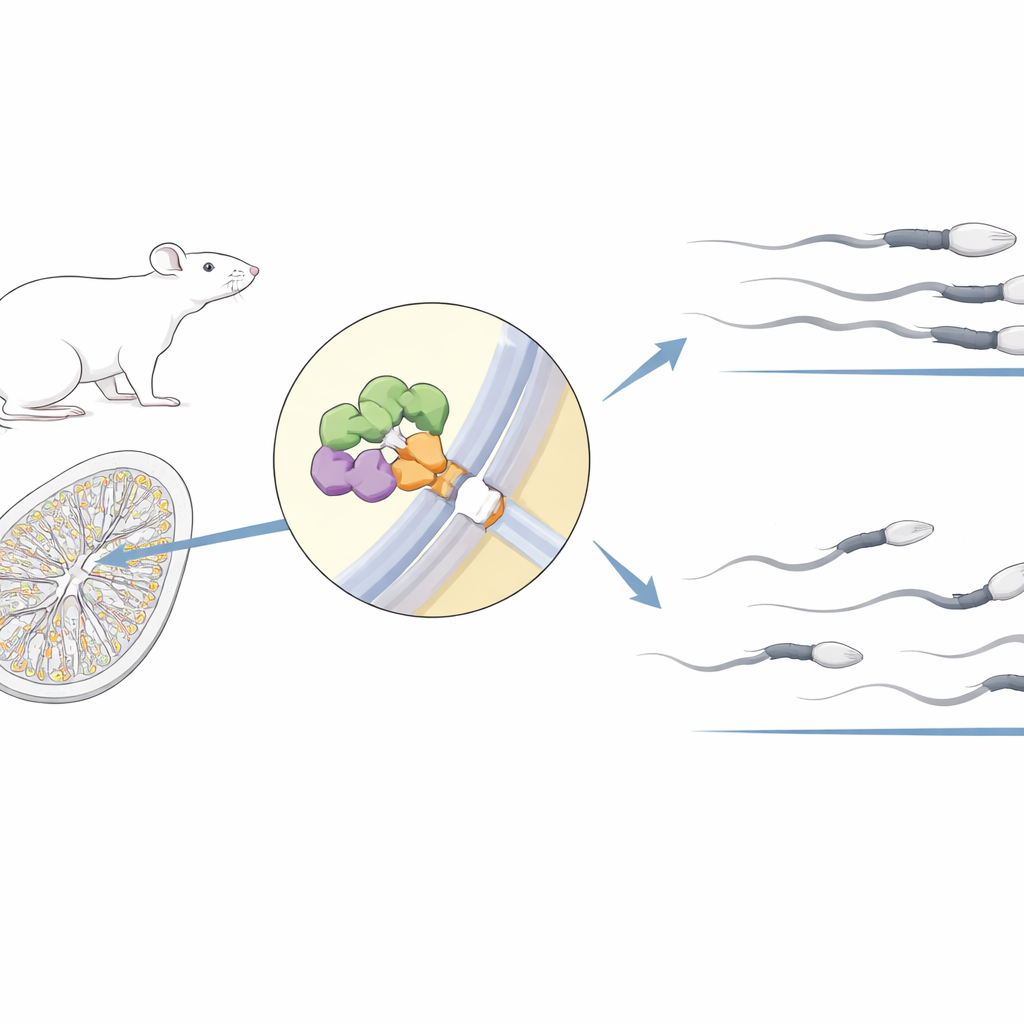
Inside every cell, damaged or no-longer-needed proteins are tagged and shredded by a machinery known as the ubiquitin–proteasome system. A central question in biology is how this general recycling system is tuned to do very specific jobs in different organs. The authors zoomed in on the testis, where developing sperm must rapidly remodel their shape and internal scaffolding. Using protein-mapping experiments across 11 mouse tissues, they discovered that a particular group of proteins comes together only in the testis to form a specialized disposal unit, which they call the ECSASB9 complex. This complex sits on a transient microtubule structure, the manchette, that wraps around the sperm head during its reshaping.
How a testis-only complex sculpts the sperm head
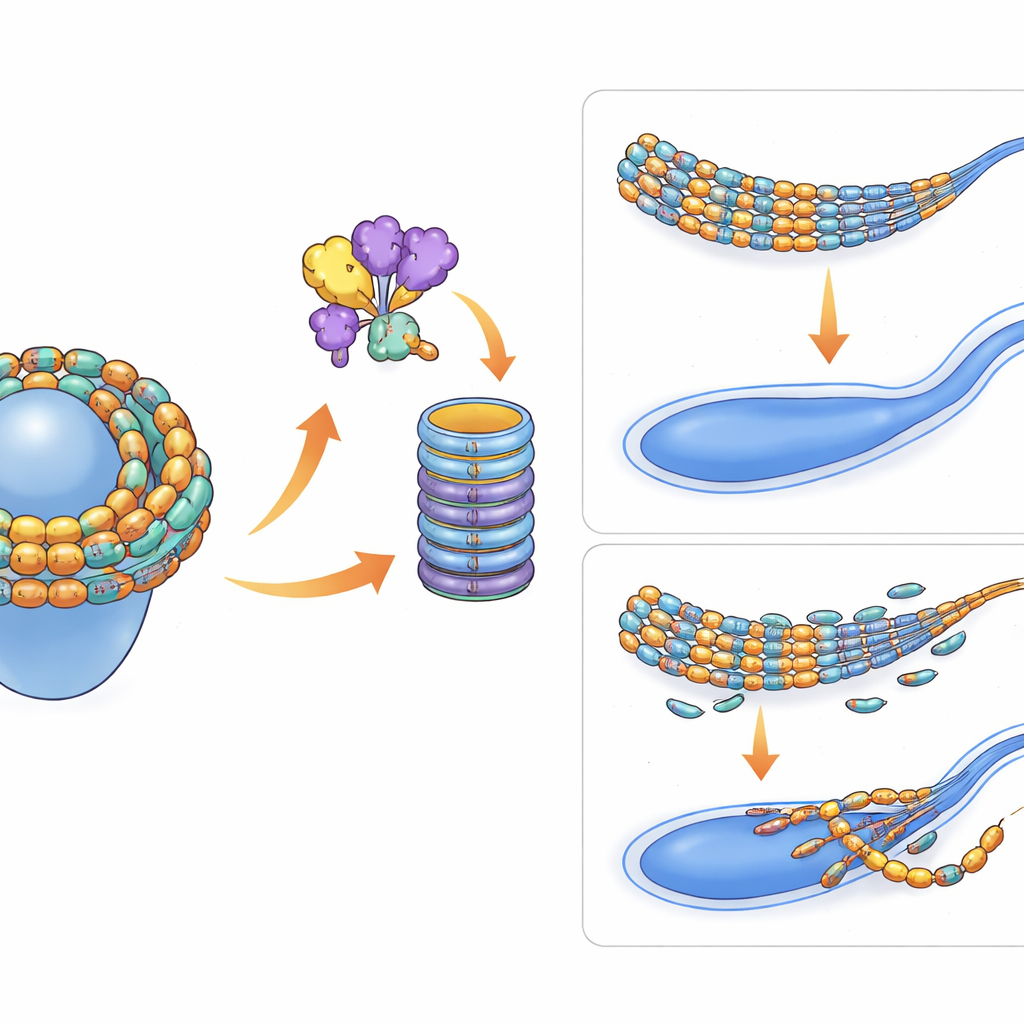
By selectively disabling parts of this complex in mice, the researchers showed that it is crucial for the final stages of sperm formation, known as spermiogenesis. When they removed the ASB9 component throughout the body, or knocked out its adaptor partners only in late-stage sperm, males produced fewer sperm with poor movement and, most strikingly, many with misshapen heads and abnormal caps (acrosomes). Detailed imaging revealed that early steps of head formation were intact, but as development progressed the manchette became thin, overextended, and disorganized. As a result, sperm heads failed to acquire their streamlined form, and many defective cells were lost before ejaculation. Despite these deformities, other organs that express ASB9, such as kidney, brain, and lung, appeared normal, underscoring the testis-specific importance of this complex.
The key target: a microtubule building block
To identify what the complex actually destroys, the team pulled down ASB9 and its partners from mouse testes and analyzed the attached proteins. Among nearly 100 candidates, one stood out: TUBB4A, a beta-tubulin that helps build microtubules. Biochemical tests confirmed that the ECSASB9 complex physically binds TUBB4A and attaches a chain of ubiquitin molecules of a type that marks proteins for destruction. The complex focuses this tag on a single amino acid, lysine 379, of TUBB4A. When ASB9 was missing, TUBB4A itself did not rise at the RNA level, but its protein accumulated and carried fewer ubiquitin chains, implying that it was no longer being cleared. Mice engineered so that TUBB4A could not be modified at this one site developed sperm defects and reduced fertility very similar to those seen when ASB9 was absent, firmly linking controlled breakdown of TUBB4A to proper manchette behavior and head shaping.
From mutant mice to infertile men
The researchers then asked whether this same pathway might explain some cases of human male infertility. In a group of 1,483 men with low sperm counts and poor motility, they found four individuals carrying rare changes in the X-linked ASB9 gene. All had severely abnormal sperm heads and impaired movement. Laboratory experiments showed that one change (G92E) made the ASB9 protein unstable and prone to self-destruction, while two others (I160T and A181V) weakened its grip on TUBB4A, blunting its ability to tag the tubulin for disposal. Mice engineered with the G92E-like mutation mirrored the human condition: they had low levels of ASB9, excess TUBB4A, deformed sperm heads, reduced motility, and subfertility. Yet when sperm from affected men or mutant mice were directly injected into eggs using intracytoplasmic sperm injection (ICSI), fertilization and early embryo development were largely normal, indicating that the main barrier is getting healthy sperm to the egg, not the genetic quality of the sperm itself.
What this means for understanding and treating infertility
This work reveals that a testis-specific protein disposal complex acts as a fine sculptor of the sperm head by pruning excess microtubule building blocks at just the right moment. When any part of this system fails—through loss of ASB9, disruption of its partners, or blocking of the critical site on TUBB4A—the manchette cannot remodel correctly, leading to the classic combination of too few, poorly moving, and misshapen sperm. Clinically, the discovery that rare ASB9 variants account for a small but real fraction of otherwise unexplained male infertility suggests that genetic testing for this gene could aid diagnosis and counseling, especially given its X-linked inheritance. More broadly, the study offers a clear example of how a universal cellular recycling system can be rewired in a single organ to support a highly specialized task: the making of fertile sperm.
Citation: Wu, T., Tu, C., Feng, Y. et al. A testis-specific E3 ubiquitin ligase complex governs spermiogenesis and male fertility. Nat Commun 17, 3100 (2026). https://doi.org/10.1038/s41467-026-70025-x
Keywords: male infertility, sperm development, protein degradation, microtubules, genetic variants