Clear Sky Science · en
Revealing intrinsic 3D spin angular momentum of evanescent acoustic phonons on a single-crystal surface using ultrafast optoacoustics
Spinning Waves You Can’t See
Sound is usually described as simple back‑and‑forth motion, but at very small scales it can behave in surprisingly rich ways. This paper explores how special sound waves that cling to the surface of a crystal carry a hidden kind of “spin” in three dimensions. Understanding and controlling this spin in solid materials could help future technologies that store, route, and process information using vibrations instead of, or alongside, light and electronics.
Why Sound Waves Can Have Spin
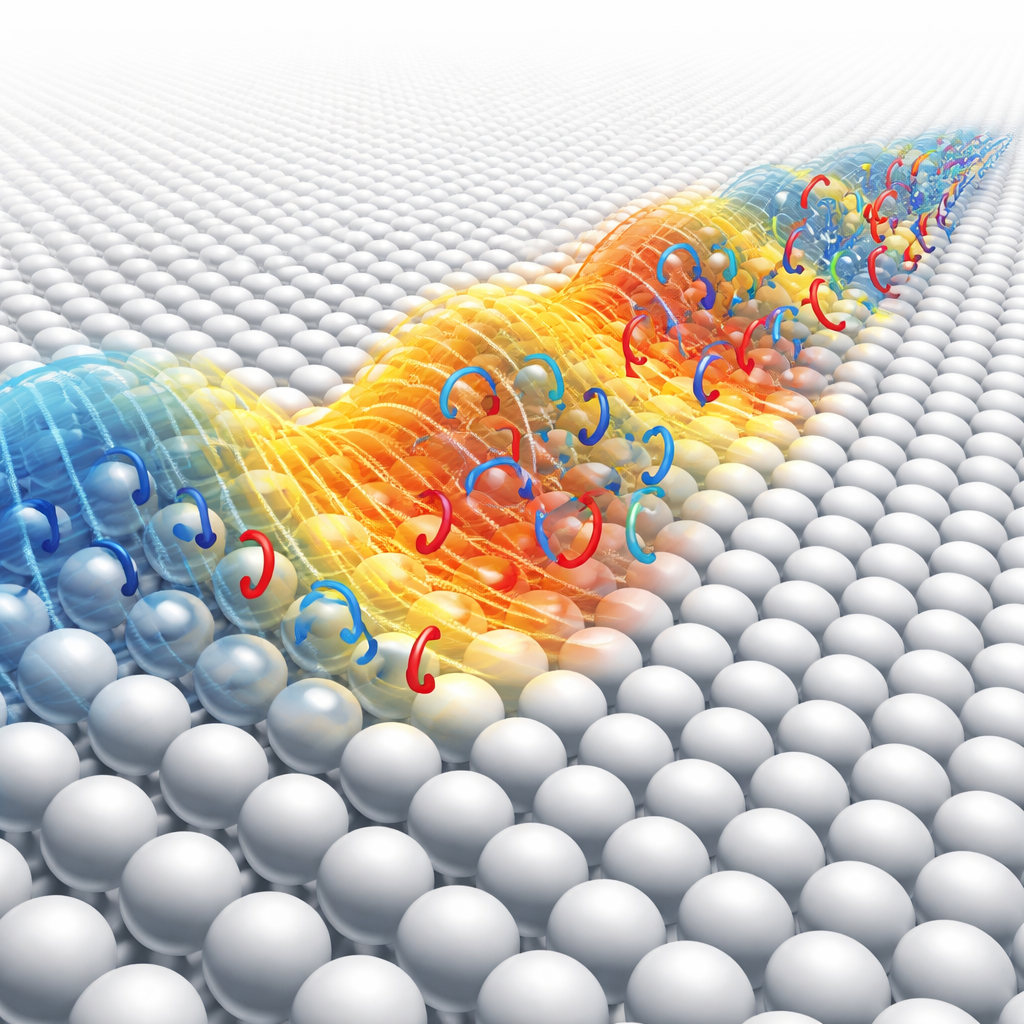
In physics, “spin” is a built‑in twisting property found in particles of light and matter. For light, spin underpins many modern optical tricks, from advanced microscopes to quantum communication. Recently, researchers have realized that vibrations in solids—tiny coordinated motions of atoms known as phonons—can also carry spin. These spins can point in different directions and can lock to how the wave travels, connecting the direction of motion and the sense of rotation. Until now, most work has focused on simple, uniform materials that behave the same in every direction. Real crystals, however, are not so simple: their atoms are arranged in repeating patterns that give different physical responses along different directions.
Waves Trapped on a Crystal Skin
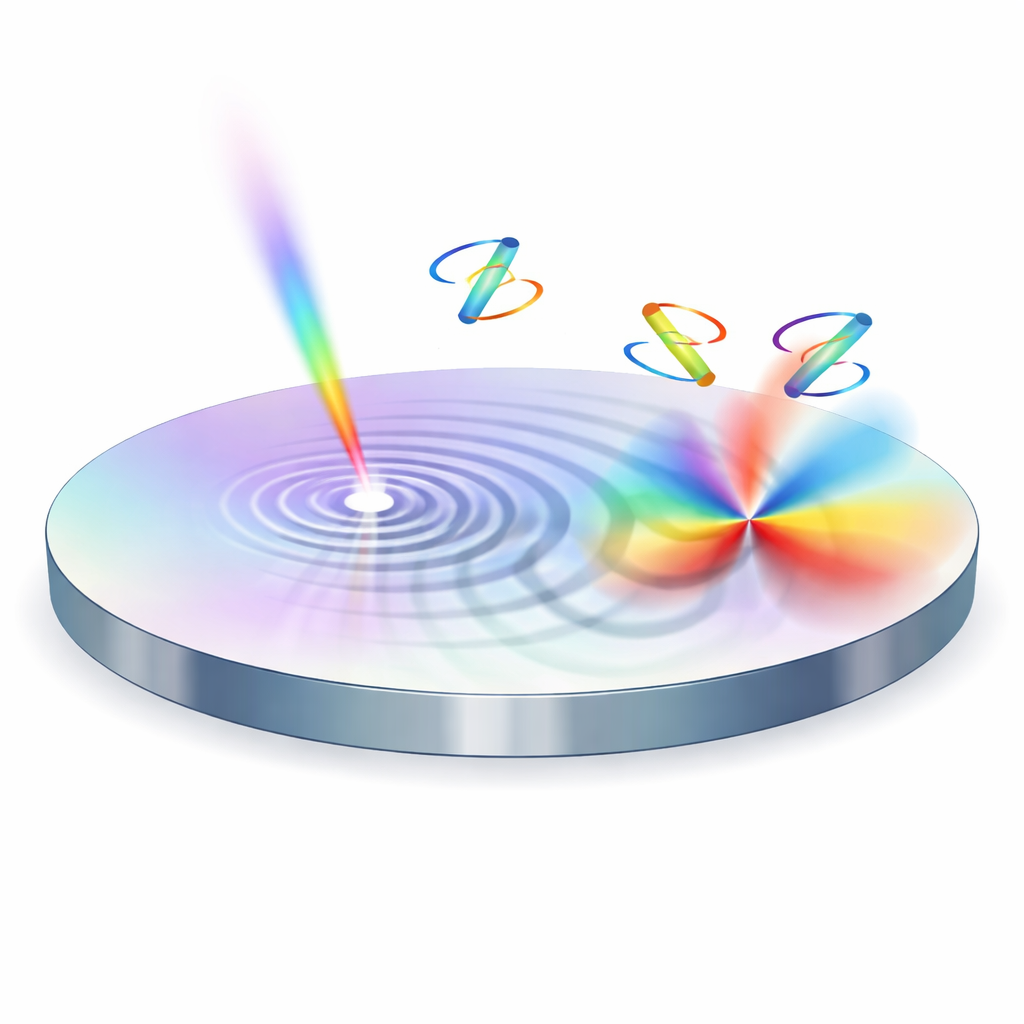
This study looks at evanescent acoustic phonons—surface‑hugging sound waves whose strength fades quickly with depth into the material. The authors focus on a silicon crystal cut along a common orientation called the (111) surface. Using a detailed model of how atoms in this lattice tug on each other, they calculate the natural vibration patterns—called eigenstates—of surface acoustic waves on this cut. Unlike sound waves in a perfectly uniform medium, these surface waves can carry an intrinsic spin that does not average to zero even in a single basic vibration pattern. When the waves travel along certain mirror‑symmetric directions in the crystal, the spin points mainly sideways, perpendicular to the direction of travel and the surface normal. Along other, less symmetric directions, the spin develops nonzero components along all three axes, forming a fully three‑dimensional texture.
Watching Atomic Motion with Ultrafast Light
Directly watching atoms move with such subtle spinning motion is extremely challenging. The researchers tackle this with an all‑optical setup built around a femtosecond laser and a Sagnac interferometer. Very short light pulses, focused to a micrometer‑sized spot, briefly heat and strain the chromium‑coated silicon surface, launching surface acoustic wave packets at gigahertz frequencies. A second, time‑delayed light pulse returns information about how the surface moves up and down with exquisite sensitivity, capturing the out‑of‑plane atomic velocity over a two‑dimensional area and over billions of frames per second. To get the full three‑dimensional motion, they combine these measurements with computer simulations of the in‑plane motion using finite‑element methods and lattice‑dynamics theory.
Reconstructing Hidden Spin Patterns
From the three‑component velocity and displacement fields, the team computes the local spin carried by the waves at each point on the surface. The resulting maps reveal a striking three‑lobed pattern that reflects the threefold rotational symmetry of the silicon (111) surface. The spin vectors swirl around the excitation point, with strong tangential components circling the source and weaker radial and out‑of‑plane parts. When all directions are considered together, the total spin of the wave packet cancels, as required by angular‑momentum conservation, but locally the spin can be strong and highly structured. By filtering around a single dominant frequency, the authors further show how these spin patterns sharpen along specific crystal directions, hinting at ways to steer or enhance particular spin states simply by choosing where and how the waves propagate.
What This Means for Future Devices
Overall, the work demonstrates that surface‑bound sound waves on a real crystal do not just vibrate—they carry a rich three‑dimensional spin that is tightly linked to the atomic lattice. This intrinsic spin arises from the way the waves are confined near the surface and from the directional character of the crystal itself. Because many emerging technologies rely on converting between light, sound, electronic, and magnetic signals, the full three‑dimensional spin of these surface waves becomes an extra “handle” for selecting which conversions are allowed or efficient. In practical terms, this could help engineers design more capable sensors, data‑storage elements, and hybrid devices where photons and phonons exchange information in a controlled, spin‑selective way.
Citation: He, Y., Luo, G., Sohn, H. et al. Revealing intrinsic 3D spin angular momentum of evanescent acoustic phonons on a single-crystal surface using ultrafast optoacoustics. Nat Commun 17, 3520 (2026). https://doi.org/10.1038/s41467-026-70019-9
Keywords: phonon spin, surface acoustic waves, silicon crystals, ultrafast optoacoustics, spin–orbit interactions