Clear Sky Science · en
Inverse problems for dynamic patterns in coupled oscillator networks: when larger networks are simpler
Why complex rhythms can reveal hidden rules
From brain waves to heartbeats and power grids, many natural and engineered systems consist of countless rhythmic elements that influence one another. These elements often fall into intriguing mixed patterns, where some move in lockstep while others behave erratically. This study shows that, by carefully averaging what we observe in such patterns, we can work backwards to uncover the hidden rules that govern the whole system—and that, surprisingly, this becomes easier as the system gets larger.
Networks of many simple clocks
The work focuses on networks of simple “phase oscillators,” mathematical stand-ins for any system that cycles repeatedly: a firing neuron, a flashing chemical reaction, or a spinning mechanical rotor. Each oscillator has its own natural rhythm and interacts with others according to a coupling rule that weakens with distance. When many of these are linked, they can spontaneously form so‑called chimera states: parts of the network beat in unison, while other parts remain disordered. Such mosaics of order and disorder have been spotted in chemical experiments, models of cilia beating in the lungs, inner-ear hair cells, and even analogies to epileptic seizures. Yet in real systems we rarely know the true interaction rules; we only see the resulting patterns.
Turning long-term behavior into simple averages
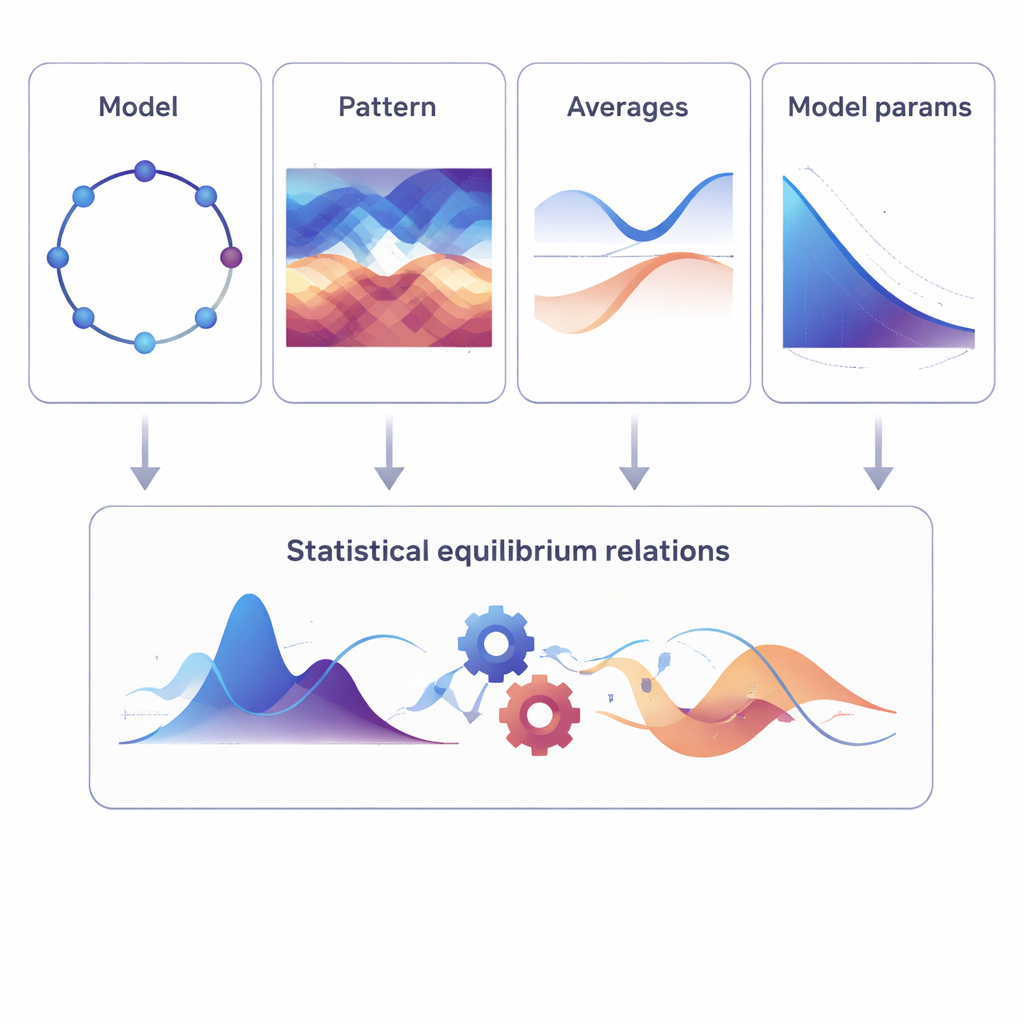
Instead of trying to track every twist and turn of each oscillator, the author uses ideas from statistical physics. In very large networks, the detailed motion of individuals settles into a kind of steady statistical balance: while each oscillator keeps changing, the overall pattern looks stationary when viewed over long times. In this regime, one can describe the system by a probability distribution rather than by every trajectory. From this description, the study derives “statistical equilibrium relations” that tie together simple time‑averaged quantities—like the long‑term average frequency of each oscillator and a measure of how strongly it moves with the crowd—to the underlying parameters of the model, such as the natural frequency, a phase-lag in the interaction, and the shape of the coupling function over distance.
Reading parameters from a single chimera snapshot
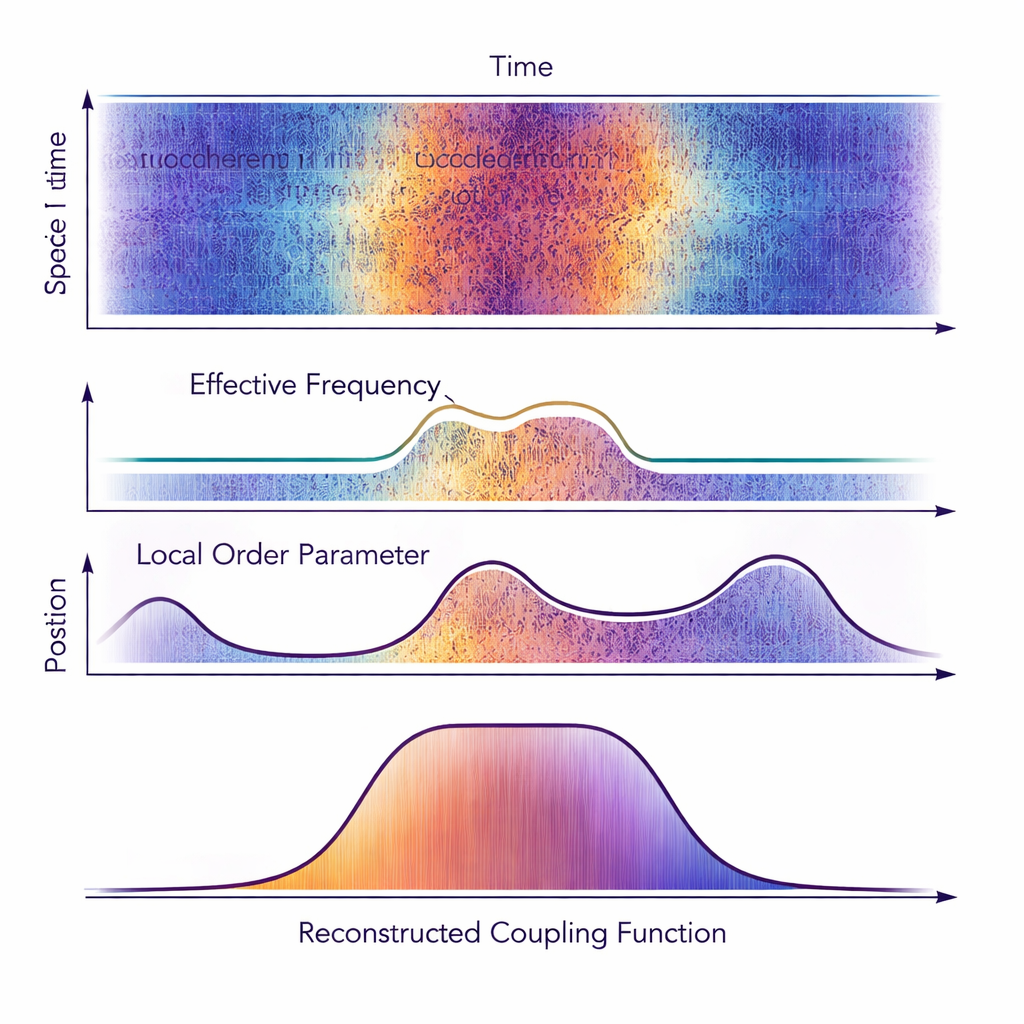
Armed with these relations, the author designs a practical reconstruction algorithm for a classic ring-shaped model that produces chimera states. The algorithm uses just a modest set of measurements from one stationary chimera: the position of each oscillator on the ring, its effective frequency over time, and its local order parameter—a complex number that indicates how synchronized that oscillator is relative to the global rhythm. Using linear fits and a compact representation of the unknown coupling rule as a sum of simple waves, the method extracts the key parameters. Tests on computer-generated data show that, once the network has more than about a thousand oscillators and the averages are taken over sufficiently long times, the inferred parameters closely match the true ones, even when the coupling rules have very different shapes.
Working with partial, noisy, and indirect data
Real-world measurements are rarely perfect, and the method is designed with this in mind. Because it uses time-averaged quantities, it naturally filters out fast, unbiased noise: random jitters in the measured phases have little effect once averaged. The procedure also works when only a subset of oscillators is observed, as long as those observations are spread across the network; the missing data simply reduce accuracy rather than breaking the method. Furthermore, experiments often provide only an indirect “protophase” extracted from signals, not the true mathematical phase. The author shows how to transform these protophases into the needed averages without ever knowing the exact conversion, as long as the observed pattern is statistically steady.
Beyond chimera states and future prospects
Although the paper develops the theory in detail for one specific model of nonlocally coupled oscillators, the broader message is that similar statistical relations exist for many other oscillator networks, including fully connected systems and random networks. These ideas could be extended to more complicated patterns such as traveling or breathing chimeras, to neural network models, and even to power-grid dynamics. For a non-specialist, the key takeaway is that complicated-looking mixed rhythms in large systems actually obey simple statistical rules—and by exploiting those rules, we can use observed patterns to infer the hidden interaction laws that created them.
Citation: Omel’chenko, O.E. Inverse problems for dynamic patterns in coupled oscillator networks: when larger networks are simpler. Nat Commun 17, 2075 (2026). https://doi.org/10.1038/s41467-026-70016-y
Keywords: synchronization, chimera states, oscillator networks, inverse problems, statistical physics