Clear Sky Science · en
Specialized aldo-keto reductases trigger complete degradation of mycotoxin deoxynivalenol
Why a Grain Toxin Matters to Your Dinner Table
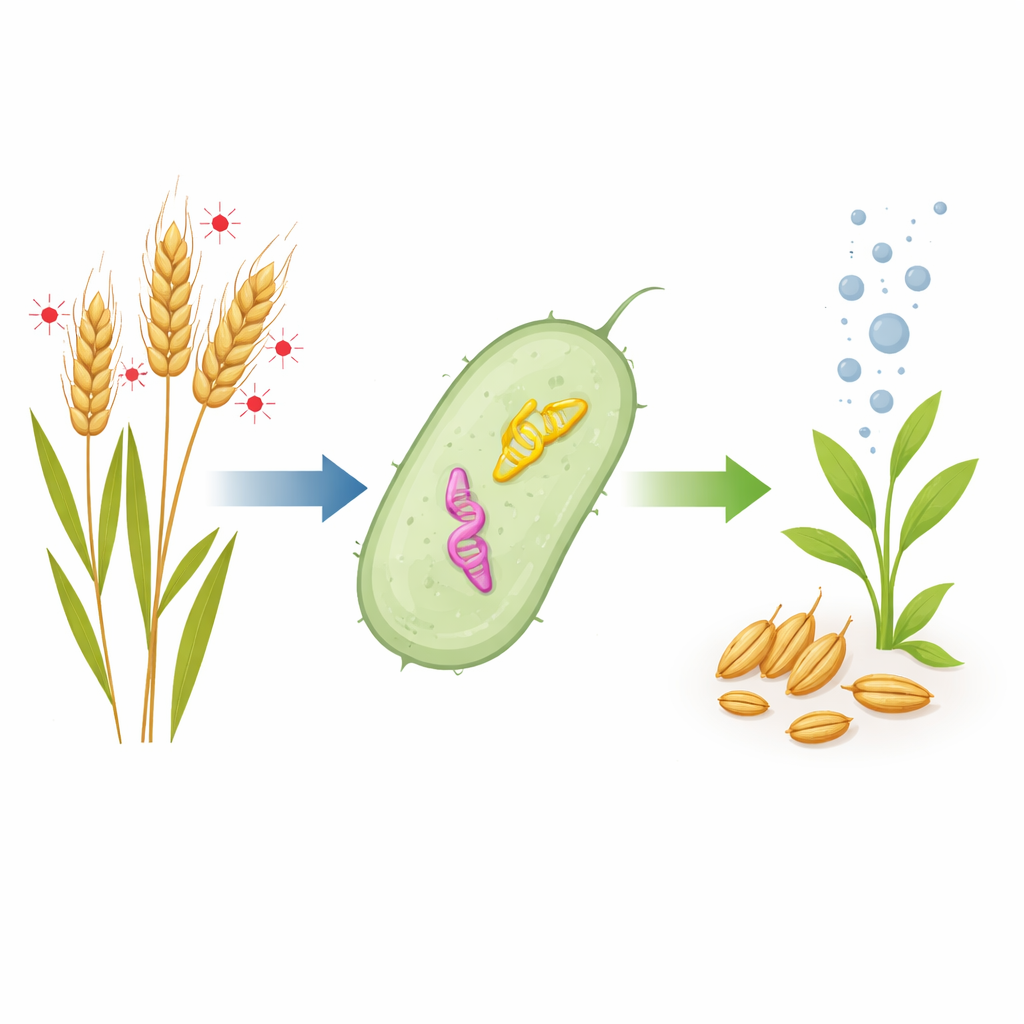
Many breads, pastas, and breakfast cereals start their lives in fields where a stealthy fungal toxin called deoxynivalenol (DON) can lurk. DON survives baking and feed processing, and at high enough levels it can make people and livestock sick. This study uncovers how a soil bacterium is able to completely dismantle DON into harmless pieces, and how one of its key detoxifying tools can even be built into plants to help protect future harvests.
A Hidden Threat in Everyday Grains
DON is produced by Fusarium fungi that infect wheat, barley, and other cereals, especially as climate change and crop residues favor more frequent disease outbreaks. Because DON is chemically stable, it is not easily removed when grain is milled, cooked, or processed into animal feed. In animals and people, DON interferes with the cell’s protein-making machinery, leading to symptoms ranging from vomiting to reduced growth and immune problems. Food safety agencies strictly monitor DON, but farmers and millers still struggle with contaminated lots that are costly to discard. Finding safe, efficient ways to destroy DON before it reaches the plate has become a pressing challenge.
Finding a Bacterium That Eats the Toxin
The researchers turned to soil from Fusarium-infected wheat fields, reasoning that some microbes there might have evolved to live on DON. Instead of simply measuring how much DON disappeared, they used a small aquatic plant, duckweed, as a living toxicity tester. Soil cultures that had been given DON were filtered, and duckweed was grown in the resulting liquids. Most samples still stunted the plants, meaning DON or harmful byproducts remained. One sample, however, showed no toxicity at all. Chemical analyses revealed that in this culture DON and even its usual breakdown products had vanished. From this community the team isolated a single bacterium, Nocardioides sp. S5-5, which could grow using DON as its only source of carbon and energy. Remarkably, it also degraded several related mycotoxins that often contaminate grains alongside DON.
Two Special Enzymes That Start the Breakdown
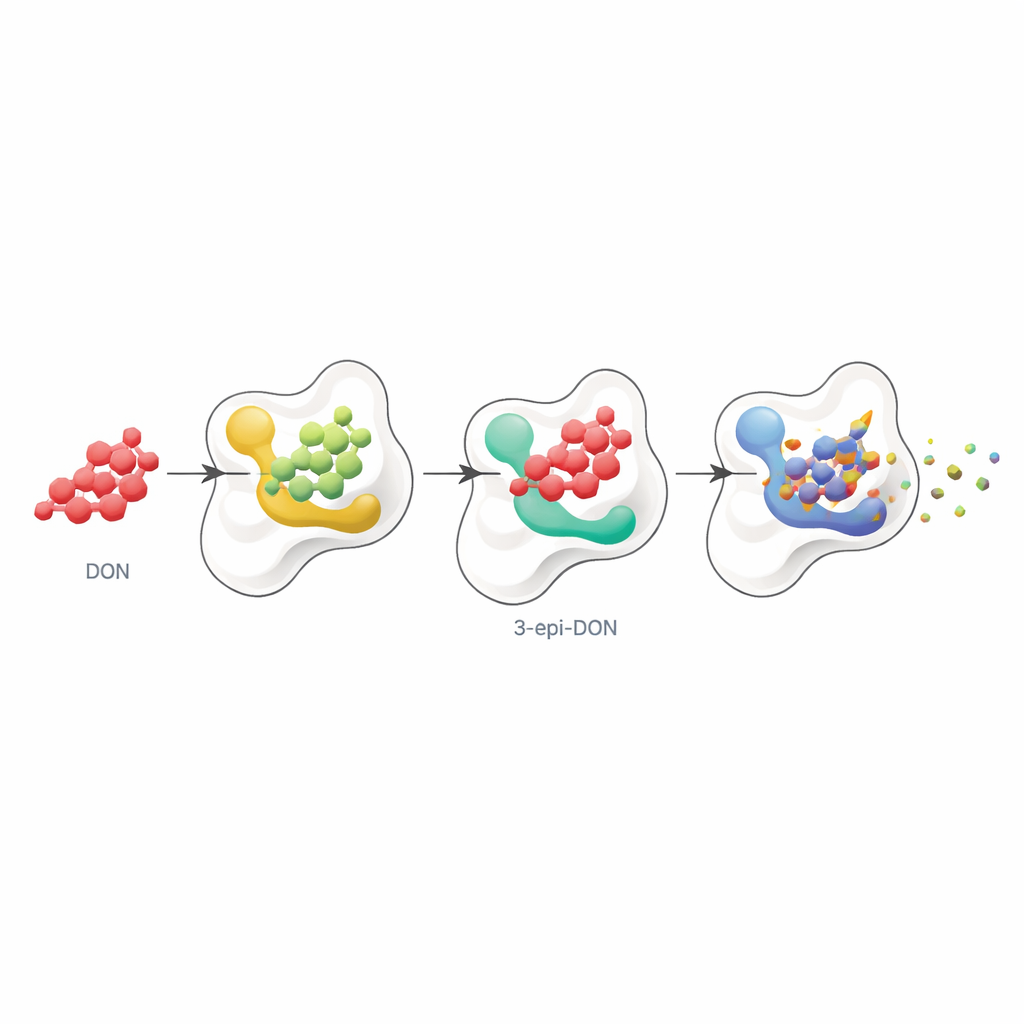
To understand how S5-5 accomplishes this feat, the scientists sequenced its genome and built a large DNA library, then screened thousands of clones for the ability to transform DON. This hunt led to two enzymes of the aldo-keto reductase family, dubbed DONepi and DONrd. Together, they launch two parallel chemical routes that start dismantling the toxin. DONepi flips the orientation of a specific chemical handle on the molecule, a step called C3-epimerization, creating a less toxic form known as 3-epi-DON. DONrd acts at a different site, C8, adding hydrogen to convert a reactive ketone into a gentler alcohol. It can perform this C8 change on both DON itself and on 3-epi-DON, creating several “8-hydroxyl” intermediates that are much easier for the bacterium to chew up further.
How the Molecular Machinery Works
Using cryo–electron microscopy, the team showed that DONepi assembles into an eight-part ring, with each subunit holding a common cellular cofactor that shuttles electrons. Computer simulations suggest that DONepi first oxidizes DON into a fleeting intermediate, then physically twists this intermediate inside the active site before reducing it back, but in mirror-image form. This built-in twist allows one enzyme to perform what is usually a two-enzyme job. A second set of modeling studies focused on DONrd, revealing how it grips DON in two slightly different orientations so that its cofactor can attack from either side of the target site, explaining why two mirror-image 8-hydroxyl products appear. Additional enzymes, likely including a cytochrome P450 oxidase, then add more oxygen and break open the toxin’s carbon framework until only simple molecules like carbon dioxide and water remain.
Borrowed Genes and Toxin-Resistant Plants
Genetic comparisons showed that the DONepi and DONrd genes sit in special DNA regions known as genomic islands and most closely resemble genes from other bacterial genera. This pattern points to horizontal gene transfer—gene swapping between unrelated microbes—as the route by which S5-5 acquired its powerful detox toolkit, probably driven by long-term exposure to DON in the field. The researchers also inserted a plant-optimized version of DONepi into Arabidopsis, a model plant. These engineered plants grew longer roots and showed less leaf damage when exposed to DON, indicating that the bacterial enzyme can function in plant tissues to blunt the toxin’s impact.
What This Means for Safer Food
The work outlines a full, biologically based route for turning DON into harmless end products, starting with two specialized enzymes that reconfigure key parts of the molecule. By revealing both the genes and the detailed workings of DONepi and DONrd, the study opens the door to new practical tools: engineered microbes or enzyme mixtures to clean up contaminated grain and storage facilities, and crop varieties that carry detox genes to resist infection in the first place. In the long run, harnessing such microbial chemistry could make our grain supply more resilient and our food safer, even as fungal diseases and climate pressures continue to rise.
Citation: He, W., Xiong, R., Zheng, M. et al. Specialized aldo-keto reductases trigger complete degradation of mycotoxin deoxynivalenol. Nat Commun 17, 3240 (2026). https://doi.org/10.1038/s41467-026-70007-z
Keywords: mycotoxin degradation, deoxynivalenol, aldo-keto reductase, bioremediation, crop protection