Clear Sky Science · en
In-cell bypass diodes for high-efficiency and shading-tolerant back contact silicon photovoltaic modules
Safer Solar Panels for Everyday Rooftops
Rooftop solar panels are expected to quietly generate electricity for decades, but in real life they get covered by leaves, snow, chimneys, and nearby buildings. Even small patches of shade can rob a panel of power and, more worryingly, create dangerously hot spots that can damage the hardware. This article explores a new kind of silicon solar cell that builds a safety feature directly inside each cell, making solar panels both more efficient and far more tolerant to everyday shading.
Why Shade Is Such a Big Problem
A solar panel is not a single device but a chain of many cells wired together. When one cell is shaded, its electrical current drops, yet the rest of the sunlit cells continue to push current through it. The shaded cell is then forced into an electrical state called reverse bias, where it no longer acts as a power source but as a power absorber. The result can be severe overheating in small regions of the cell, known as hot spots, which waste energy and, in extreme cases, can damage or even ignite parts of the module. Standard protection uses extra electronic parts called bypass diodes wired around groups of cells, but installing one diode for every cell would be too bulky and costly, and grouping many cells under a single diode only offers partial protection.
Turning Each Cell into Its Own Safety Valve
The authors propose a clever redesign of back-contact silicon solar cells so that every cell includes its own built‑in “bypass” behavior without adding separate components. Instead of relying on one external diode to rescue many cells, they engineer the layers on the back side of the cell to create many tiny reverse-conduction channels spread across the surface. These channels stay essentially off during normal operation, preserving high efficiency, but they switch on when the cell is pushed into reverse bias by shading. In effect, the cell gains an internal safety valve, automatically providing a path for current to flow around shaded regions before dangerous voltages and hot spots can develop. 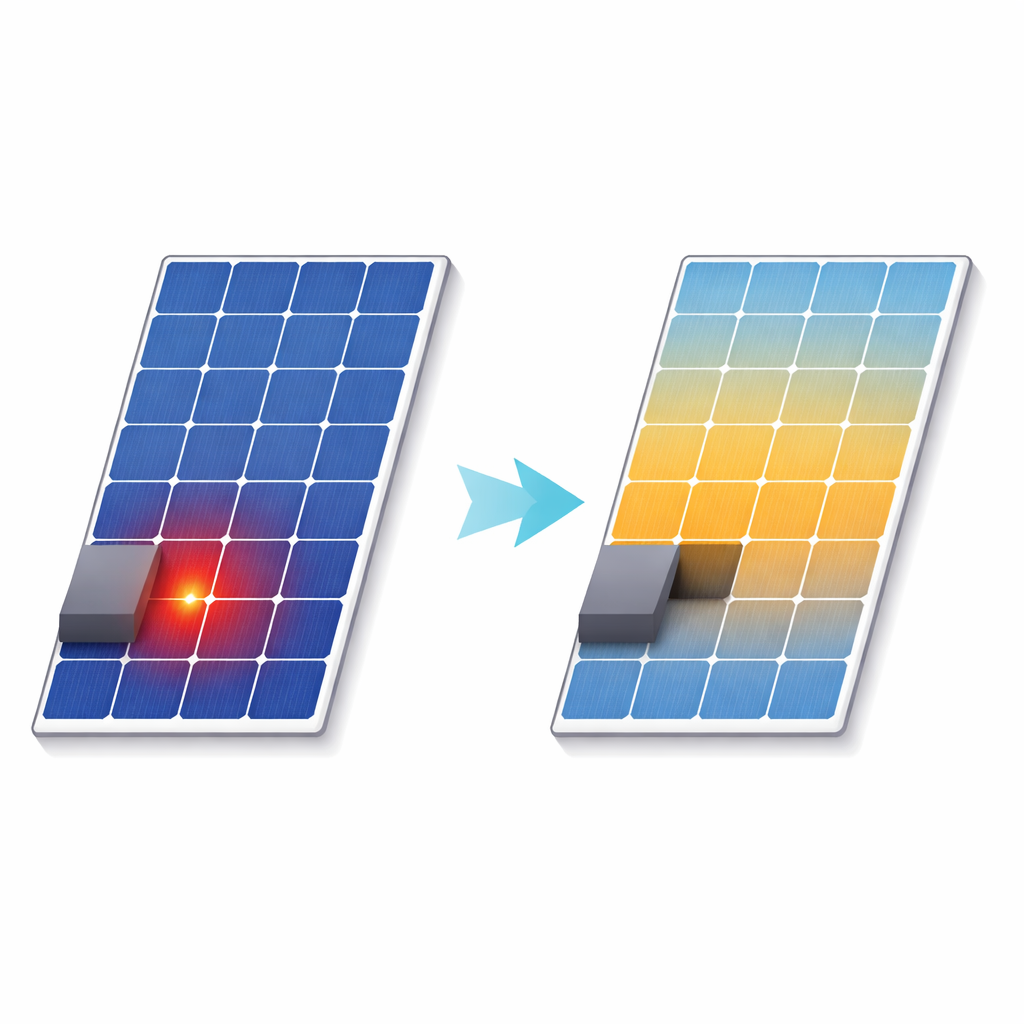
How the Hidden Channels Work Inside the Cell
At the heart of the design is a carefully stacked combination of materials on the back of the silicon wafer. Back-contact cells already place positive and negative contacts side by side on the rear, separated by narrow gaps. The team takes advantage of these gap edges to insert overlapping thin layers that favor electrons in one part and holes (their positive counterparts) in another. Under reverse bias, electrons entering the shaded cell travel through the silicon and are funneled toward these overlap regions, where the energy landscape allows them to “tunnel” through the stack and re-emerge as current that can be safely carried away. Because similar stacks are repeated hundreds of times across the cell back, the reverse current spreads out instead of concentrating at a single weak spot. Simulations and measurements show that these engineered channels behave like many tiny, specially tuned diodes integrated directly into the cell.
Keeping Performance High in Everyday Sunlight
Any extra path for current risks turning into a leak that wastes power when the cell is working normally. A key achievement of this work is designing the stacked layers so that they carry substantial current only when the cell is driven into reverse, but contribute very little when the cell is operating in its usual forward direction. The team analyzes how electrons and holes move through the stacks under both conditions and adjusts the thickness and material properties so that the tunneling effect gradually shuts down as the forward voltage rises toward the working point of the cell. As a result, prototype devices with the new structure reach a certified power conversion efficiency of 27.49%, on par with the best back-contact silicon cells, while still offering strong reverse conduction when needed. 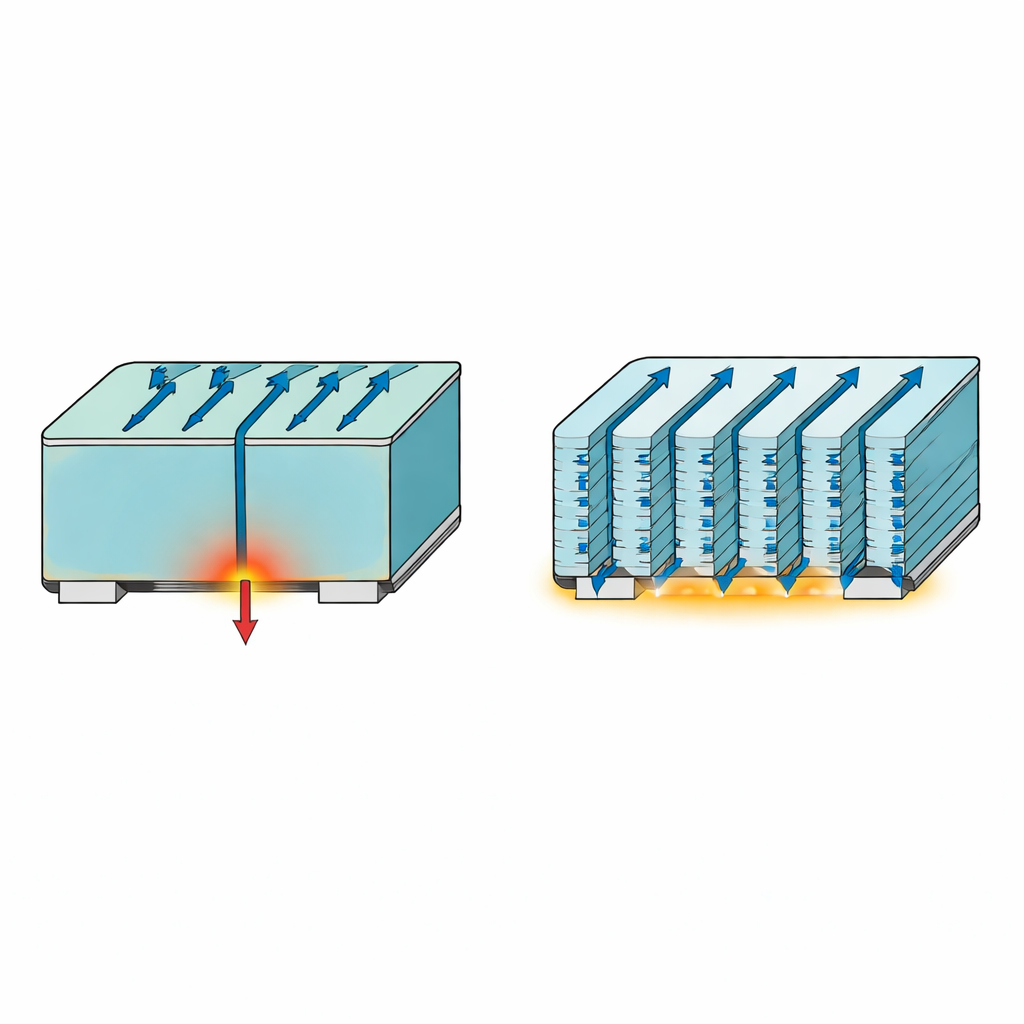
Cooler, More Stable Panels in Realistic Conditions
To test whether this microscopic redesign makes a real‑world difference, the researchers built full solar modules using their new cells and compared them with conventional modules under harsh shading tests. When several cells were heavily shaded, standard modules developed hot regions that quickly climbed to about 190 degrees Celsius. The new modules, by contrast, stabilized near 90 degrees, with heat spread more evenly and far fewer permanently damaged spots. In tests where only part of a single cell was shaded, conventional modules lost nearly half of their power output, even though external bypass diodes were present. Modules using the new cells showed only modest power drops, demonstrating that the built‑in channels help keep electricity flowing more smoothly despite uneven light.
A Step Toward Smarter, Tougher Solar Power
This work shows that protection against shading does not have to come from extra wiring and components outside the cell. By weaving bypass behavior into the cell’s own structure, the authors create solar modules that are both highly efficient and much more tolerant of everyday shadows, while potentially lowering cost and complexity. As solar power spreads onto crowded rooftops and into cities full of obstacles and variable light, such self‑protecting, shading‑resilient cells could make solar systems safer, longer‑lasting, and more reliable for homeowners and utilities alike.
Citation: Tang, H., Li, Y., Lin, H. et al. In-cell bypass diodes for high-efficiency and shading-tolerant back contact silicon photovoltaic modules. Nat Commun 17, 3360 (2026). https://doi.org/10.1038/s41467-026-70005-1
Keywords: solar cells, partial shading, back-contact silicon, bypass diode, photovoltaic modules