Clear Sky Science · en
Embryo metabolite analysis and implantation potential prediction using chemiluminescent microfluidic chips with dielectric wetting valves
Why measuring tiny clues around embryos matters
When people turn to in vitro fertilization (IVF), choosing which embryo to transfer is one of the most consequential decisions. Today, doctors mainly judge embryos by how they look under a microscope, a method that is partly subjective and often fails to predict which embryo will actually lead to a healthy pregnancy. This study introduces a small lab‑on‑a‑chip device that reads chemical fingerprints left by each embryo in its culture liquid, offering a more objective and powerful way to estimate its chances of implantation and live birth.
Looking beyond appearance
For decades, clinics have relied on visual grading systems that rank embryos by their shape, structure and apparent health. While helpful, these scores cannot reveal what is happening inside the embryo’s cells. Researchers have long suspected that metabolism—the way an embryo consumes and produces key fuels—holds deeper clues about its developmental potential. However, existing methods to measure these molecules typically require expensive, bulky instruments and larger sample volumes than the few microliters available from a single embryo, limiting their use in routine IVF practice.
A tiny chip that shines light on embryo metabolism
The team developed a credit‑card‑sized microfluidic chip that can analyze just 3 microliters of "spent" culture medium from an individual blastocyst—liquid that would normally be discarded. The chip draws the sample through narrow channels by capillary action, so no external pumps are needed. Within the device, special valves based on electrical control of liquid wetting hold and then release the flow at precise moments. In three parallel branches, preloaded enzymes react with glucose, lactate and pyruvate, molecules that reflect how actively the embryo is using energy. These reactions generate hydrogen peroxide, which then triggers a light‑producing chemiluminescent reaction; sensitive detectors read the brightness in each branch as a direct measure of each metabolite. 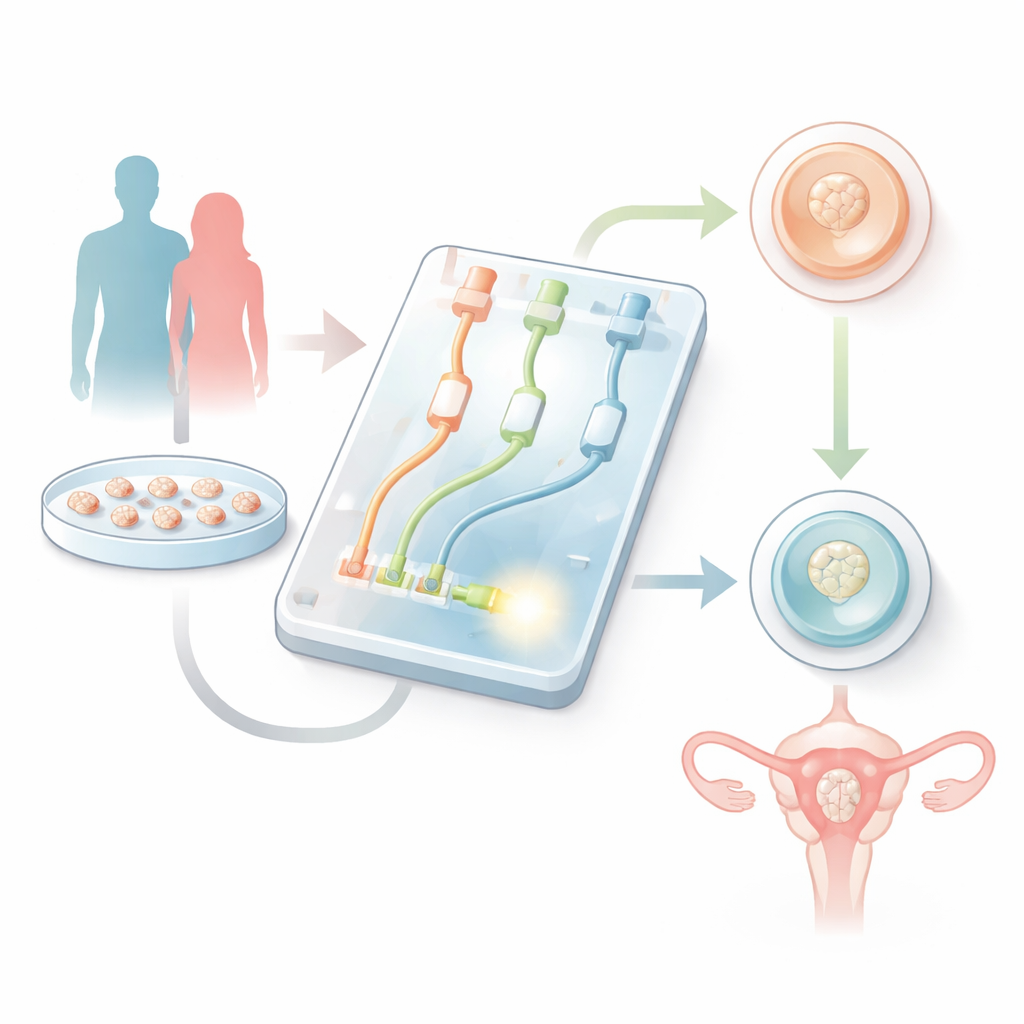
How the chip was tuned and tested
To make this work reliably, the researchers carefully optimized the chemistry and physics inside the chip. They adjusted the thickness of the insulating layer and the applied voltage so that the electrical valves would stop and restart capillary flow on demand. They fine‑tuned the concentrations of enzymes and light‑producing reagents, and determined that allowing a few minutes of incubation before opening the valves greatly boosted the signal. The device reached very low detection limits—down to sub‑micromolar levels—and could measure a wide range of concentrations, accommodating the natural differences between glucose and lactate (present at thousand‑fold higher levels) and the scarcer pyruvate. The chip also proved reusable after cleaning and remained stable after storage, features important for real‑world clinical use. 
Reading embryos’ fuel use to predict pregnancy
With the chip validated, the team analyzed culture media from 169 human embryos that were transferred one by one in an IVF clinic, tracking which led to ongoing pregnancies and live births. They found clear metabolic patterns: embryos that implanted successfully tended to consume more glucose and pyruvate and to produce more lactate than those that did not. Using these three rates, the researchers built a simple scoring system and combined it with standard visual grading. In both an initial training group and an independent validation group, the metabolism‑based score predicted clinical pregnancy much better than appearance alone, and the combined model performed best of all, correctly separating higher‑ and lower‑potential embryos in most cases.
What this could mean for IVF patients
For patients, the implications are practical and hopeful. Because the method uses only leftover culture medium and does not disturb the embryo itself, it fits seamlessly into current IVF workflows. The chip’s strong predictive accuracy—summarized by an area‑under‑the‑curve value of 92% when combined with morphology—suggests that adding metabolic information could help clinicians select embryos more confidently, potentially improving pregnancy rates while keeping the number of embryos transferred low. Although larger, multi‑center studies are still needed, this work shows that a tiny, light‑emitting microchip can turn invisible chemical traces into actionable guidance, offering a more informed path toward successful implantation and healthy births.
Citation: Tong, W., Shi, J., Yu, Z. et al. Embryo metabolite analysis and implantation potential prediction using chemiluminescent microfluidic chips with dielectric wetting valves. Nat Commun 17, 3331 (2026). https://doi.org/10.1038/s41467-026-69999-5
Keywords: embryo selection, IVF metabolomics, microfluidic chip, chemiluminescence, implantation prediction