Clear Sky Science · en
Large piezoelectricity in crosslinked ferroelectric polymers
Why flexible power materials matter
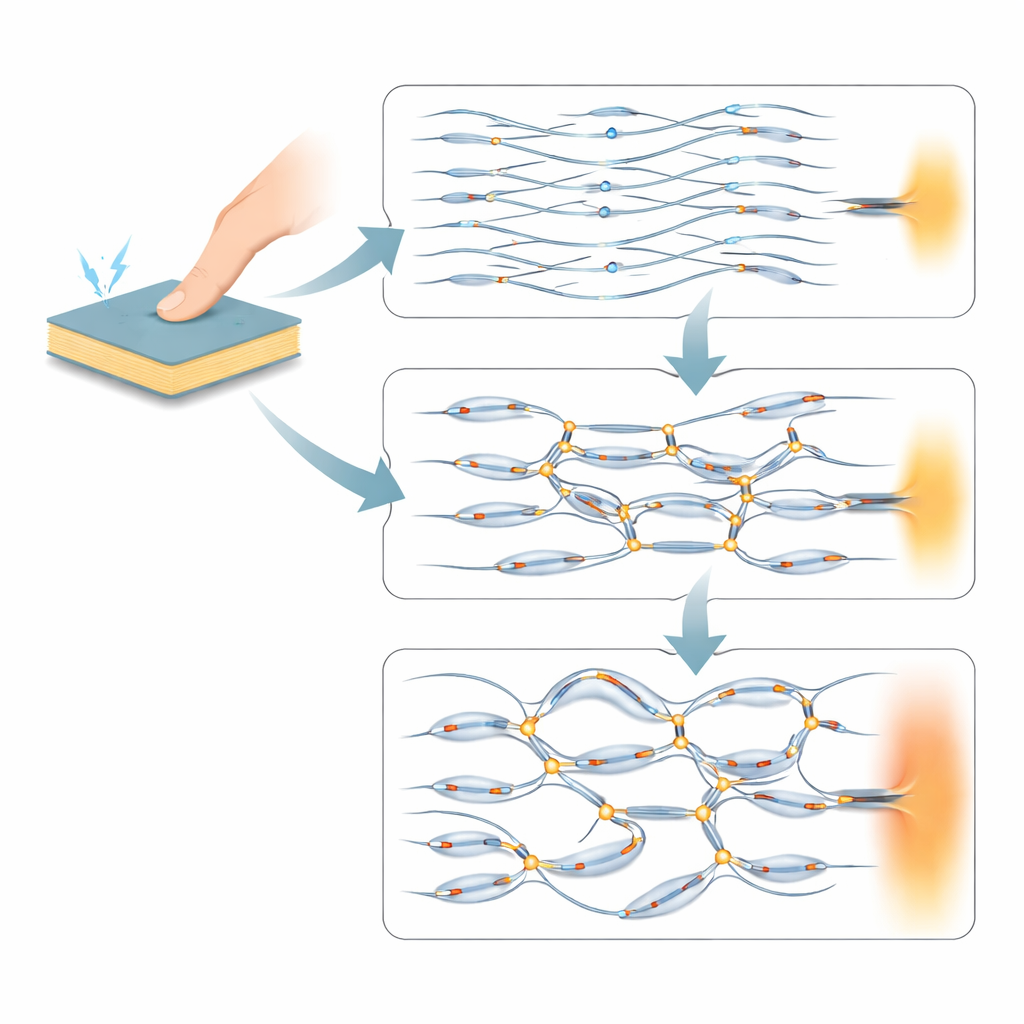
From smart watches and soft robots to tiny medical implants, many emerging devices need materials that can turn movement into electricity without being heavy or brittle. Today, the best-performing piezoelectric materials—the ones that convert pressure into electrical signals—are usually hard ceramic crystals that contain lead and are difficult to shape into thin, bendable films. This study explores a way to make soft, lead‑free plastic films far more sensitive to pressure, bringing us closer to lightweight, wearable power sources and sensors that can be manufactured at large scale.
From hard crystals to soft plastics
Piezoelectricity has been known since the 19th century, first in minerals like quartz and later in engineered ceramic crystals that now underpin ultrasound imaging, precision motors, and sonar. These rigid materials work extremely well but are not ideal for flexible or skin‑mounted technologies. A promising alternative is a family of plastics called ferroelectric polymers, based on poly(vinylidene fluoride), or PVDF, and its chemical cousins. These polymers are light, bend easily, and can be cast into large sheets, yet their pressure sensitivity, quantified by a parameter called d33, has stubbornly remained much lower than that of the best ceramics. Previous attempts to boost their performance mostly tinkered with the shape of individual polymer chains, with limited gains.
Linking chains to unlock stronger response
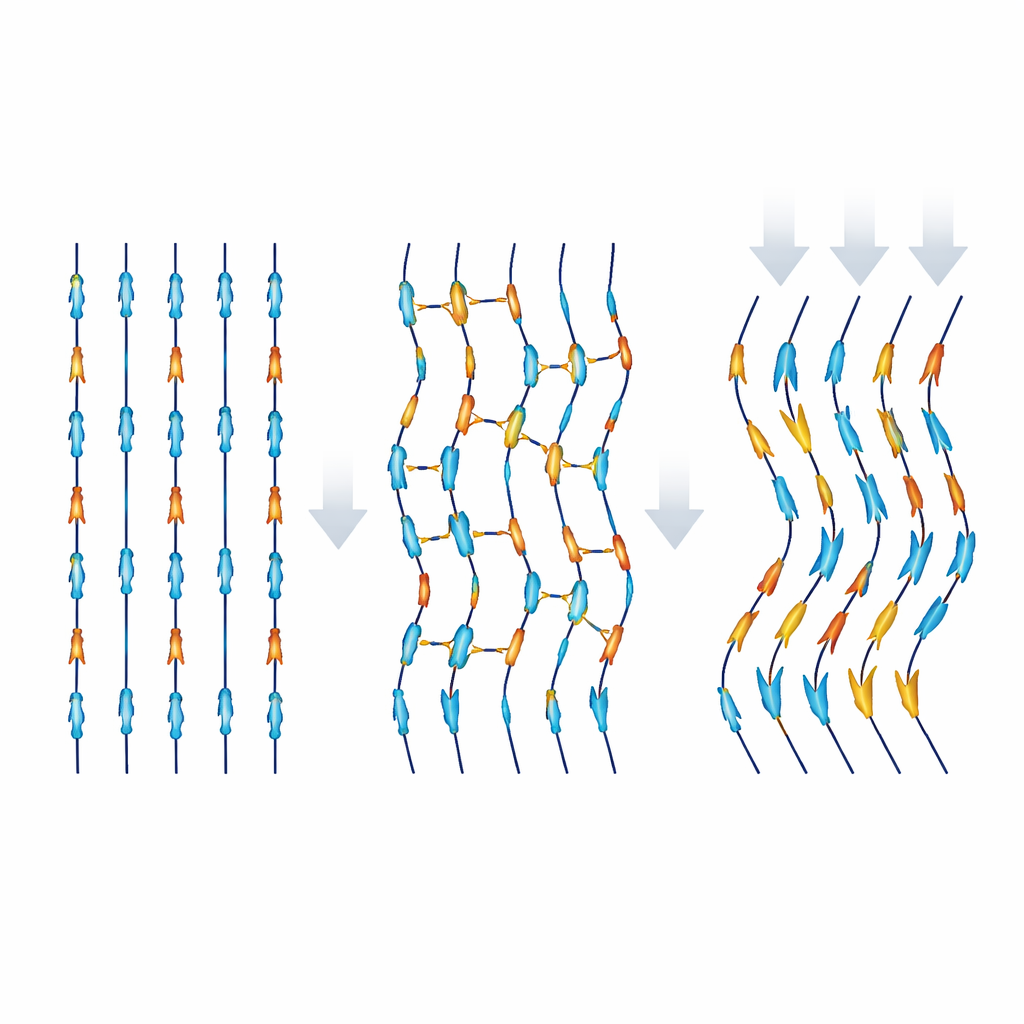
The authors take a different route: instead of only reshaping single chains, they connect neighboring chains to each other using small chemical bridges, a process known as crosslinking. They focus on a copolymer called P(VDF‑TrFE), choosing compositions where two different internal structures of the chains are almost equally stable. This delicate balance means that a small nudge can tip the material from one structure to another, a situation known to amplify piezoelectric effects in ceramic crystals. By adding tiny amounts of short crosslinking molecules during a simple solution casting and heating step, the team subtly alters how the chains pack and move in the solid, without destroying the useful crystalline order.
Creating controlled local disorder
Advanced measurements and computer simulations reveal what these crosslinks do at the molecular level. Where two chains are tied together, local segments of the polymer backbone become more twisted and irregular, leading to what the authors call conformational heterogeneity: nearby segments adopt slightly different shapes and can more easily rotate when pushed by an electric field or mechanical force. Calculations show that around the crosslink sites, the energy barriers for small bond rotations become almost flat, meaning that these regions are highly responsive to small stimuli. Experiments using X‑ray scattering and electrical measurements confirm that even very low amounts of crosslinking drive the material from a well‑ordered ferroelectric state into a “relaxor‑like” state with strong local disorder but still robust overall polarization.
Record performance in flexible films
This engineered local disorder pays off in performance. At an optimized crosslinking level of around 1.2%, the piezoelectric coefficient d33 of P(VDF‑TrFE) nearly doubles compared with the uncrosslinked polymer and reaches about three to four times the value of standard PVDF. This gain is confirmed both by direct measurements of the electrical charge generated under pressure and by tracking the tiny strains produced when an electric field is applied. The improvement is not tied to a single chemical recipe: several different crosslinking agents and related polymers show similar trends, though short, compact linkers work best. The crosslinked films also retain good mechanical strength, stretchability, and stability over many loading cycles, and can be produced as thin, uniform sheets using industrially familiar solution processes.
What this means for future devices
To a non‑specialist, the key message is that carefully “stitching together” soft ferroelectric polymers at the right spots makes their internal building blocks easier to nudge, so the material responds much more strongly to gentle pushes or electric signals. Instead of relying on heavy, rigid, lead‑based ceramics, designers of sensors, flexible generators, and wearable electronics could use these crosslinked polymer films to harvest motion, detect pressure, or actuate soft components with far greater efficiency. Because the strategy is simple, adaptable to many polymer chemistries, and compatible with large‑area manufacturing, it offers a practical pathway toward high‑performance, environmentally friendlier piezoelectric materials for the next generation of flexible technologies.
Citation: Yuan, Z., Li, C., Gong, Y. et al. Large piezoelectricity in crosslinked ferroelectric polymers. Nat Commun 17, 3143 (2026). https://doi.org/10.1038/s41467-026-69998-6
Keywords: ferroelectric polymers, piezoelectric films, crosslinked PVDF, flexible sensors, energy harvesting