Clear Sky Science · en
Low breakdown field and high ionization index in ReSe2 avalanche field-effect transistors
Turning Weak Light into Strong Signals
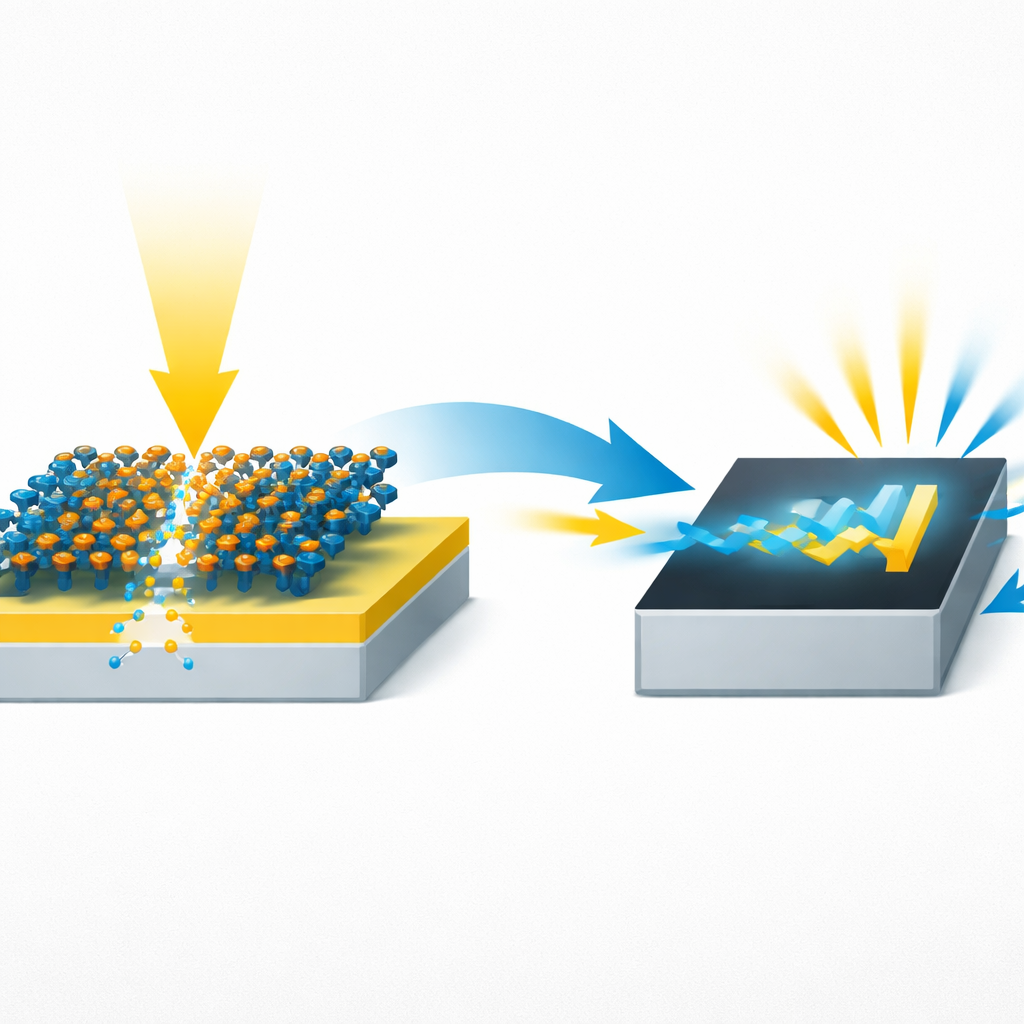
Modern technologies—from fiber‑optic internet to medical imaging—rely on devices that can detect extremely faint flashes of light and turn them into clear electrical signals. This article reports a new kind of ultrasensitive light detector built from an exotic, sheet‑like crystal called ReSe2. By carefully engineering how electrons move and multiply inside this material, the researchers achieve strong signal amplification at unusually low voltages, pointing toward faster, more energy‑efficient cameras, sensors, and communication systems.
Why Multiplying Electrons Matters
Many state‑of‑the‑art light detectors use a phenomenon called an avalanche: a single energetic electron can knock loose additional electrons, which in turn free even more, rapidly multiplying the electrical signal created by incoming light. Conventional avalanche devices made from bulk silicon or compound semiconductors need very strong electric fields and high voltages to start this process, and they often waste energy because electrons scatter and lose momentum before they can trigger impact events. Two‑dimensional materials—crystals only a few atoms thick—offer a way around these limits by giving electrons a well‑defined, tightly confined pathway in which to move.
A Crystal with a Built‑In Direction
Among these ultrathin materials, the team focuses on rhenium diselenide, or ReSe2, which has a low‑symmetry, chain‑like atomic structure. Unlike more symmetric two‑dimensional crystals, ReSe2 is strongly directional: electrons move more easily along certain in‑plane pathways and have a harder time jumping between layers. Calculations of the electron effective mass—essentially how heavy electrons behave along different directions—show that motion out of the plane is much more sluggish, which suppresses unwanted scattering between layers. Experiments further reveal that the basic electrical behavior of ReSe2 does not change much as the crystal is made thicker or thinner, confirming that the layers are only weakly coupled and that transport is dominated within the plane of the sheet.
Designing a Gentle yet Powerful Avalanche
To harness these properties, the researchers build an avalanche field‑effect transistor (AFET) in which a thin flake of ReSe2 serves as the channel that carries current between metal contacts. Beneath it they place a high‑“k” dielectric layer made from hafnium zirconium oxide (HfZrO2), which acts as an efficient gate insulator, allowing the gate electrode to strongly tune the electric field in the channel. When the voltage between source and drain is ramped up, the current suddenly rises by orders of magnitude—a hallmark of avalanche multiplication—but at a breakdown field far lower than in most other devices based on two‑dimensional materials. By adjusting the gate voltage, they can further reduce the number of electrons present and fill defect sites with holes, both of which cut down on scattering and let carriers gain enough energy to trigger more frequent impact events.
Peering into the Electron Traffic
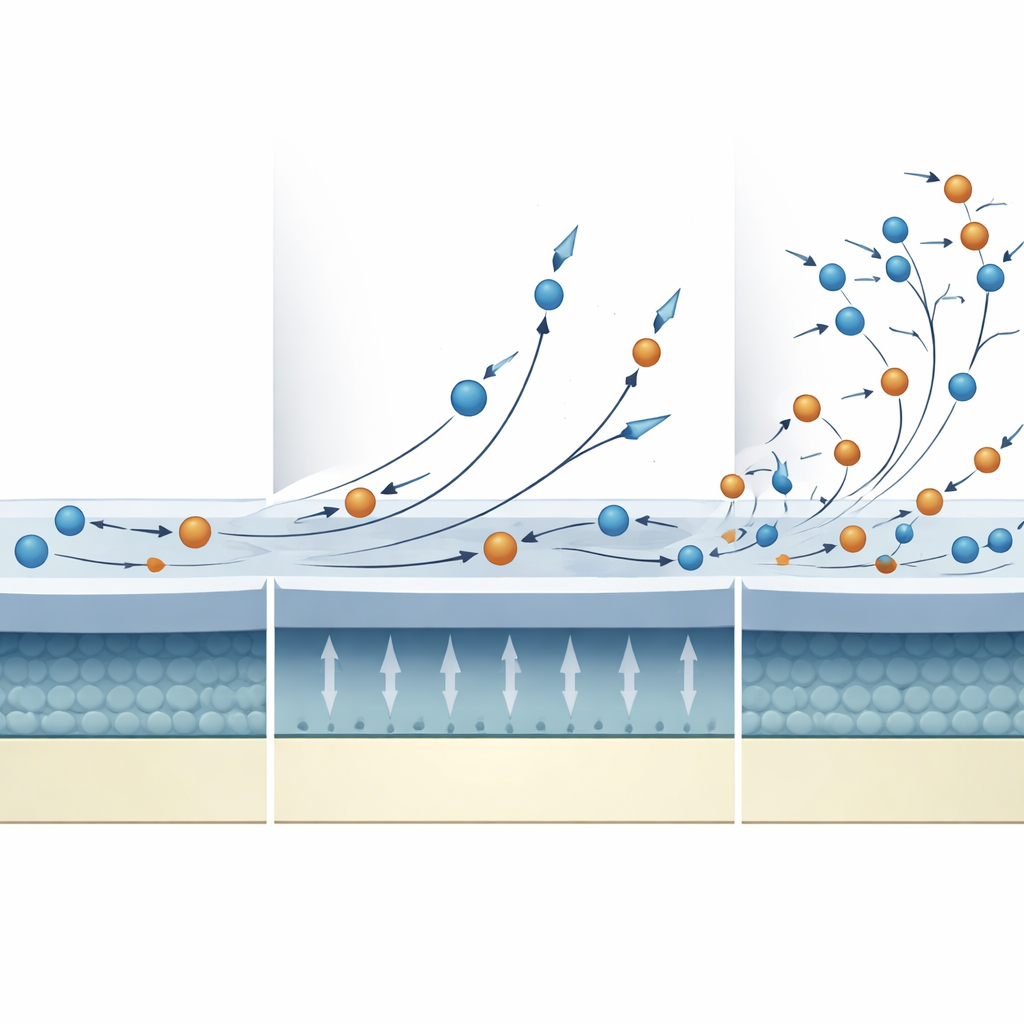
To understand why their device performs so well, the authors combine computer simulations and experiments to quantify how often electrons collide and change course. They show that the heavy out‑of‑plane effective mass in ReSe2 suppresses vertical motion, keeping electrons flowing within the flat channel and minimizing wasteful side collisions. A scattering probability parameter extracted from the electrical data decreases as the gate voltage is tuned to an optimal range, then rises again once the vertical electric field becomes too strong, driving more out‑of‑plane motion. This gate‑controlled balance explains why the device achieves both a very low breakdown field and an unusually high “ionization index,” a measure of how rapidly the avalanche multiplication grows with electric field compared with other two‑dimensional AFETs.
From Transistor to Ultrafaint Light Detector
Building on this transistor, the team demonstrates an avalanche phototransistor by shining a red laser onto the ReSe2 channel. Even at picowatt‑level light powers, the detector generates a large photocurrent and a strong reduction in the voltage needed to trigger avalanche. The resulting photoresponsivity—how much current flows per unit of incident light—and the gain—how much the signal is multiplied—rank among the highest reported for similar devices, all while operating at only a few volts. The detector also switches off in tens of microseconds, fast enough for many imaging and communication tasks, and its response becomes quicker as the gate voltage fills more defect sites and prevents long‑lived charge trapping.
What This Means for Future Sensors
In everyday terms, this work shows that carefully choosing and stacking atomically thin materials can make light detectors that are both more sensitive and easier to power. By combining the directional, low‑scattering transport of ReSe2 with a gate stack that tightly controls the electric field, the researchers create a device that launches avalanches of electrons with relatively gentle nudges. Such designs could lead to compact, low‑voltage sensors capable of spotting very weak light signals in applications ranging from high‑speed fiber‑optic links to low‑dose medical imaging and environmental monitoring.
Citation: Zhang, J., Wang, J., Liu, D. et al. Low breakdown field and high ionization index in ReSe2 avalanche field-effect transistors. Nat Commun 17, 3207 (2026). https://doi.org/10.1038/s41467-026-69994-w
Keywords: avalanche photodetector, two-dimensional materials, ReSe2 transistor, low-light sensing, optoelectronics