Clear Sky Science · en
Declining anthropogenic aerosols amplify Northern Hemisphere Hadley circulation weakening in the 21st century
Why cleaner air still matters for our climate
Efforts to cut air pollution have made the air noticeably cleaner over many parts of the world. But in the atmosphere, nothing comes for free. This study explores an invisible trade-off: as human-made air pollution particles (aerosols) decline, they quietly reshape one of the planet’s largest wind patterns, the Hadley circulation, which helps move heat and moisture from the tropics toward the subtropics. Understanding how this circulation changes matters because it influences where tropical rain falls and where dry zones form—features that affect agriculture, water supplies, and the lived experience of climate change for billions of people.
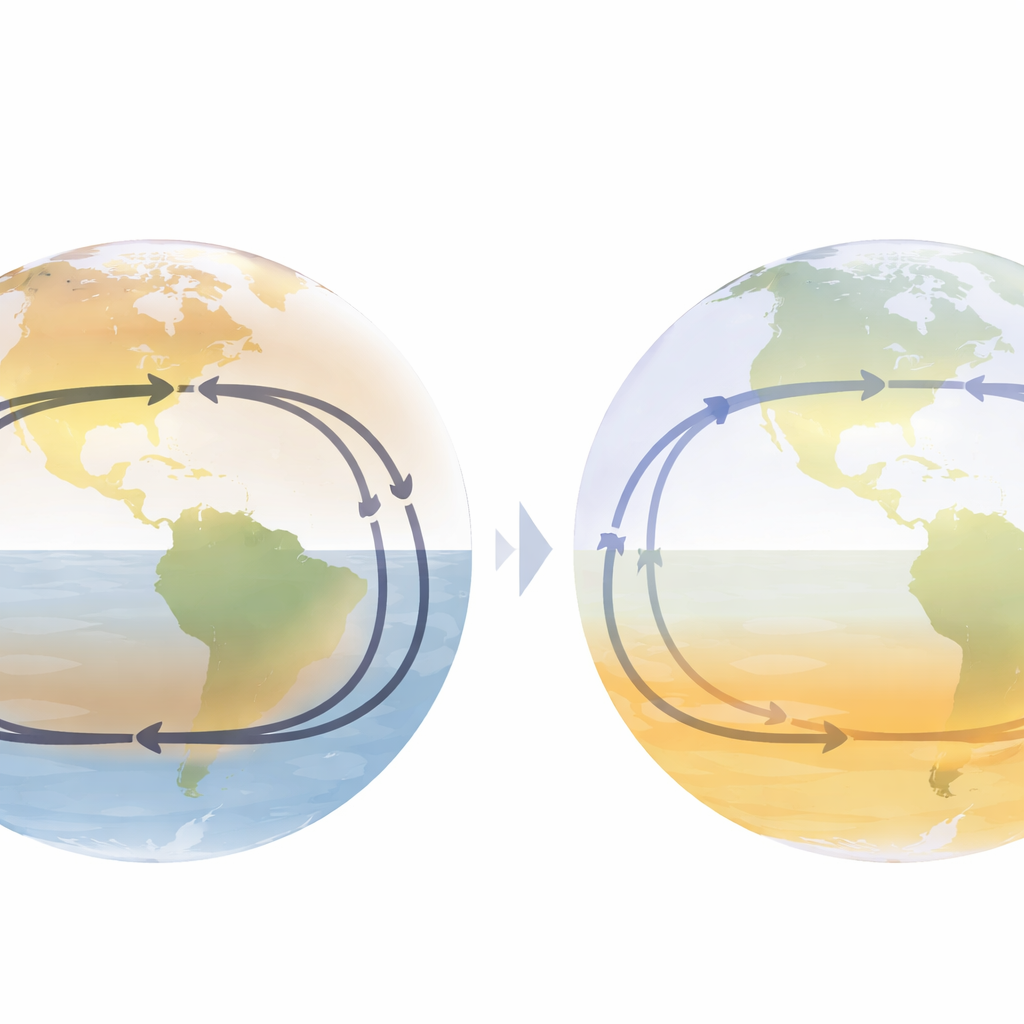
A giant heat engine in the sky
The Hadley circulation can be thought of as a massive heat engine that spans from the equator to the subtropics. Warm air rises in the deep tropics, flows high above the surface toward higher latitudes, sinks in the subtropics, and then returns near the surface. This overturning pattern shapes tropical rainfall belts and helps maintain the dry zones over the world’s deserts. Climate models have long suggested that this engine in the Northern Hemisphere will gradually weaken as greenhouse gases build up, but the role of changing air pollution has been less clear. Aerosols cool the climate by blocking some sunlight and by affecting clouds, and their uneven distribution between regions makes their influence on winds and rain surprisingly complicated.
Tracing a century of human fingerprints
To untangle these effects, the authors used large sets of climate model simulations in which they could turn individual human influences on and off. One set included all known human and natural drivers, while other sets isolated just greenhouse gases or just aerosols. They then tracked how the strength of the Northern Hemisphere Hadley circulation changed from 1920 to 2080. The models showed that, overall, this circulation weakens strongly over the century, but the timeline is not smooth: it first strengthens up to about 1980, and then weakens rapidly afterward. This shift in direction lines up with historical aerosol emissions, which climbed globally after World War II but began to fall in Europe and North America around 1980 as air-quality regulations took hold.
How fewer particles weaken a giant wind pattern
The simulations reveal that changes in aerosols alone can explain roughly one-third of the weakening of the Northern Hemisphere Hadley circulation between 1980 and 2080. Before 1980, rising aerosol levels cooled the Northern Hemisphere and tended to strengthen the circulation; after 1980, falling aerosol levels let the region warm more quickly, reversing this effect. The authors used a diagnostic approach that links changes in the circulation to changes in heating, rainfall, and atmospheric stability. They found that greenhouse gases and aerosols both increase the stability of the tropical atmosphere aloft, which naturally slows the overturning. But declining aerosols add an extra twist by shifting and reshaping tropical rainfall: as the Northern Hemisphere warms faster than the Southern Hemisphere, the main tropical rain band nudges northward and its heating pattern changes in a way that directly weakens the circulation.
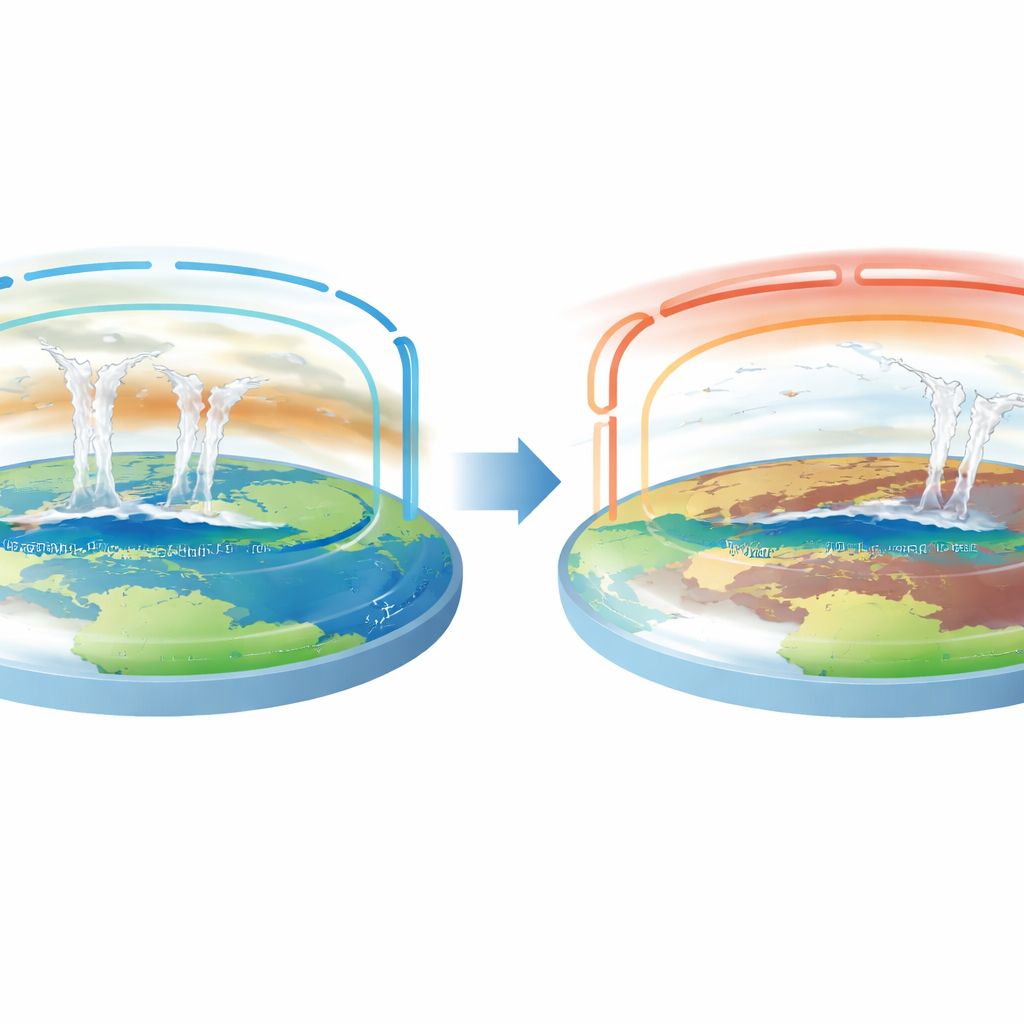
Robust signals across different climate models
To check that these results were not an artifact of a single model, the team repeated their analysis across multiple climate-model families and additional large ensembles. Despite differences in experimental design and future pollution scenarios, the same broad message emerged: when aerosols are reduced, the Northern Hemisphere Hadley circulation weakens more than it would from greenhouse gases alone. In some near-term decades, the influence of declining aerosols on the circulation is even stronger than that of rising greenhouse gases. This strengthens confidence that the link between cleaner air and circulation change is a robust feature of how the climate system responds to human activity.
What this means for our future climate
For non-specialists, the key takeaway is subtle but important. Cleaning up air pollution is unequivocally good for health and ecosystems, yet it removes a cooling influence and allows greenhouse-gas-driven warming and circulation changes to stand out more clearly. According to this study, the long-term decline in human-made aerosols will speed up the weakening of the tropical heat engine in the Northern Hemisphere, affecting patterns of rain and dryness that many societies depend on. Policymakers and planners cannot treat air-quality and climate actions as separate levers: cutting pollution and cutting greenhouse gases must proceed together, while recognizing that cleaner air can temporarily reveal, and in some ways intensify, the atmospheric shifts driven by our changing climate.
Citation: Kim, SY., Son, SW., Ming, Y. et al. Declining anthropogenic aerosols amplify Northern Hemisphere Hadley circulation weakening in the 21st century. Nat Commun 17, 3355 (2026). https://doi.org/10.1038/s41467-026-69990-0
Keywords: Hadley circulation, aerosols, tropical climate, atmospheric circulation, climate change