Clear Sky Science · en
Dual slab stagnation depths controlled by grain-size-induced sporadic low-viscosity zones at around 1000 km depth
Why the Deep Earth Matters
Far beneath our feet, the rocky shell of Earth slowly sinks and stirs like taffy. Where one tectonic plate dives under another, the descending “slab” sometimes mysteriously stalls instead of sinking all the way to the planet’s core. This study tackles a long-standing puzzle: why many slabs stop at two preferred depths, around 660 and 1000 kilometers down. By revealing how tiny mineral grains and ancient, long‑vanished plates shape the flow of rock in the deep mantle, the work links the hidden interior of Earth to the evolution of continents, oceans, and even future supercontinents.
Hidden Shelves Inside the Planet
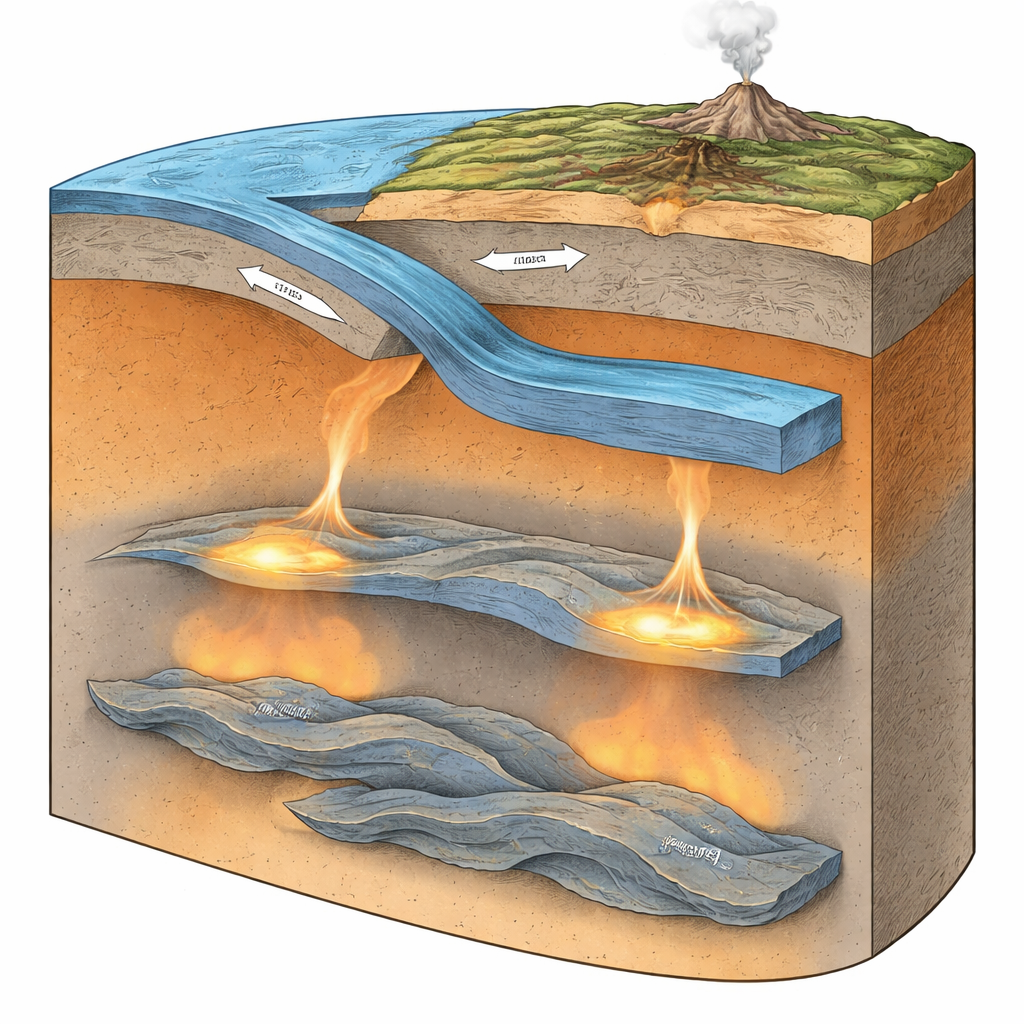
Seismic images, built from earthquake waves, show that many subducting slabs do not plunge straight through the mantle. Instead, they often flatten out and “park” just above 660 kilometers depth or within the uppermost part of the lower mantle, between roughly 660 and 1000 kilometers. The shallow level coincides with a major mineral phase change, where mantle rocks suddenly become denser. The deeper level, near 1000 kilometers, has no obvious boundary, yet geophysical studies suggest the mantle there is suddenly more resistant to flow. Previous explanations focused on either the 660‑kilometer transition or a uniform, global jump in mantle stiffness near 1000 kilometers, but no single idea convincingly explained both favored depths at once.
Tiny Grains with Big Effects
The authors used large computer simulations of mantle flow to test a new idea centered on grain size—the microscopic crystals that make up mantle rocks. When a cold slab crosses the 660‑kilometer phase boundary, its minerals transform and their grains become dramatically smaller. Fine grains allow rock to deform more easily, acting like a patch of “soft” mantle with low viscosity. As old slabs, called fossil slabs, continue sinking into the lower mantle, they drag this fine‑grained material with them. Above these fossil slabs, the simulations show that a thick, lens‑shaped zone of unusually weak rock naturally develops between about 660 and 1000 kilometers depth: a localized low‑viscosity zone rather than a continuous global layer.
How Old Slabs Control New Ones
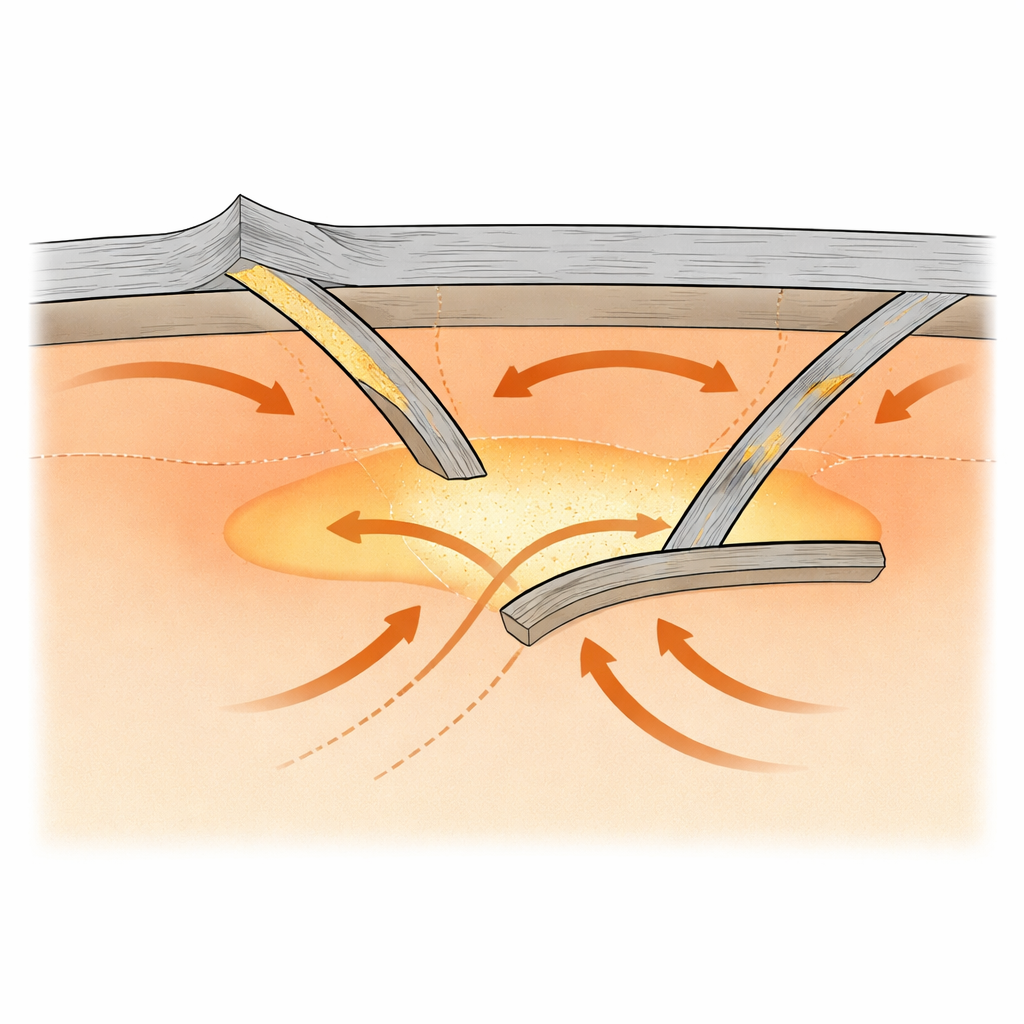
Next, the study introduces a younger slab that begins to subduct above the edge of this weak zone, while the model also varies how quickly the trench—the surface line where plates meet—retreats backward. When a low‑viscosity zone is present and the trench retreats slowly, the new slab can more easily punch through the 660‑kilometer boundary. Once inside the weak pocket, the mantle’s resistance to flow rises sharply with depth, so the slab bends and flattens near the bottom of the zone, stalling around 1000 kilometers. Without this soft region, or when trench retreat is too fast, the behavior changes: slabs either stall at the 660‑kilometer boundary or thicken and sink much deeper into the mantle. This shows that the combination of inherited weak zones and plate motions can naturally produce all the main slab patterns seen by seismologists.
A Patchwork Mantle, Not a Layer Cake
The simulations further explore how quickly the weak zones heal as grains grow larger again, and how strongly their softness must contrast with the surrounding mantle. For realistic grain‑growth rates and viscosity contrasts, the low‑viscosity pockets can persist for tens to hundreds of millions of years—long enough to influence several generations of subduction. The authors identify four main modes of slab behavior, depending on whether such a pocket exists beneath a trench and whether the trench retreats slowly or quickly. These modes match the distinct slab shapes observed under regions like Northeast Asia, South America, West Java, and the Izu–Bonin–Mariana system, suggesting that the deep mantle is a patchwork of soft and stiff regions created by the long history of plate sinking.
What It Means for Our Restless Planet
By tying the two favorite slab “parking levels” to sporadic pockets of weak rock generated by ancient slabs, this work offers a unified and intuitive picture of how the deep mantle works. Instead of a simple, layered structure, Earth’s interior is shaped by feedback between past and present tectonic activity: old plates carve out soft channels that steer and stall new ones. These channels can speed up or slow down plate motions, influence where slabs accumulate, and even help gather continents into future supercontinents. In everyday terms, the study shows that the deep Earth has a long memory—its buried past quietly guides the surface changes we see today.
Citation: Li, J., Li, K., Li, J. et al. Dual slab stagnation depths controlled by grain-size-induced sporadic low-viscosity zones at around 1000 km depth. Nat Commun 17, 3374 (2026). https://doi.org/10.1038/s41467-026-69987-9
Keywords: subduction slabs, Earth mantle, plate tectonics, low-viscosity zones, seismic tomography