Clear Sky Science · en
Experimental observation of non-Hermitian phase transitions using laser-induced thermoacoustics
Turning Light into Sound Control
Imagine steering sound as precisely as we now steer light in fiber optics—making it vanish from one side, echo from the other, or even twist into a whirlpool shape on demand. This paper shows how a thin, laser-heated film made of carbon nanotubes can do exactly that, creating a new kind of acoustic device where loss and amplification of sound are finely balanced. The work opens paths to quieter sensors, advanced imaging, and compact sound-based circuits that process information in ways ordinary speakers and microphones cannot.
Why Balance of Loss and Gain Matters
In many physical systems, including those that handle light and sound, energy usually leaks away. But in the past few decades, researchers have discovered that if they carefully balance energy loss with energy gain, strange and useful behaviors emerge. These systems, known as non-Hermitian, can reach special operating points where waves behave in unusual ways—for example, where an object is invisible from one side but reflective from the other, or where small changes in conditions lead to huge responses. Until now, realizing these effects for sound has been difficult, especially when trying to combine two mirror-opposite behaviors called PT symmetry and anti-PT symmetry within the same acoustic device.
Laser-Heated Nanotubes as an Invisible Sound Engine
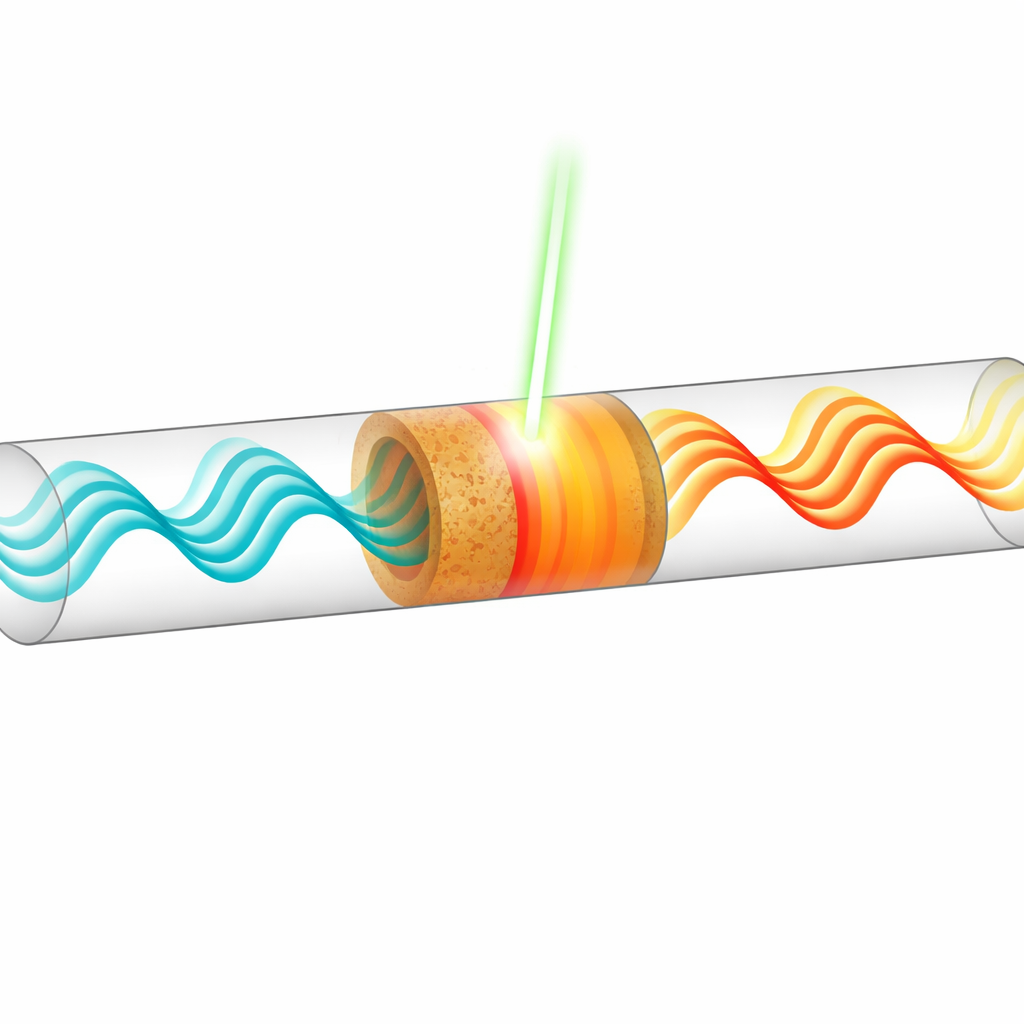
The key innovation in this work is a way to give sound controlled amplification without bulky, mechanical hardware. The researchers use laser-induced thermoacoustics: short laser pulses heat an ultrathin carbon nanotube film so quickly that the surrounding air expands and launches sound waves. Because the film is extraordinarily thin, it is almost invisible to passing sound waves when the laser is off, allowing sound to travel through with barely any disturbance. When the laser is on, the film behaves like an adjustable sound source, adding energy to the acoustic field. By pairing this gain element with an ordinary lossy sponge inside a narrow tube that guides sound, the team creates a compact building block where loss and gain can be precisely tuned against each other.
Shaping One-Way and Two-Way Scattering
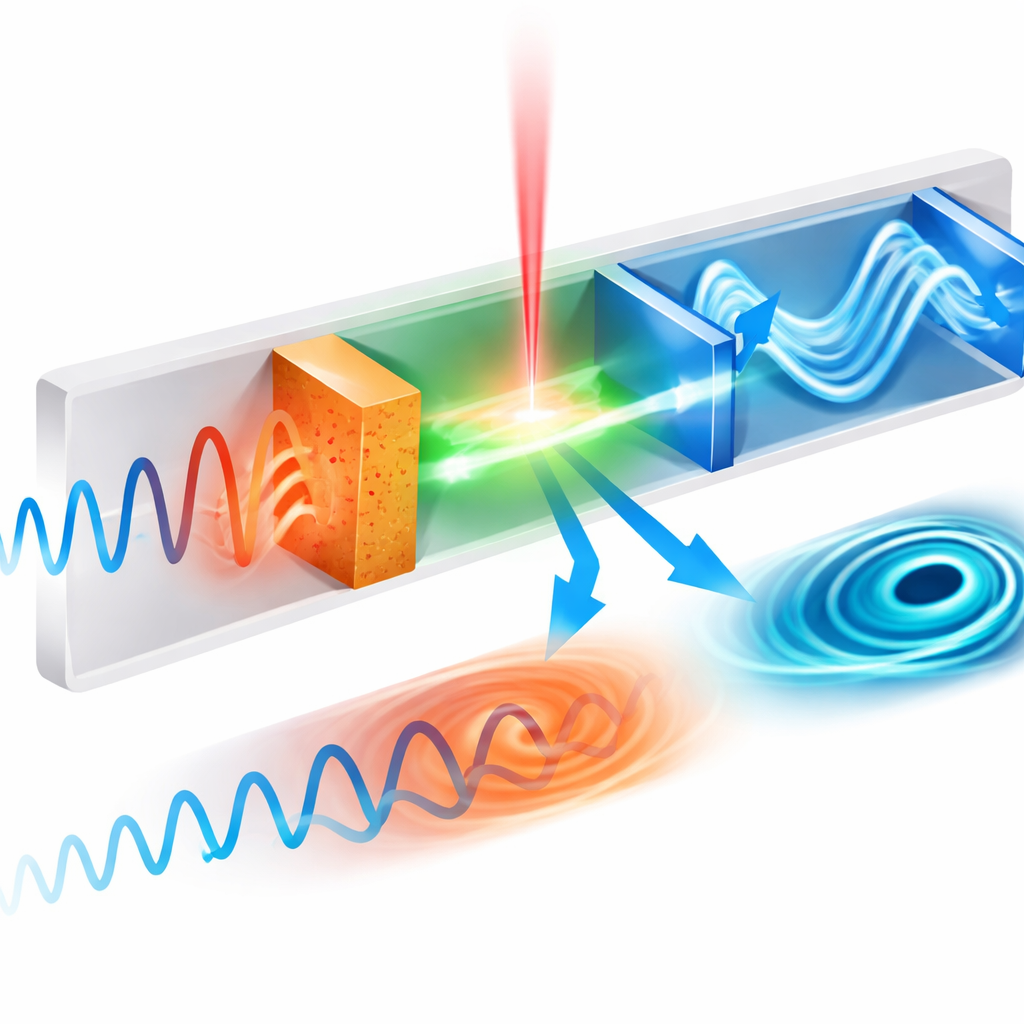
To understand how this tiny unit affects sound, the authors track how waves reflect and transmit when coming from either side. By changing the distance between the sponge and the nanotube film and adjusting the laser-driven gain, they steer the system through several distinct regimes. In some cases, sound arriving from the lossy side passes through almost perfectly with no echo, while sound from the opposite side still reflects strongly. In a second configuration, the roles are reversed and the “invisible” side switches. In yet another setting, the reflections from both sides become equal but mirror each other in phase, and the transmitted sound is purely real and the same in both directions. These three regimes correspond to different types of non-Hermitian phase transitions, including the elusive anti-PT case, and are pinpointed by special operating conditions known as exceptional points.
Spinning Beams and Twisted Sound
Beyond straight, plane-like waves, the team also engineers sound beams that carry orbital angular momentum—so-called acoustic vortex beams, whose pressure pattern winds around a central core like a tiny tornado. They create these beams by rotating a laser spot across the nanotube film, so that the heated region and resulting sound source trace a circle much faster than heat can spread. This continuous, contact-free method produces clean, stable vortex beams inside a cylindrical tube. When these swirling beams pass through the same loss–gain unit at a carefully chosen operating point, the system can flip the “twist” of the beam, effectively reversing its topological charge, and can do so differently depending on whether the beam comes from the loss side or the gain side.
From Exotic Physics to Future Sound Devices
In everyday terms, this study shows how a nearly invisible, laser-driven film and a simple piece of sponge can be combined to make sound behave in highly selective and directional ways—sometimes passing freely, sometimes reflecting, and sometimes twisting, all controlled by light. By unifying PT and anti-PT behaviors in a single acoustic platform and extending them to structured beams, the work provides a flexible recipe for next-generation sound devices. These could include ultra-sensitive sensors, compact acoustic chips, and topological sound components that route or filter audio and ultrasound in ways that conventional loudspeakers and microphones cannot achieve.
Citation: Zhang, H., Fan, R., Xiong, W. et al. Experimental observation of non-Hermitian phase transitions using laser-induced thermoacoustics. Nat Commun 17, 3236 (2026). https://doi.org/10.1038/s41467-026-69986-w
Keywords: laser-induced thermoacoustics, non-Hermitian acoustics, parity-time symmetry, acoustic vortex beams, carbon nanotube film