Clear Sky Science · en
Regional nonsense constraint offers biological and clinical insights into genetic disease
Why tiny glitches in our genes matter
Modern DNA tests are uncovering countless small genetic glitches, but doctors often struggle to tell which ones truly cause disease. This study focuses on a particularly tricky class: mutations that create an early "stop" signal in a gene, potentially chopping a protein short. Not all such mutations are equally harmful. By using DNA data from more than 700,000 people, the authors map which parts of thousands of genes are especially sensitive to these early-stop changes, and show how this information can sharpen diagnoses for people with rare disorders.
How cells police faulty messages
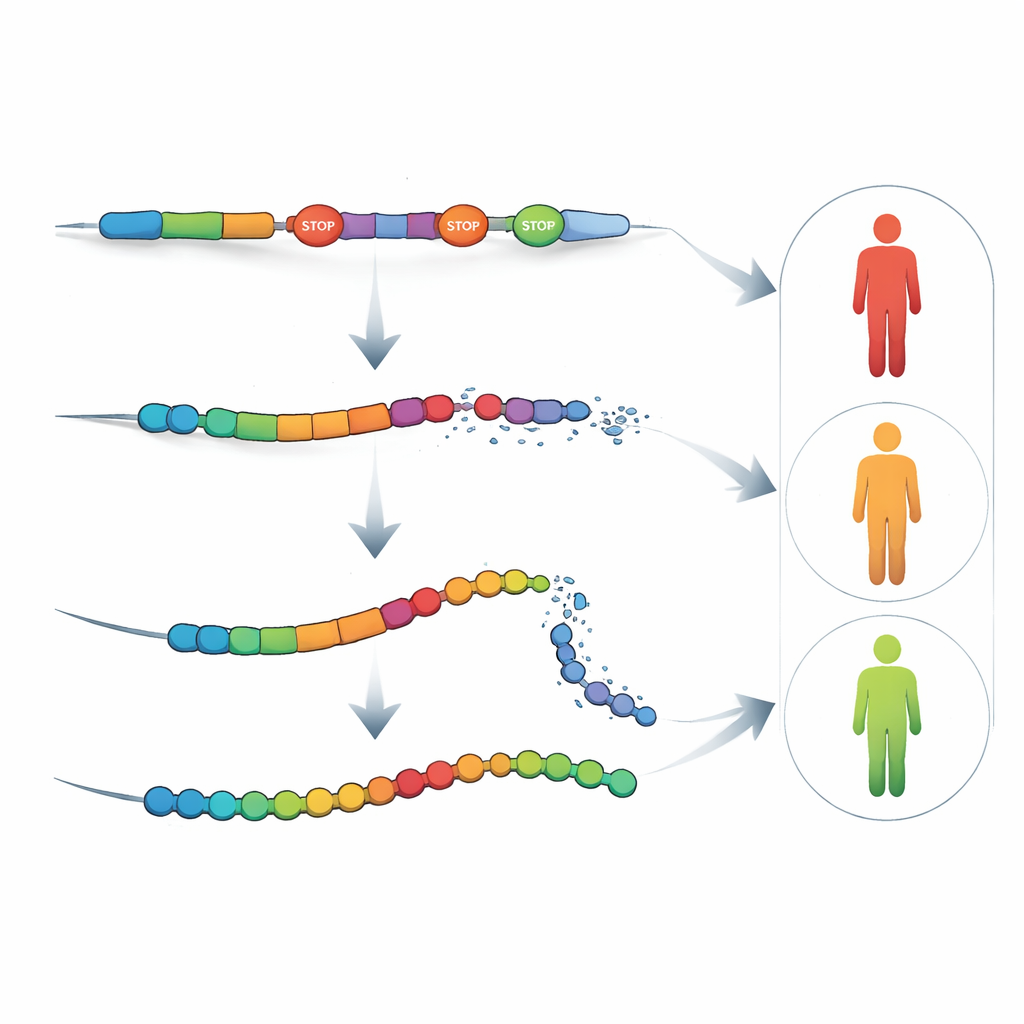
Our genes are copied into RNA messages, which are then read to build proteins. When a mutation inserts a premature "stop" signal into this message, the cell often activates a quality-control process called nonsense-mediated decay. This machinery detects the faulty message and destroys it, preventing the production of a truncated protein. But the system is not all-or-nothing. Whether decay is triggered depends strongly on where in the gene the stop appears. Early stops near the beginning, very late stops near the end, or stops in unusually long sections of a gene can sometimes slip through this surveillance, allowing shortened proteins to be made. Those truncated proteins may be harmless, may simply weaken gene function, or may actively interfere with normal proteins.
Mapping fragile and tolerant gene segments
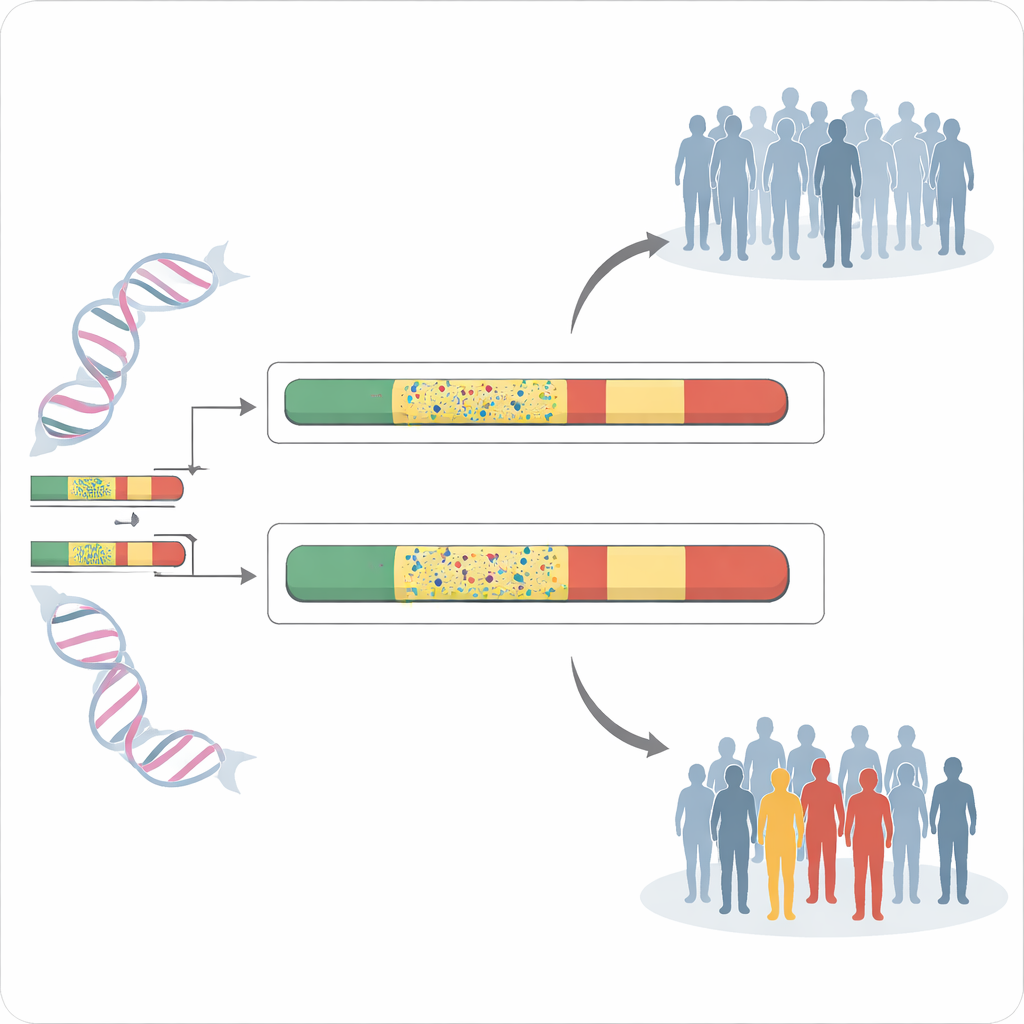
The researchers first divided each protein-coding gene into different positional zones: regions predicted to lead to message destruction, and regions where early stops are expected to escape that process. They then combined this map with enormous sequencing datasets from the gnomAD resource, totaling 730,947 individuals. By comparing how many early-stop mutations are actually observed in each region with how many would be expected by chance, they created a "regional nonsense constraint" score. Regions that carry far fewer early-stop mutations than expected are considered constrained, meaning that damaging changes there are likely weeded out by natural selection because they reduce health or reproductive success.
What the human population reveals
About 39 percent of the protein-coding genome falls into zones predicted to escape the cell’s decay machinery, yet many of these escape regions are still under strong constraint. Overall, the study finds 2,764 human genes with at least one region that is strongly depleted of early-stop mutations. Some genes are uniformly sensitive across their length, but many show sharp contrasts: certain segments tolerate truncation, while others are almost never hit in healthy people. Intriguingly, hundreds of these constrained regions would be missed by widely used whole-gene metrics, meaning that previous tools treated some genes as relatively tolerant even though specific segments are clearly fragile.
Clues for diagnosing rare diseases
To test how useful these maps are for patients, the team examined more than 32,000 families in which a child has a suspected genetic disorder and both parents have been sequenced. They focused on new, spontaneous early-stop or frameshift mutations not present in either parent. Such mutations in constrained regions were far more common than expected if they were harmless, with up to a roughly tenfold enrichment in certain late or long sections of genes. Children carrying a new truncating mutation in a constrained region had up to about six times higher odds of receiving a genetic diagnosis than those whose truncating mutation fell in an unconstrained region. The authors also identified 22 genes with clusters of such high-impact mutations but no established disease link, marking them as strong candidates for new genetic syndromes.
What this means for patients and doctors
This work shows that, for early-stop mutations, location is everything. Two mutations that both cut a protein short can have very different consequences depending on which segment of the gene they affect and whether the resulting message is destroyed or translated into a problematic protein. By quantifying which regions of thousands of genes are most intolerant to such changes, the study supplies a powerful new layer of evidence for interpreting genetic test results. In practice, this means doctors can be more confident that a truncating mutation in a highly constrained region is likely to be disease-causing, while similar changes in tolerant regions may be safely deprioritized. Ultimately, this regional view of genetic sensitivity promises more accurate diagnoses and faster discovery of previously unrecognized genetic diseases.
Citation: Blakes, A.J.M., Whiffin, N., Johnson, C.A. et al. Regional nonsense constraint offers biological and clinical insights into genetic disease. Nat Commun 17, 3152 (2026). https://doi.org/10.1038/s41467-026-69983-z
Keywords: nonsense-mediated decay, premature stop mutations, genetic constraint, rare disease diagnosis, protein-truncating variants