Clear Sky Science · en
Structural heterogeneity and substrate engagement mechanism of the bacterial proteasome activator Bpa
How a Bacterial Cleanup Machine Gets Switched On
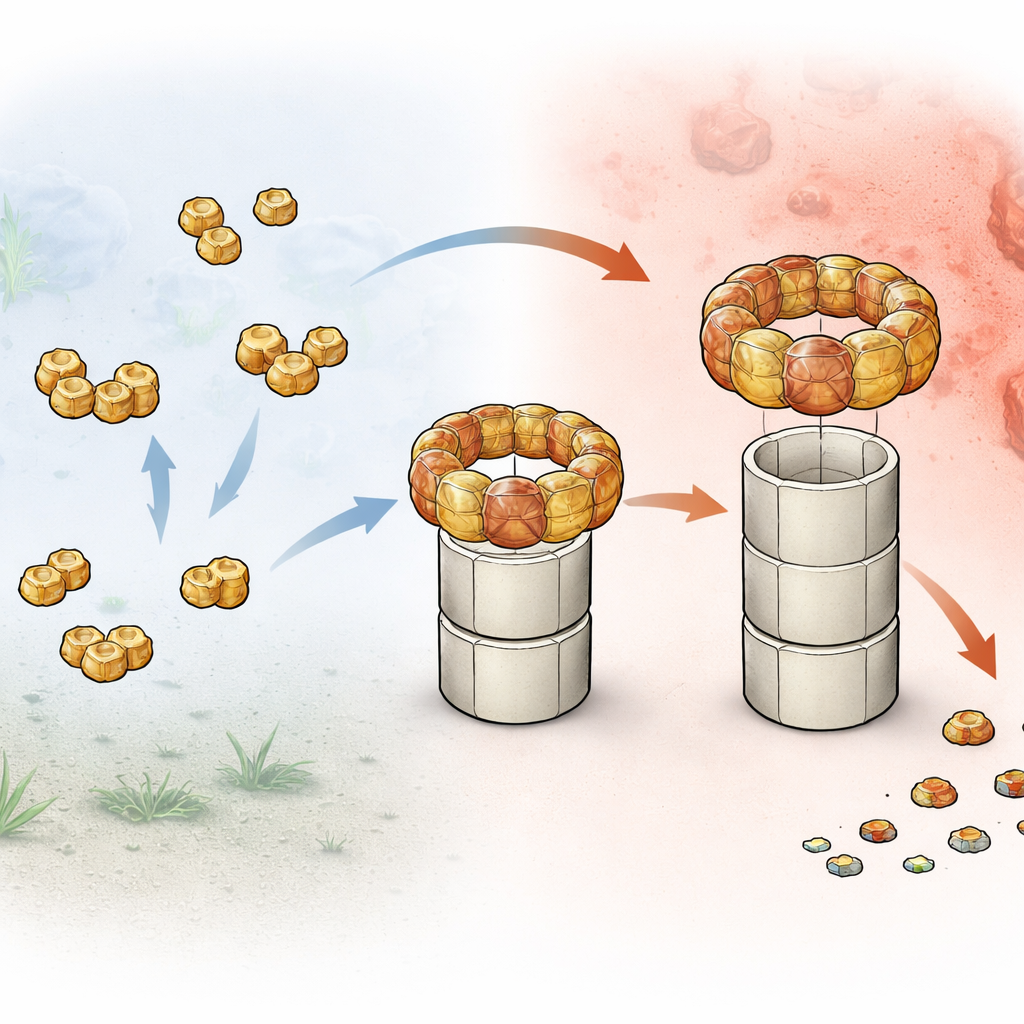
Bacteria that cause tuberculosis must constantly clean up damaged proteins to stay alive inside the human body. This paper looks at a key helper in that cleanup system, a ring-shaped protein called Bpa, which helps feed other proteins into a molecular “shredder” known as the proteasome. By uncovering how Bpa assembles and grabs its targets, the study points to new ways we might disable this machinery and weaken hard-to-treat tuberculosis infections.
A Hidden Weak Point in Tuberculosis Defenses
Mycobacterium tuberculosis, the microbe behind tuberculosis, survives inside our immune cells by resisting toxic stresses such as heat and reactive chemicals. To do this, it relies on a rare bacterial proteasome, a barrel-like structure that chews up unwanted proteins. Bpa is one of the gatekeepers that sits on top of this barrel and helps decide which proteins get destroyed. Unlike another, better-known partner that uses chemical energy (ATP), Bpa works without ATP and targets a different set of proteins, including a repressor that normally keeps heat-shock genes turned off. When that repressor is removed, the bacterium can quickly boost its stress-response systems. Yet until now, scientists did not know how Bpa itself was assembled in solution or how it recognized its protein clients.
Temperature as an On–Off Switch
The authors found that Bpa behaves like a temperature-sensitive switch. At low temperatures, Bpa exists mostly as smaller clusters—pairs and groups of four subunits. As the temperature rises to human body levels, these smaller pieces gradually rearrange into a larger ring made of twelve identical subunits. Using several high-resolution methods, including different kinds of mass spectrometry and nuclear magnetic resonance (NMR), the team measured how quickly this rearrangement occurs and mapped which parts of Bpa touch each other during assembly. They showed that sections of the protein that are tightly packed together in the four-part form must loosen and disengage before the functional twelve-part ring can form, revealing a built-in structural shift that responds to warmth.
Building a Tractable Test Substrate
Studying how Bpa grabs its natural client proteins has been difficult because its best-known target, a protein called HspR, is unstable and clumps easily in the test tube. To get around this, the researchers turned to a small, well-behaved fragment from a human DNA-binding protein called hTRF1. This 53–amino acid piece has been widely used as a model in other protein–quality-control studies and shares some key features with HspR, including a similar DNA-binding region and interaction with the same cellular chaperones. The team first confirmed that, in combination with the bacterial proteasome, Bpa can indeed drive the breakdown of this hTRF1 fragment, making it a suitable stand-in for harder-to-handle natural substrates.
How Bpa Grabs Disordered Protein Segments
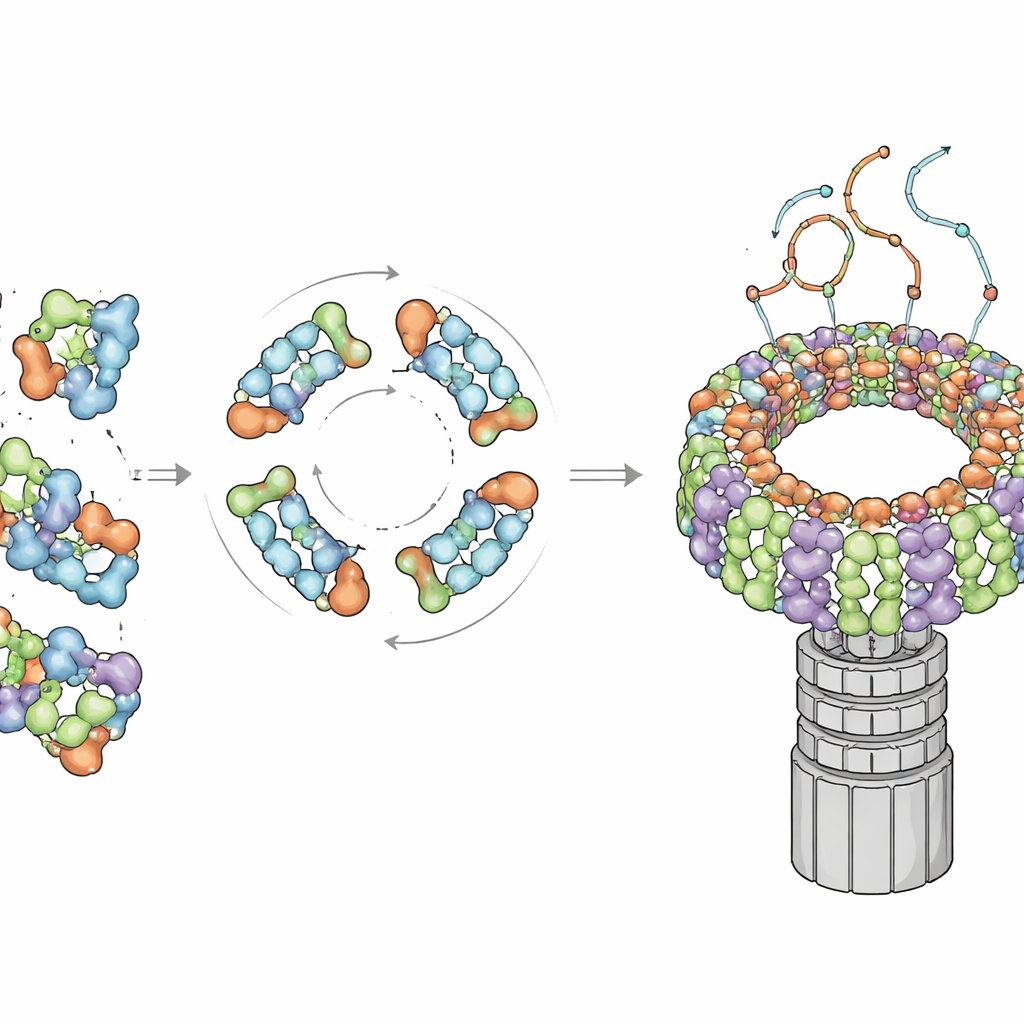
Armed with this model client, the researchers used specialized NMR techniques to zoom in on the interaction surface between Bpa and hTRF1. They discovered that only the fully assembled twelve-part Bpa ring presents the right surfaces for binding. On the inside face of the ring, near its lower edge, Bpa exposes stripes of water-repelling (hydrophobic) patches, flanked by positively and negatively charged regions. hTRF1, for its part, contributes two very short, greasy stretches of amino acids that sit within otherwise floppy, unstructured segments. When hTRF1 unfolds, these two hydrophobic patches latch onto the inner band of Bpa’s ring. By systematically deleting pieces of hTRF1, the authors showed that these patches act as primary hooks, while nearby charged residues help steer the client into place.
A Tunable Grip and a Crowded Ring
The team next asked how tightly Bpa holds onto its clients and how many can bind at once. By observing subtle shifts in the NMR signals of Bpa’s methyl groups as they titrated in hTRF1, they determined that a single Bpa ring can bind three hTRF1 molecules at a time. The strength of this grip depends on salt concentration: in lower salt, electrostatic attractions between charged regions on both partners strengthen the interaction, while in higher salt, these attractions are partially screened, leading to weaker binding. Across conditions, the binding remained specific—other test proteins lacking the right hydrophobic-and-charged pattern did not stick to Bpa—suggesting that Bpa is tuned to recognize particular sequence features rather than simply any floppy chain.
What This Means for Tuberculosis and Drug Design
Taken together, the results support a simple picture a non-expert can appreciate: when temperatures rise and stress mounts, Bpa’s small pieces snap together into a full ring that exposes just the right sticky patches on its inner surface. Disordered segments of client proteins that carry short greasy motifs can then dock into this ring, be handed off to the proteasome barrel, and broken down. Because tuberculosis bacteria rely on this system to survive inside human hosts, small molecules that freeze Bpa in its inactive four-part form, or that mask its inner sticky band, could block the cleanup process and weaken the pathogen. Beyond tuberculosis, the work offers a general blueprint for how bacteria might couple environmental changes, such as temperature shifts, to the activation of powerful protein-degrading machines.
Citation: Davis, B.T.V., Rennella, E., Haris, A. et al. Structural heterogeneity and substrate engagement mechanism of the bacterial proteasome activator Bpa. Nat Commun 17, 3332 (2026). https://doi.org/10.1038/s41467-026-69978-w
Keywords: Mycobacterium tuberculosis, proteasome activator Bpa, protein degradation, temperature-dependent assembly, substrate recognition