Clear Sky Science · en
Blunt-force assembly of programmable DNA architectures using π–π stacking
Building with Nature’s Tiny Bricks
DNA is best known as life’s instruction manual, but it is also a remarkably versatile construction material. For decades, scientists have snapped DNA strands together like LEGO bricks using short sticky ends that specifically recognize each other. This paper explores a bolder idea: can we build intricate 3D structures from DNA using only flat, blunt ends with no obvious matching pattern, and still keep the process programmable and precise? The answer turns out to be yes—and it opens the door to new kinds of nano‑scale materials and ways for mirror‑image molecules to communicate.
From Sticky Ends to Flat Connections
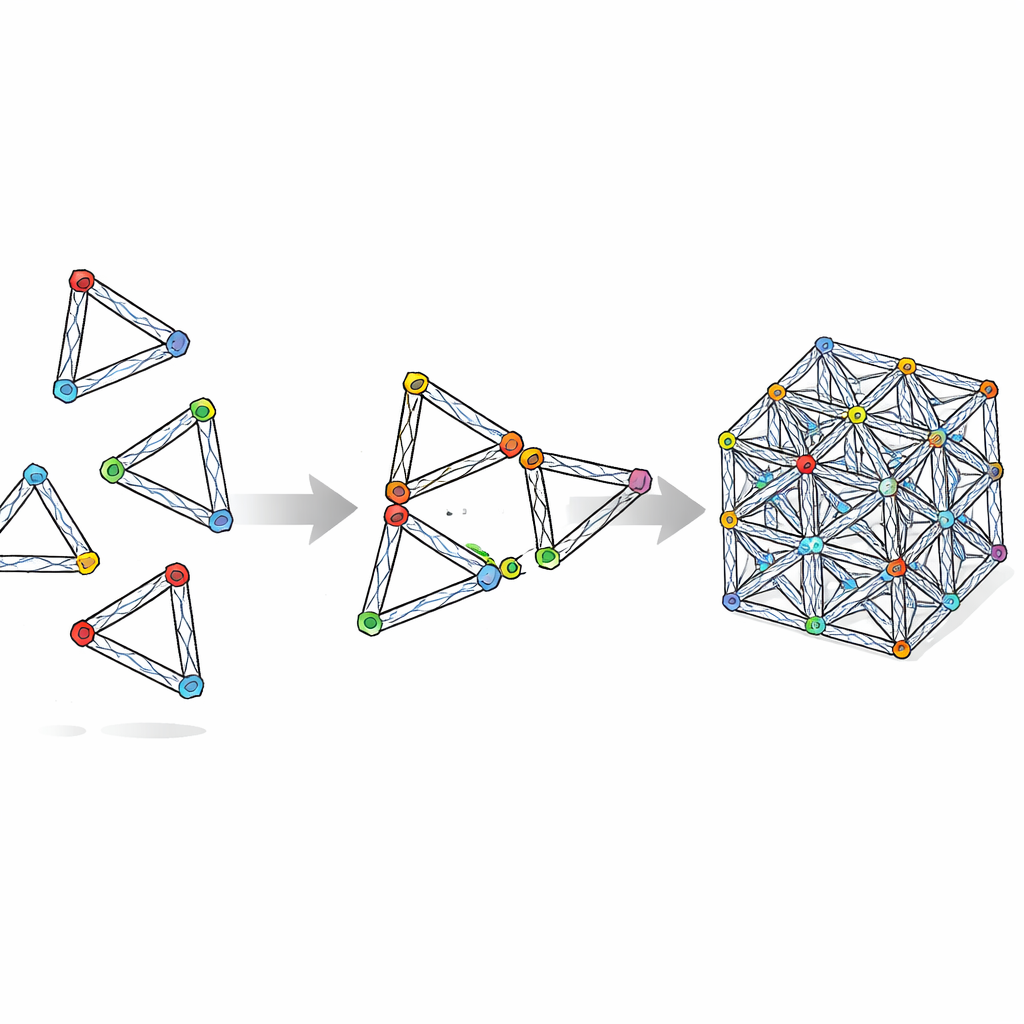
Traditional DNA nanotechnology relies on sticky ends—short overhanging segments that base‑pair with a matching partner—to guide self‑assembly. In that scheme, the genetic sequence acts as a postal code, telling each piece where to go, while subtle stacking of the flat bases helps lock the structure in place. By cutting off those overhangs, the authors force DNA tiles to meet edge‑to‑edge with blunt ends only. At first glance this seems like removing the address labels altogether. But at a blunt end, the flat, ring‑shaped bases can stack directly on one another, creating a rich landscape of attractive interactions. The team set out to see whether this hidden variation in base stacking could be turned into a design language for building crystals.
Designing Triangles That Choose Their Neighbors
The researchers worked with a well‑known DNA building block called the tensegrity triangle: three short double helices joined at their corners to form a rigid triangular tile. By adjusting edge lengths and which bases sat at the very tips, they created a library of tiles whose edges met through different combinations of purines and pyrimidines—the two broad classes of DNA bases. They then grew 3D crystals from these tiles and examined them by X‑ray diffraction. The resulting structures, which reached record‑high resolution for DNA nanomaterials, revealed six recurring ways that bases stack at the blunt interfaces. Some arrangements aligned bases neatly, giving gentle twists between tiles, while others involved sharper angles, flips, or crossings that produced more dramatic rotations. In every case, the choice of terminal bases and the overall triangle geometry worked together to decide how tiles packed in the final crystal.
Encoding Patterns into the Joints
Because the same triangular frame could host many different edge chemistries, the team could watch nearly identical tiles sort themselves into distinct crystal forms solely based on their end bases. Some combinations favored simple cubic lattices, others hexagonal or trigonal packs, and still others introduced inversion pairs where tiles stack on rotated copies of themselves. The authors pushed this further by designing “asymmetric” triangles that combined one traditional sticky end with two different blunt ends. In crystals grown from these mixed tiles, several types of cohesion—hydrogen bonding, blunt stacking, and self‑stacking—appeared along different directions. Together they produced zig‑zag cavities and new symmetries that would be difficult to achieve with sticky ends alone, showing that complexity can be encoded directly into the joints between tiles.
When Mirror Molecules Meet
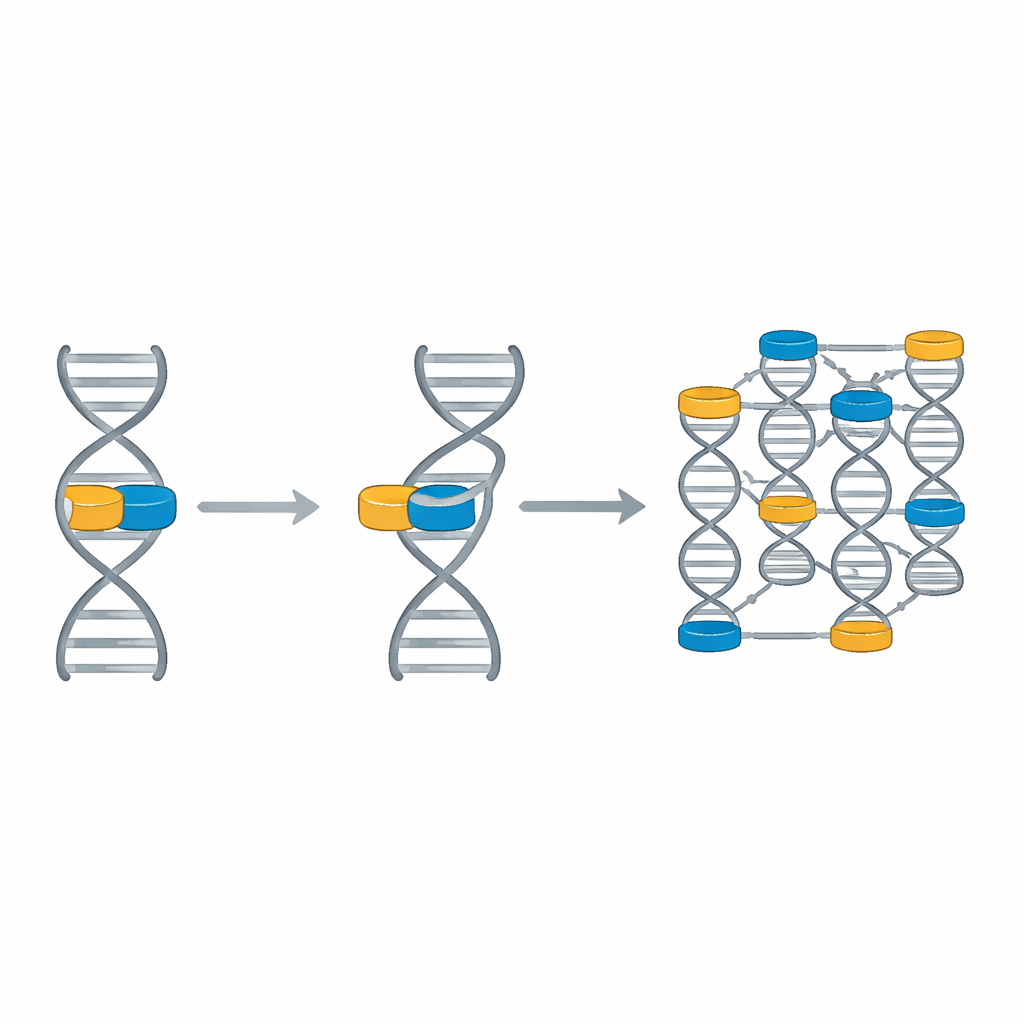
The study also tackles a timely question about mirror‑image DNA. Natural DNA comes in a right‑handed form (D‑DNA), but chemists can synthesize its left‑handed mirror (L‑DNA), which living systems barely recognize. The authors built left‑ and right‑handed versions of their triangles and gave them different fluorescent dyes so they could track how they mixed during crystallization. Depending on the choice of terminal bases, the two mirror types either blended into single crystals, stayed apart in separate crystals, or formed layered structures with interleaved sheets. In effect, the stacking interactions at blunt ends allowed mirror molecules to “decide” whether to mingle, separate, or grow on each other’s surfaces, suggesting a subtle way for our familiar biochemistry to interact with otherwise isolated mirror‑world materials.
Why This Matters for Future Nano‑Materials
Overall, the work shows that the flat faces of DNA strands—where aromatic rings stack—can be used as programmable connection points, not just passive glue. By cataloging how different base combinations and geometries influence the twist, orientation, and symmetry of assembled crystals, the authors lay out a design toolkit for high‑precision DNA lattices. These blunt‑end assemblies can reach very high structural resolution and support large cavities, making them promising scaffolds for studying guest molecules, tailoring light‑harvesting networks, or encoding complex patterns at the nanometer scale. For non‑specialists, the key message is that DNA is more than a code for life: it is an engineerable construction set whose invisible stacking forces can be harnessed to build new kinds of ordered matter—and even to manage communication between mirror‑image molecular worlds.
Citation: Woloszyn, K., Horvath, A., Jaffe, M. et al. Blunt-force assembly of programmable DNA architectures using π–π stacking. Nat Commun 17, 3136 (2026). https://doi.org/10.1038/s41467-026-69973-1
Keywords: DNA nanotechnology, self-assembly, pi stacking, DNA crystals, mirror-image DNA