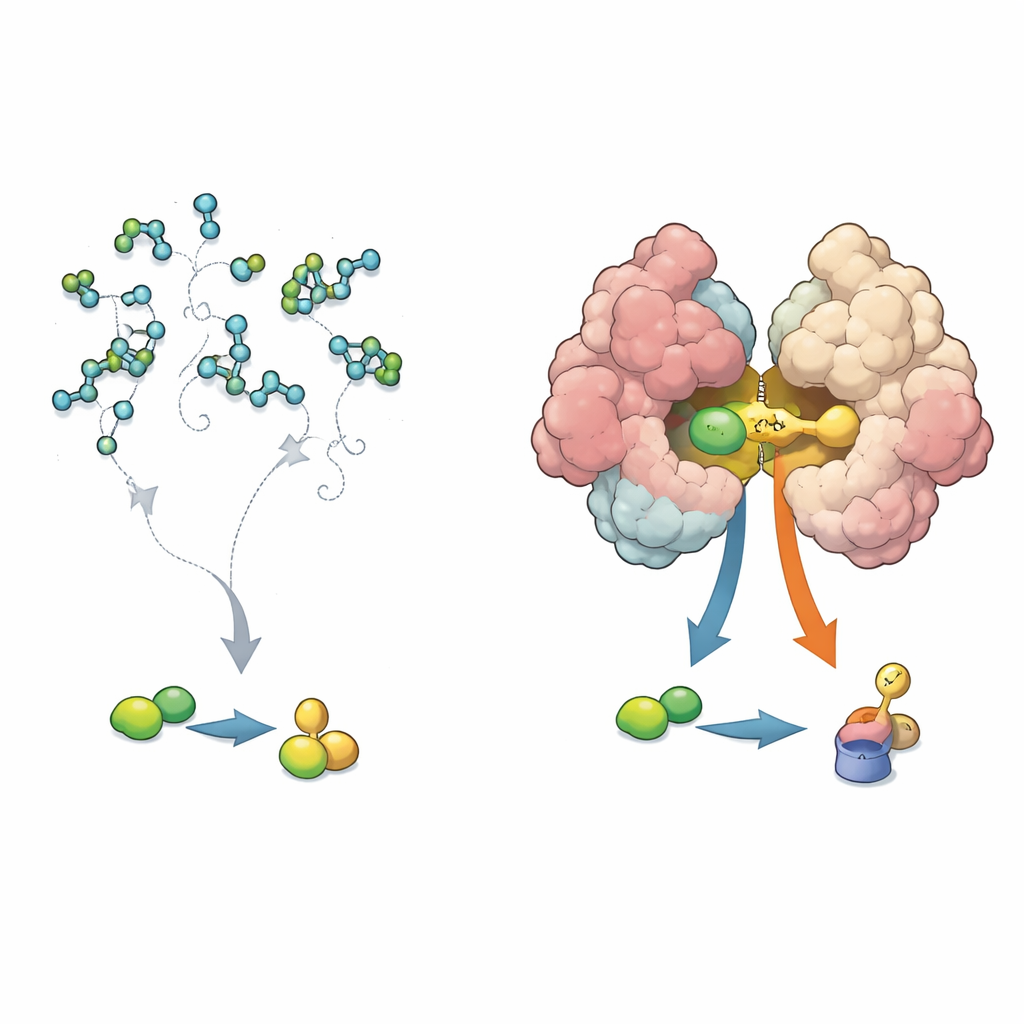
Chemists and drug makers constantly seek cleaner, more efficient ways to build complex molecules, especially those that must be made in one exact mirror-image form. This study shows how a naturally occurring protein can be retooled to use a simple building block of life— the amino acid L‑proline— as a powerful, highly selective catalyst. The work points toward a future where tailor‑made enzymes help manufacture medicines and fine chemicals with minimal waste and energy use.
Why Shape Matters in Chemistry
Many important molecules, including drugs, come in left‑ and right‑handed versions that behave very differently in the body. Traditional chemical methods often produce both versions at once, forcing companies to separate them later at considerable cost. Enzymes, the catalysts of life, excel at favoring one hand over the other, but natural enzymes evolved for biology’s needs, not industry’s. As a result, chemists are trying to design new enzymes that can carry out reactions rarely seen in nature, while still offering the high precision and mild operating conditions that make biocatalysts so attractive.
A Hidden Talent in a Bacterial Protein
The team focused on LmrR, a protein from the bacterium Lactococcus lactis known not for catalysis but for its roomy, water‑repelling pocket. Earlier work showed that this pocket could be outfitted with metal ions or light‑absorbing dyes to create artificial enzymes. Here, the authors asked a different question: could LmrR itself, using only its natural amino acids, carry out a key carbon–carbon bond‑forming reaction known as an aldol addition? They discovered that unmodified LmrR can already speed up an aldol reaction between cyclohexanone and an aromatic aldehyde in water, achieving high conversion but poor preference for one mirror‑image product. Tests and mass measurements traced this activity to three lysine residues whose reactive nitrogen atoms temporarily bind the starting materials inside the pocket.
Freeing Proline to Do the Heavy Lifting Figure 1.
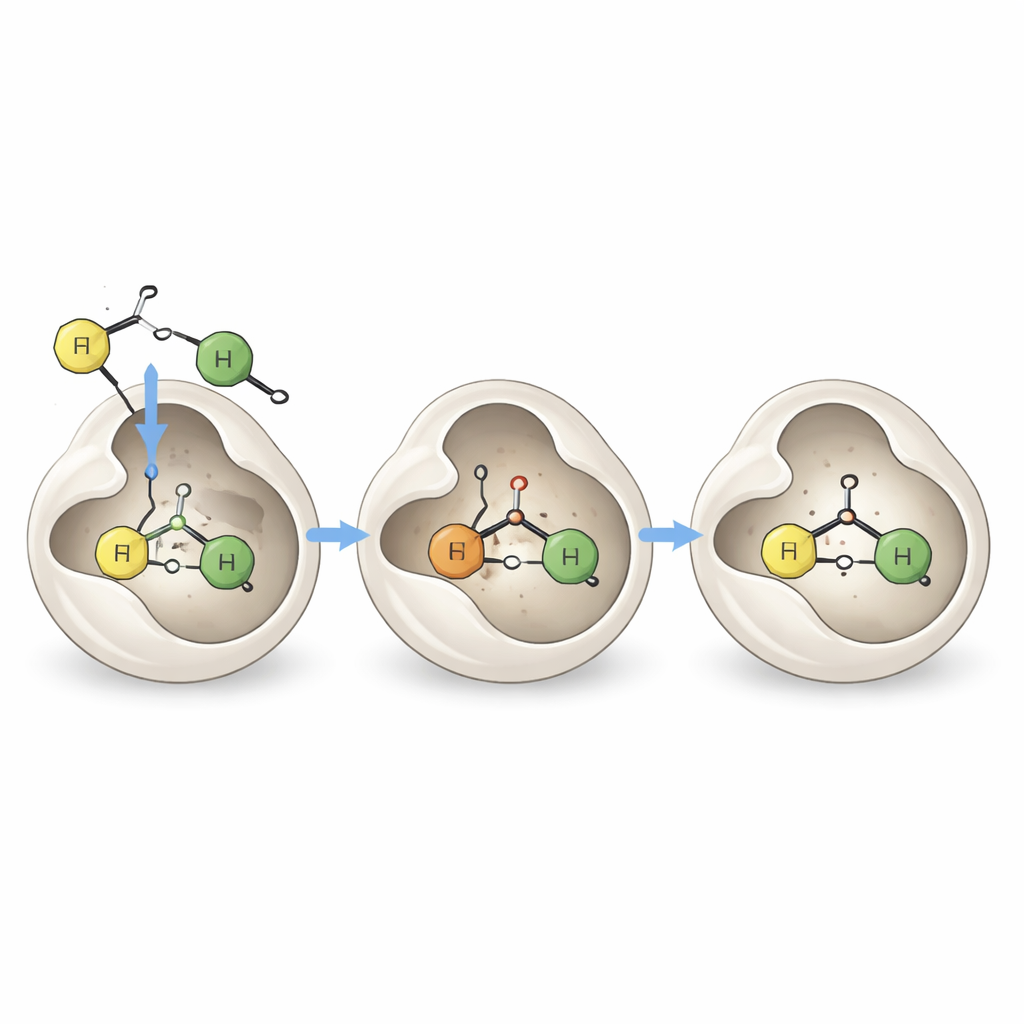
Instead of laboriously reshaping the lysine‑based site to improve selectivity, the researchers turned to another amino acid: L‑proline. In small‑molecule form, proline is a classic “organocatalyst” for aldol reactions, but inside proteins its key nitrogen atom is usually tied up in peptide bonds and cannot act. Notably, LmrR carries a proline near its beginning. By trimming away the first four amino acids, the authors moved this proline to the very start of the chain, where its nitrogen becomes free and reactive. Further deletions nudged this exposed proline deeper into the hydrophobic pocket, closer to aromatic side chains that help corral the starting molecules. Chemical trapping experiments confirmed that, in these engineered variants, the new N‑terminal proline forms the same kind of transient intermediate seen in classic proline‑based organocatalysis, while the original lysines are rendered catalytically silent.
Fine-Tuning the Pocket for One-Handed Products Figure 2.
With the proline now acting as the sole catalytic center, the team used targeted mutations to reshape nearby residues and subtly adjust the local environment. Removing certain polar side chains reduced unwanted hydrogen‑bonding to the incoming aromatic aldehyde, while introducing flexible or helix‑breaking residues near the N‑terminus gave the catalytic proline more freedom to adopt a geometry that distinguishes between left‑ and right‑handed pathways. Over three rounds of design, they arrived at a variant called LPEK4, which maintained robust activity yet improved its preference for one mirror image by more than ten‑fold compared with the original LmrR. Although the rate of reaction dropped somewhat—likely because fewer amino acids participate directly in bond‑making—the gain in selectivity more than compensated from a synthetic standpoint.
From One Reaction to a Versatile Platform
Beyond a single model reaction, LPEK4 proved capable of handling a broad menu of aromatic and heteroaromatic aldehydes, delivering products in up to 99% yield and greater than 99% mirror‑image purity under mild, water‑based conditions. By adjusting temperature and acidity, the researchers found a sweet spot—cool, slightly acidic buffer—that balanced speed with near‑perfect selectivity. The engineered protein stayed structurally sound and retained its hallmark pocket, as verified by several biophysical techniques. Together, these results show that carefully positioning a natural proline residue inside a protein cavity can unlock latent catalytic power without resorting to exotic nonnatural building blocks.
What This Means for Greener Chemistry
To a non‑specialist, the key message is that the authors have turned an ordinary protein into a highly selective chemical tool simply by rearranging and tweaking its own amino acids. By freeing and repositioning a built‑in proline residue, they created a catalyst that carries out an industrially valuable reaction with excellent control over molecular “handedness,” all in water and at low temperatures. This strategy could be extended to other proteins that harbor proline near a pocket or cavity, offering a practical route to new enzymes for making pharmaceuticals and specialty chemicals in a cleaner, more sustainable way.
Citation: Lu, H., Liu, WQ., Ji, X. et al. Engineering LmrR protein for L-proline-based asymmetric aldol biocatalysis.
Nat Commun17, 3269 (2026). https://doi.org/10.1038/s41467-026-69968-y
Keywords: biocatalysis, enzyme engineering, organocatalysis, asymmetric synthesis, LmrR protein