Clear Sky Science · en
Photoelectrocatalytic-microbial biohybrid for succinic acid synthesis
Turning Waste into a Useful Ingredient
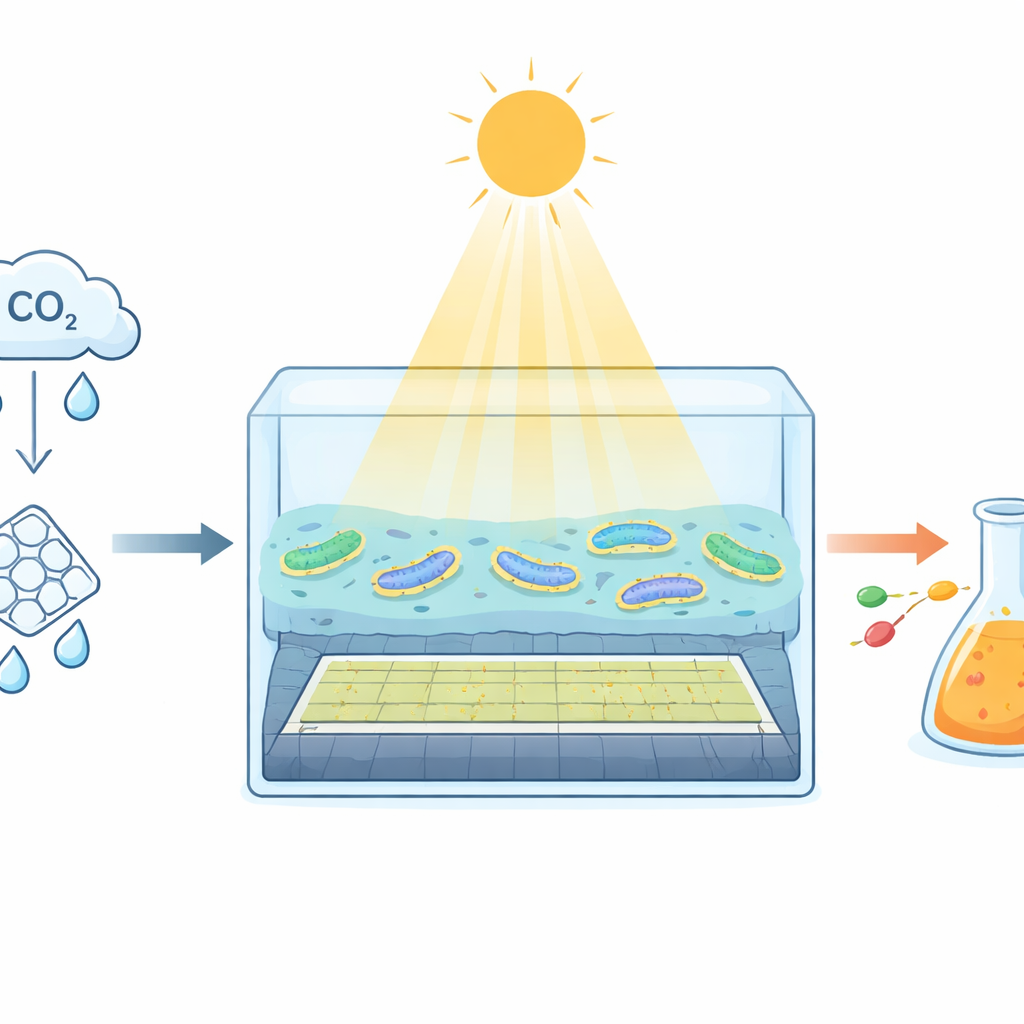
Succinic acid may not be a household name, but it quietly underpins everyday products, from food flavorings and medicines to solvents and biodegradable plastics. Today it is mostly made from fossil fuels in energy-hungry factories that emit greenhouse gases. This study explores a very different route: using sunlight, carbon dioxide, and specialized bacteria wired to an artificial electrode to make succinic acid in a cleaner, potentially carbon‑neutral way.
Why This Everyday Molecule Matters
Succinic acid is a versatile building block that can be transformed into materials such as soft plastics, solvents, and pharmaceutical ingredients. Global demand is rising, yet most commercial production still relies on petrochemicals derived from liquefied petroleum gas or maleic anhydride. These methods require high temperatures and pressures and generate unwanted emissions and toxic by‑products. Microbes can instead ferment plant‑based sugars into succinic acid, promising lower energy use and a smaller environmental footprint. However, even the best natural strains struggle to reach the productivity needed for large, economical factories.
Recruiting a Ruminal Microbe
The bacterium Actinobacillus succinogenes, originally isolated from the stomach of cattle, is one of the most efficient natural producers of succinic acid. It converts glucose into an intermediate compound that can either flow into a “good” pathway yielding succinic acid, or into competing routes that produce side products such as acetic and formic acids. Crucially, the succinic acid branch needs a strong supply of electrons and carbon dioxide to operate at full capacity. Under ordinary fermentation conditions, the bacterium’s internal electron‑handling machinery becomes a bottleneck, slowing down production and diverting some of the carbon into less valuable chemicals.
Building a Sun‑Powered Living Electrode
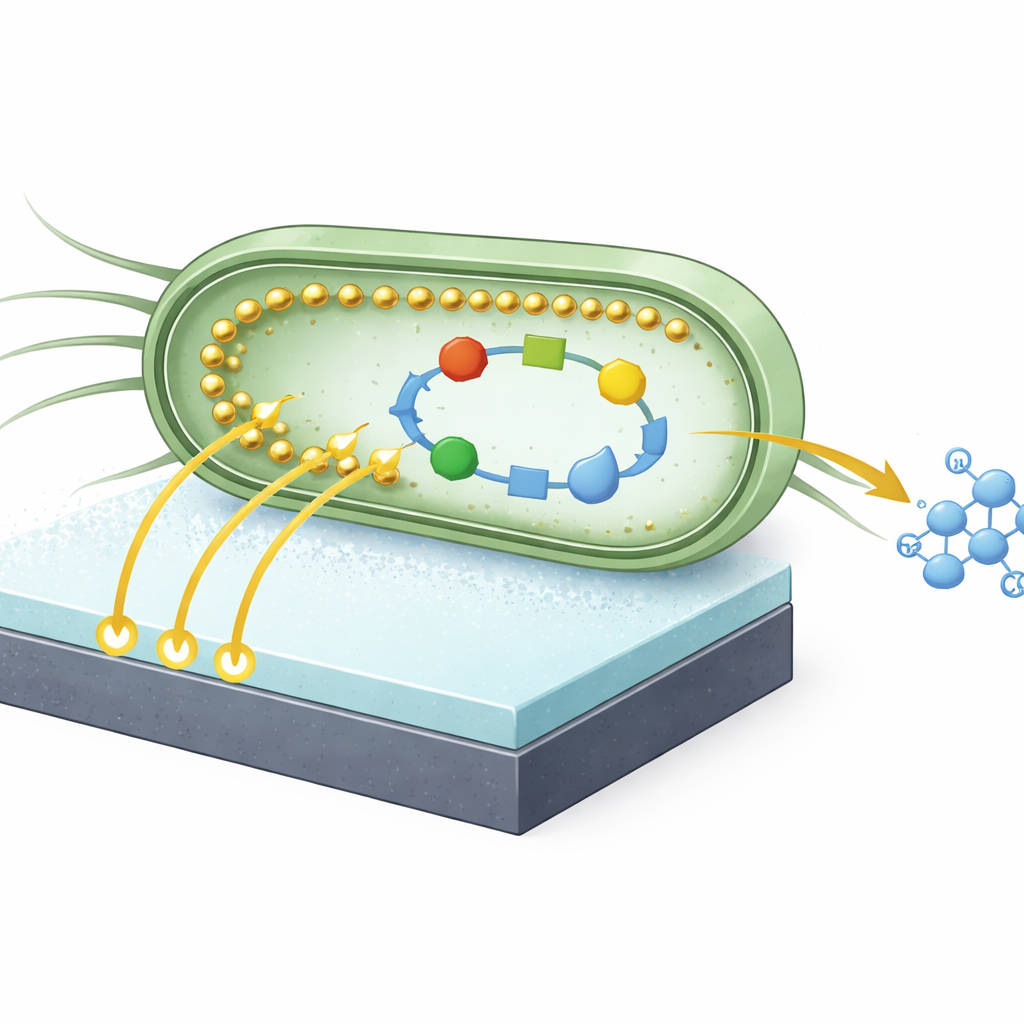
To overcome this bottleneck, the researchers created a hybrid device that marries a light‑absorbing electrode with living bacteria. The base is a thin layer of nickel oxide grown on nickel foam, which behaves as a p‑type semiconductor: under simulated sunlight and a small applied voltage, it generates a flow of electrons. This surface is coated with a water‑rich polymer hydrogel that presents chemical groups able to “grab” onto bacterial surface proteins, anchoring dense layers of cells while keeping them hydrated and active. Into the bacteria themselves, the team slowly introduced gold ions through an adaptive evolution process, allowing the cells to reduce these ions into tiny gold nanoparticles that accumulate near their inner membrane without killing or deforming them.
How the Hybrid System Boosts Production
In the final configuration, sunlight frees electrons in the nickel oxide electrode, which travel through the hydrogel and then into the gold nanoparticles embedded in the bacterial envelope. These gold particles act like nanoscale wires, shortening the distance electrons must cross to reach the cell’s internal metabolism. Measurements showed that gold‑bearing bacteria conducted charge more readily and exhibited faster electronic relaxation, consistent with speedier electron transfer. Inside the cells, this extra reducing power increased the energy currency ATP and shifted the balance of key redox molecules, pushing carbon away from side pathways and toward the four‑carbon route that yields succinic acid. When operated under a modest bias in a carbon‑dioxide‑rich solution, the hybrid system reached a succinic acid production rate of about 1.4 grams per liter per hour per square centimeter of electrode—far higher than dark fermentation alone—and converted roughly two‑thirds of the incoming CO2 into this single useful product.
Stability and Practical Promise
Beyond raw productivity, the authors tested how robust the living electrode would be in situations more akin to real manufacturing. The bacteria remained viable and even multiplied during extended operation, and the photocurrent stayed stable for many hours. Over several days of alternating light and dark cycles—mimicking day and night by switching between photo‑assisted and purely electrical modes—the system continued to make succinic acid, though at a slower rate in the absence of light. Comparative experiments with simpler electrodes or bacteria lacking internal gold showed clearly that both the sticky hydrogel layer and the intracellular nanoparticles were crucial to achieving high yields and strong carbon‑dioxide conversion.
What This Means for a Cleaner Chemical Future
In essence, this work shows that carefully “wiring up” microbes to a solar‑driven electrode can turn them into far more powerful chemical factories. By supplying electrons directly through engineered interfaces—rather than relying solely on the microbe’s own metabolism—the researchers steered carbon dioxide and sugar into succinic acid with impressive efficiency and stability. While scaling such systems to industrial volumes will require advances in reactor design and light management, the study offers a concrete proof of concept: hybrid devices that blend nanomaterials with living cells could help shift the chemical industry away from fossil resources and toward sunlight and waste carbon as primary inputs.
Citation: Feng, T., Zhou, X., Zhang, Y. et al. Photoelectrocatalytic-microbial biohybrid for succinic acid synthesis. Nat Commun 17, 3112 (2026). https://doi.org/10.1038/s41467-026-69962-4
Keywords: succinic acid, biohybrid electrode, CO2 utilization, solar-driven biocatalysis, Actinobacillus succinogenes