Clear Sky Science · en
Crystallization-assisted water adsorption in amorphous molecular adsorbents
Why drying gas really matters
Before natural gas or key building-block chemicals like ethylene reach our homes and factories, they must be carefully dried. Even tiny traces of water can corrode metal pipes, form icy plugs that block flow, and shorten the life of expensive equipment. Today’s drying agents work, but they are energy-hungry, can slowly fall apart, and often need harsh processing to be reused. This study reports a new class of simple, reusable solids that grab water very strongly while letting valuable fuel molecules slip by untouched—offering a cleaner, cheaper way to keep our gas streams dry.
A new kind of water sponge
The researchers designed a family of small metal–organic molecules, called M-PyC, built from abundant metal ions such as manganese, cobalt, nickel, or zinc connected to a common organic component derived from pyridine. Unlike traditional drying materials that depend on permanent pores or channels, these compounds behave more like tiny clusters held together by a three-dimensional web of hydrogen bonds and coordinated water molecules. Each metal center binds four water molecules and two organic linkers, and neighboring units interlock via strong hydrogen bonding. This creates a solid that, despite being nearly nonporous to gases, can store a surprisingly large amount of water—about 30% of its own weight.
Switching between ordered and disordered states
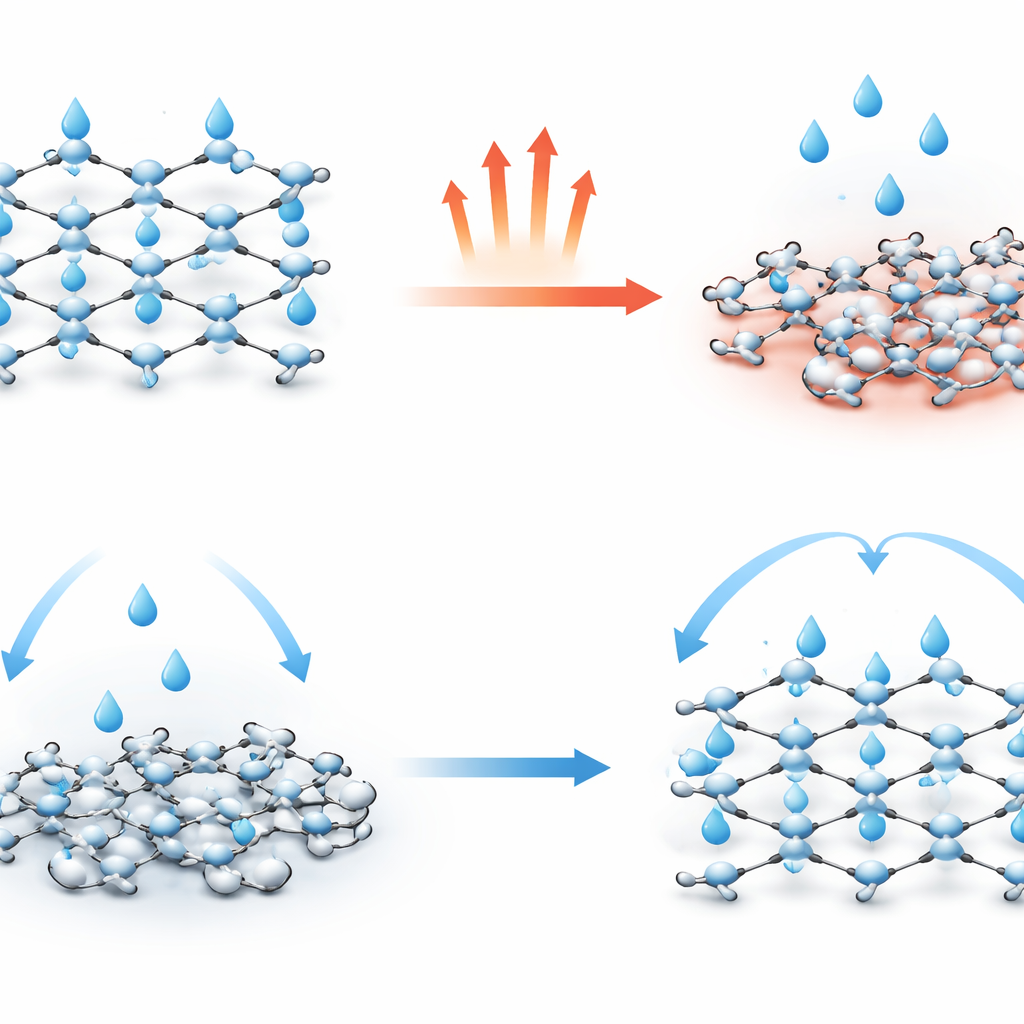
The key trick is a reversible shape-shift between an ordered crystalline form and a disordered amorphous form. When the solid is gently heated in air to about 90–120 °C, the bound water molecules are driven off. As they detach, the hydrogen-bonded network collapses and the material becomes amorphous, losing its long-range order. Yet its basic molecular building blocks remain intact. When this dry solid is exposed again to water vapor or liquid water, the water molecules rebind to the metal centers, rebuild the hydrogen-bonded network, and restore the crystalline structure. This back-and-forth transformation can be repeated many times, with the solid regaining its original structure and water-holding capacity.
Drying gas while ignoring fuel
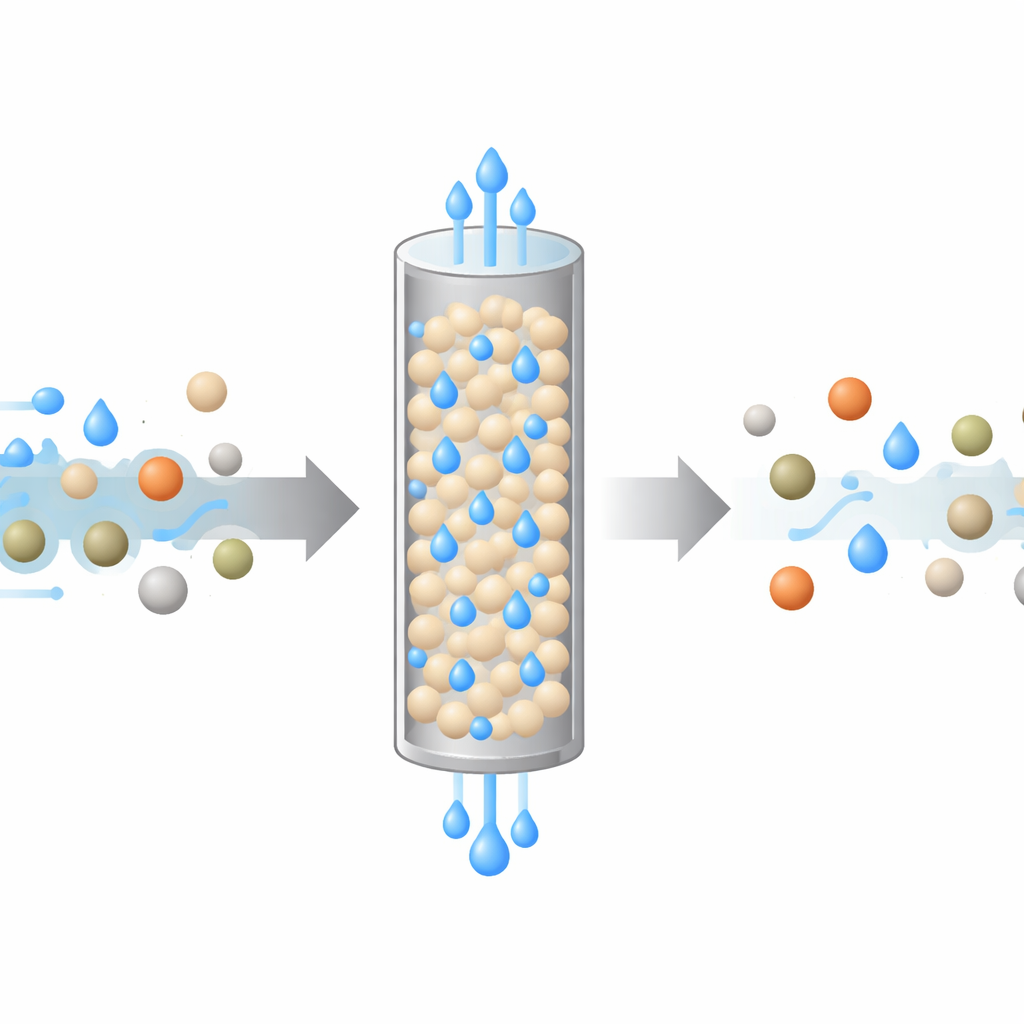
Because the dry M-PyC material is essentially nonporous, common fuel molecules such as methane, ethylene, and propylene cannot easily lodge inside it. At the same time, water molecules bond directly to the metal centers and help reconstruct the crystal, leading to strong and selective capture. Measurements show that water uptake is comparable to or better than that of commercial alumina and zeolite drying agents at room temperature, and it falls much less as temperature rises. Tests with mixed gas streams that mimic real natural gas and petrochemical feeds reveal that water is held back in the column while hydrocarbons pass through almost immediately, emerging with water levels below one part per million—far drier than industrial specifications require.
Fast reuse with gentle heating
For an industrial drying agent, it is not enough to capture water; it must also release it quickly and cheaply so the material can be reused. Here, the crystallization-assisted mechanism offers a significant advantage. Because regeneration simply requires breaking the water–metal connections and allowing the hydrogen-bonded network to relax into the amorphous state, complete drying of the solid can be achieved by modest heating at 90–120 °C in ordinary air. This is far cooler than the 200–300 °C often needed for zeolites and does not require a protective atmosphere. The new sorbent also retains its performance over at least 100 adsorption–desorption cycles and remains stable after months in humid air, boiling water, strong acid, or strong base, and even in sulfur-containing solutions. The synthesis itself is simple and green: a one-step water-based process that has already been scaled up to produce more than a kilogram of material.
What this means for cleaner industry
By showing that a nearly nonporous, amorphous material can repeatedly “crystallize” around water molecules and then let them go with gentle heating, this work proposes a fresh strategy for industrial drying. Instead of painstakingly preserving delicate crystalline frameworks, engineers can rely on robust molecular clusters that function best in their disordered form. These M-PyC compounds combine high water capacity, exceptional selectivity against hydrocarbons, low energy use for regeneration, and long-term stability under harsh conditions. Together, these traits make them strong contenders to replace or complement traditional drying agents, potentially reducing energy use, costs, and environmental impact in natural gas processing and petrochemical production.
Citation: Xie, F., Yu, L., Teat, S. et al. Crystallization-assisted water adsorption in amorphous molecular adsorbents. Nat Commun 17, 3098 (2026). https://doi.org/10.1038/s41467-026-69953-5
Keywords: natural gas dehydration, water adsorption, molecular desiccants, petrochemical processing, gas purification