Clear Sky Science · en
Gas separation with binary-cooperative heterogeneous membranes
Why smarter filters for gases matter
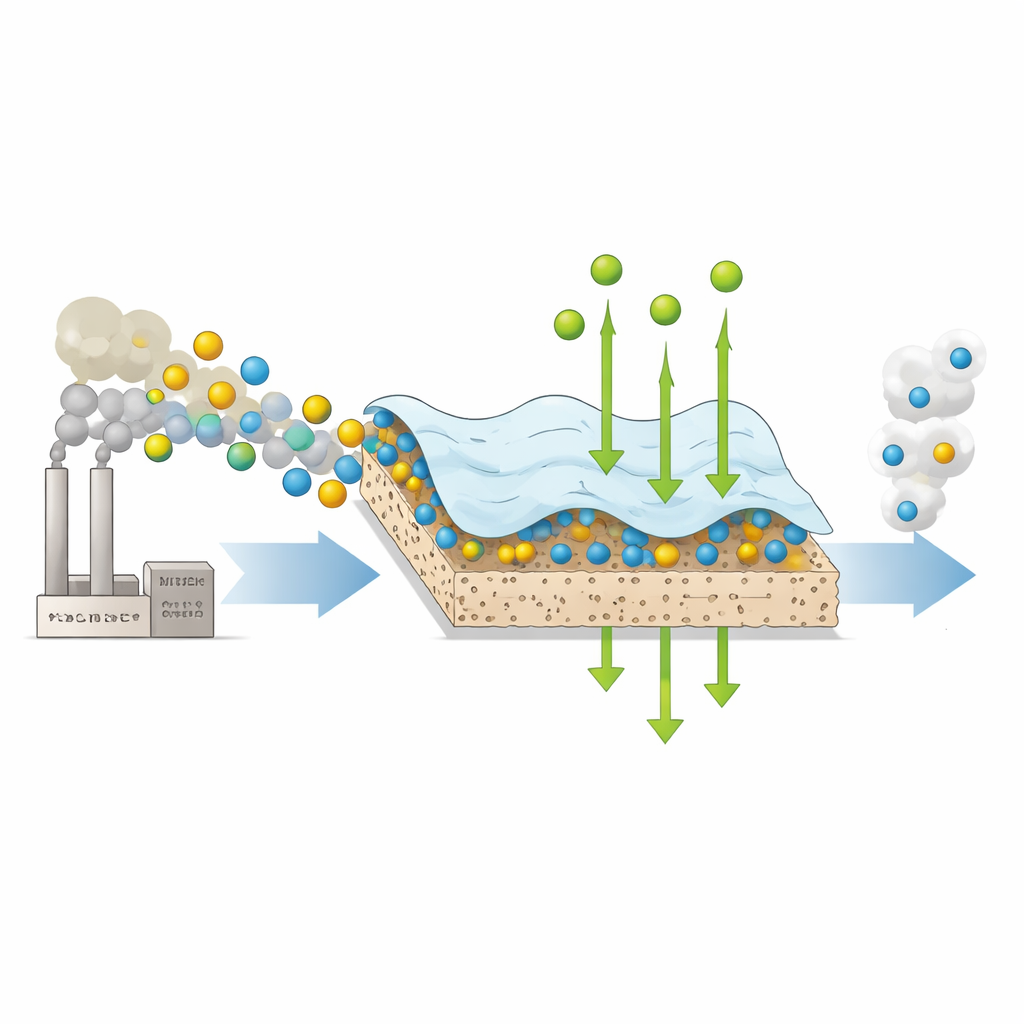
Modern life depends on massive industrial plants that separate gases for fuels, plastics, fertilizers and, increasingly, for cleaning up carbon dioxide from exhaust. Today, many of those separations are done with heat-hungry distillation towers that burn through energy and money. Thin plastic-like filters, called membranes, can do the same job using far less energy, but the best-performing versions tend to sag or compact under real operating pressures, losing their edge just when they are most needed. This study describes a new kind of membrane that keeps working hard under pressure, pointing toward more efficient systems for capturing carbon dioxide and handling other difficult gas mixtures.
A new kind of wavy filter
The researchers set out to solve a long-standing trade-off: membranes that let gas through quickly often collapse or rearrange under pressure, while sturdier ones slow the gases too much. Drawing inspiration from tough natural materials like bone and tooth enamel, which combine different building blocks to share stress, the team deliberately built a membrane with two cooperating regions rather than one uniform material. Using a controlled reaction at the interface between two liquids, they grew an ultrathin polyamide film atop a soft silicone-based support. Under carefully tuned conditions, this film spontaneously formed a crumpled, hill-and-valley surface instead of lying flat.
Peaks and valleys that work together
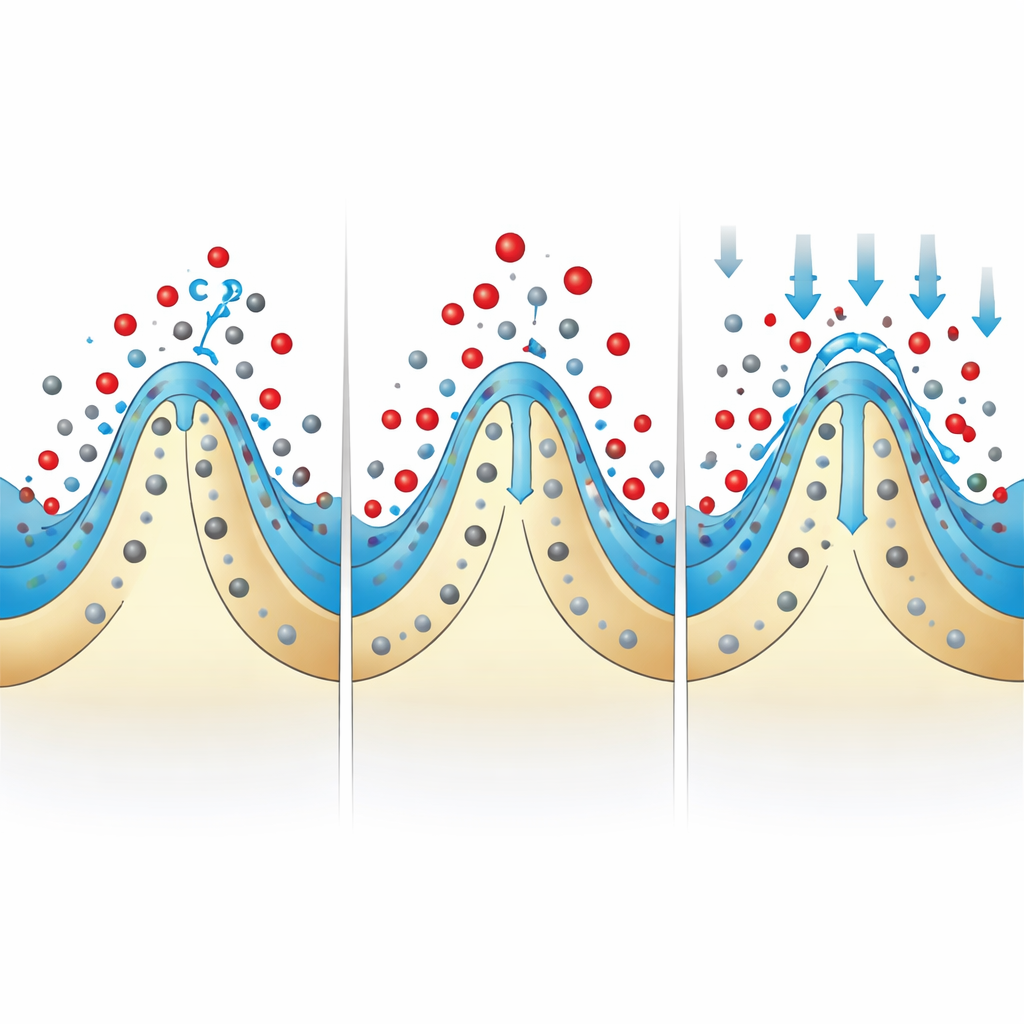
Closer analysis revealed that these surface peaks and valleys are not just shapes—they are chemically distinct zones. With advanced microscopy that can also read chemical signals, the authors showed that the peaks are richer in amide groups, which interact strongly with carbon dioxide, while the valleys contain more rigid ring-shaped units. This subtle reorganization of chemical groups, driven by how the reaction unfolds inside tiny pores in the support, creates what the authors call a heterogeneous membrane: the peaks act as fast lanes for carbon dioxide, and the valleys behave like stiff pillars that resist crushing and help keep open spaces for gas to move.
Built-in shock absorbers under stress
To see how the wavy structure responds to stress, the team stretched and compressed the membranes while watching their surfaces at the nanoscale. Under repeated stretching, crumpled regions of the heterogeneous membranes gently flattened and then sprang back, avoiding the cracks that quickly appeared in otherwise similar but smooth, uniform films. Vertical pressing tests showed that the peak zones are softer, deforming more readily, while the valleys are stiffer and harder to compress. This “soft-on-stiff” arrangement lets the membrane absorb both sideways and head-on forces without forming damage-prone stress hot spots, much like a carefully engineered suspension system.
Faster carbon dioxide with fewer leaks
The real test, however, is gas separation. When the membranes were challenged with mixtures of carbon dioxide and nitrogen at practical pressures up to about ten times atmospheric, the heterogeneous, crumpled version far outperformed the smoother, uniform one. An optimized sample delivered roughly three times the carbon dioxide throughput and higher carbon dioxide–over–nitrogen selectivity at one megapascal, and maintained its performance over pressure cycles and at temperatures mimicking hot flue gas. Clever experiments using charged gold nanoparticles as tracers, together with computer simulations, confirmed that gas moves more rapidly through the peak regions while the valleys guard against collapse, keeping pathways open even as pressure rises.
Implications for cleaner industrial separations
By designing a membrane that is both fast and tough, this work offers a practical route toward lower-cost carbon dioxide capture and other demanding separations. Economic modeling suggests that the new material could cut the energy and equipment footprint for removing carbon dioxide from power-plant exhaust, lowering the cost per tonne captured. More broadly, the strategy of building membranes with cooperating, chemically distinct zones—rather than striving for perfect uniformity—could be extended to other gas and liquid mixtures that are currently hard to separate. In the long run, such “binary-cooperative” membranes may help shrink the environmental impact of the chemical industry while making advanced separations more accessible.
Citation: Wang, B., Zhang, C., Zhang, J. et al. Gas separation with binary-cooperative heterogeneous membranes. Nat Commun 17, 3325 (2026). https://doi.org/10.1038/s41467-026-69949-1
Keywords: gas separation membranes, carbon dioxide capture, heterogeneous polymer films, interfacial polymerization, industrial separations