Clear Sky Science · en
Chip scale coil stabilized Brillouin laser driving a room temperature trapped ion qubit
Sharper Light for Tiny Quantum Machines
Quantum computers and ultra-precise clocks promise navigation systems, sensors, and timekeeping devices far beyond today’s technology. But the lasers that drive the key quantum bits (qubits) are usually bulky, fragile, and tied to lab benches. This paper shows that a laser system small enough to fit on chips can still deliver the ultra-clean light needed to control a single trapped ion at room temperature—an important step toward portable quantum devices.
From Room-Size Lasers to Chips
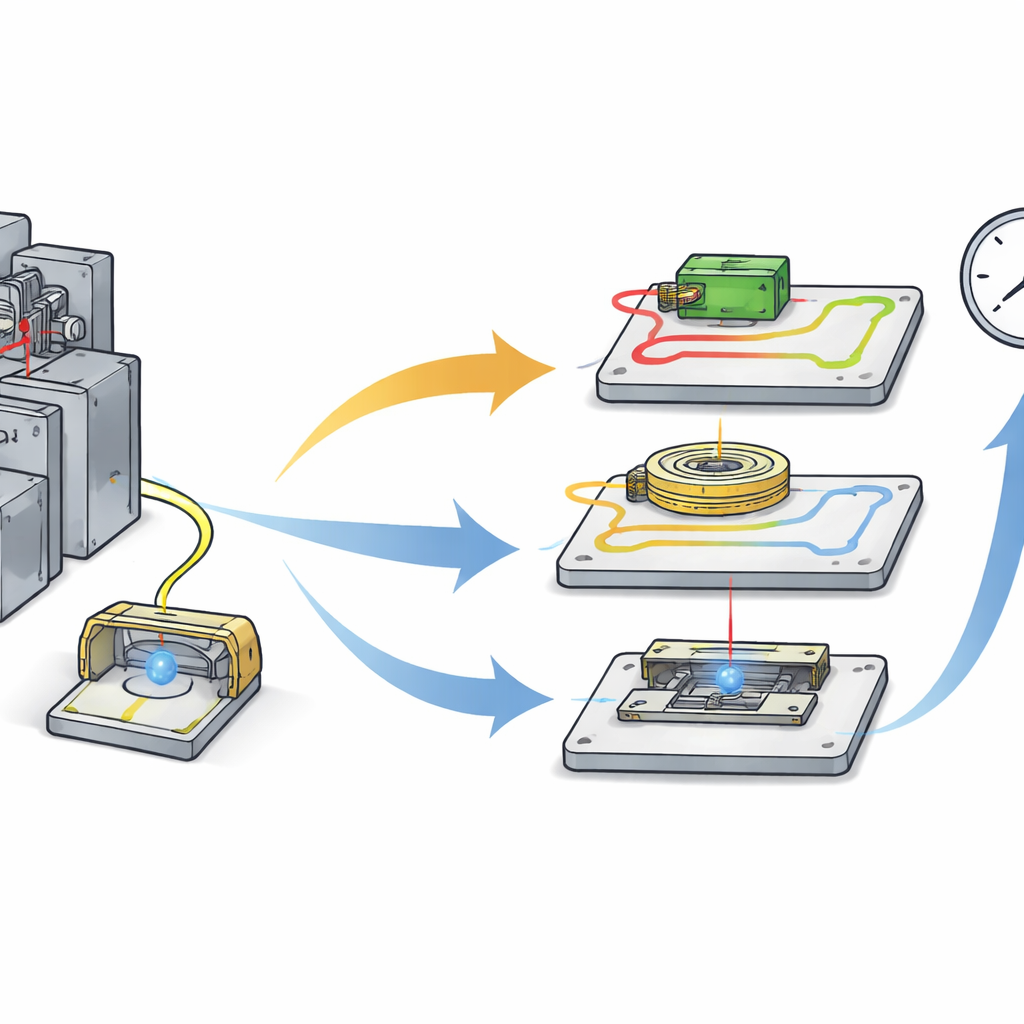
Trapped ions are one of the leading approaches to building quantum computers and optical clocks. A single ion held above a microfabricated electrode chip can serve as both a qubit and a timekeeper. However, today’s systems rely on large external-cavity lasers and meter-scale glass cavities to keep the laser frequency stable. These setups fill optical tables, require careful isolation from vibrations and temperature changes, and are difficult to move outside the lab. The authors aim to shrink this infrastructure by moving key laser and optical functions onto integrated photonic chips made from silicon nitride, a material compatible with standard semiconductor manufacturing.
A Coiled Path to Ultra-Stable Light
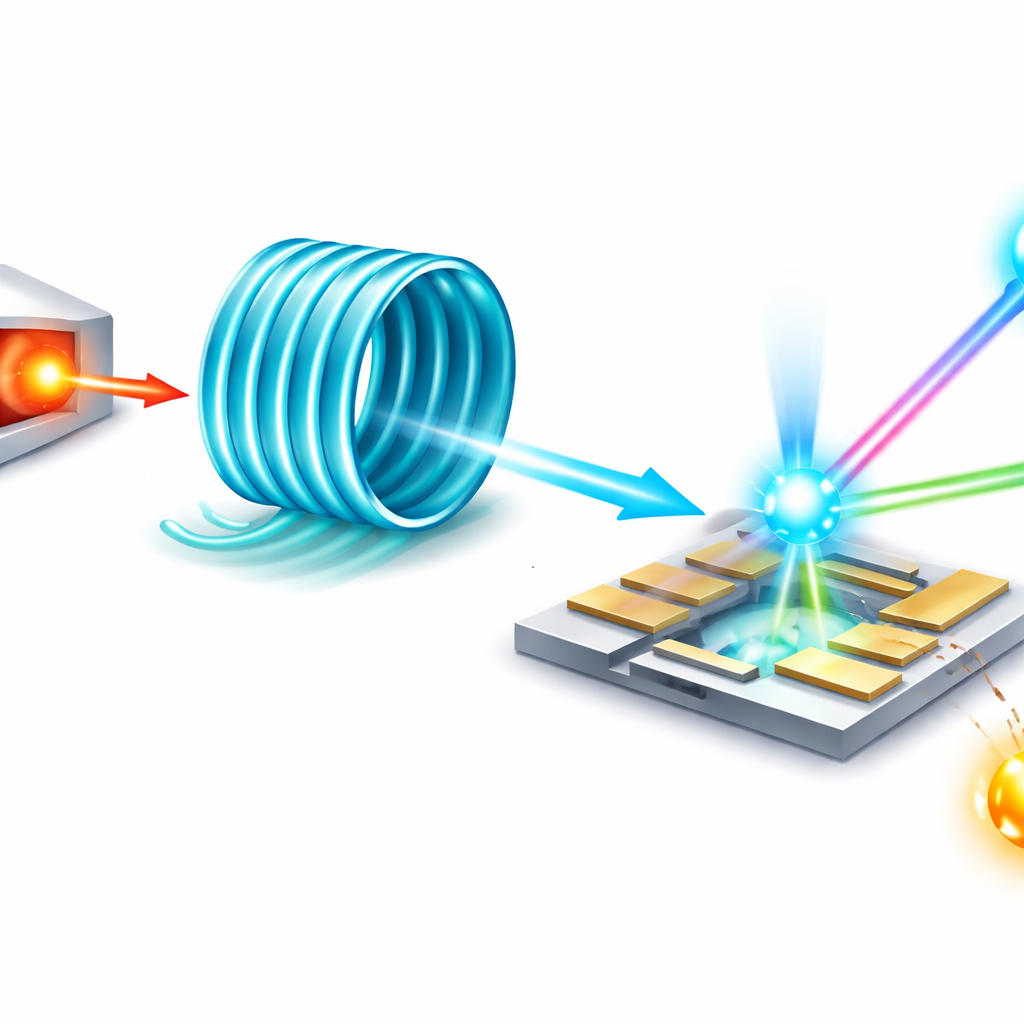
The core of the new system is a special kind of laser called a Brillouin laser, built directly on a silicon nitride chip and operating at a visible red wavelength of 674 nanometers—the exact color needed to address a crucial transition in a strontium ion. Light from a conventional diode laser pumps a tiny on-chip ring, where interactions between light and sound waves generate an extremely narrow and quiet Brillouin signal. This light is then locked to a second chip: a three-meter-long optical path coiled into a compact spiral resonator. The long path averages out temperature fluctuations and other disturbances, dramatically reducing noise in the laser’s frequency. The resulting chip-scale system achieves a fundamental linewidth of about 14 hertz and a broader effective linewidth of only a few hundred hertz, rivaling much larger laboratory systems.
Letting the Ion Tune the Laser
To push stability even further, the team lets the trapped ion itself act as the final authority on frequency. The Brillouin laser, already quieted by the coiled resonator, is repeatedly tuned to probe opposite sides of an extraordinarily sharp transition in a single strontium-88 ion, whose natural width is just 0.4 hertz. By comparing how likely the ion is to be excited on each side and feeding back tiny corrections every 20 milliseconds, the researchers “discipline” the laser to follow the ion’s own reference frequency. Running two such feedback loops in an interleaved fashion allows them to compare the loops against each other and show that, in the ion’s local frame of reference, the laser’s frequency jitters by only about 180 hertz over 100 seconds—corresponding to a fractional stability better than one part in 1012.
Preparing and Reading Quantum States
With this stabilized chip-scale laser, the team performs the full suite of basic qubit operations on a room-temperature trapped ion. They use carefully timed laser pulses to pump the ion into a chosen starting state, drive it between two energy levels that form a qubit, and then shelve one of those levels into a long-lived state for measurement by fluorescence. The low noise of the Brillouin laser allows clear spectroscopy of the ion’s internal structure, narrow spectral lines as tight as 1.5 kilohertz, and clean oscillations of the qubit’s state in time. Overall, they achieve state preparation and measurement accuracy of 99.6%, with more efficient operation—fewer pulses and longer coherent interactions—than when using a standard diode laser stabilized only to the coil.
Toward Pocket-Size Quantum Technology
The study demonstrates that chip-scale photonic components can deliver laser performance good enough to run demanding ion-based quantum experiments without bulky reference cavities or complex frequency conversion. Because the silicon nitride platform is compatible with the electrode chips that hold the ions, future devices could integrate lasers, resonators, and ion traps on a single substrate. Such integration would reduce phase noise from optical paths, cut size and power needs, and open the door to portable quantum computers, field-ready optical clocks, and compact quantum sensors for navigation and science.
Citation: Chauhan, N., Caron, C., Isichenko, A. et al. Chip scale coil stabilized Brillouin laser driving a room temperature trapped ion qubit. Nat Commun 17, 3982 (2026). https://doi.org/10.1038/s41467-026-69948-2
Keywords: trapped ion qubits, integrated photonics, Brillouin laser, optical atomic clocks, quantum computing hardware