Clear Sky Science · en
Engineering biomimetic chloride channels in ultramicroporous hydrogen-bonded organic framework membranes for high-salinity wastewater valorization
Turning Salty Waste into Useful Resources
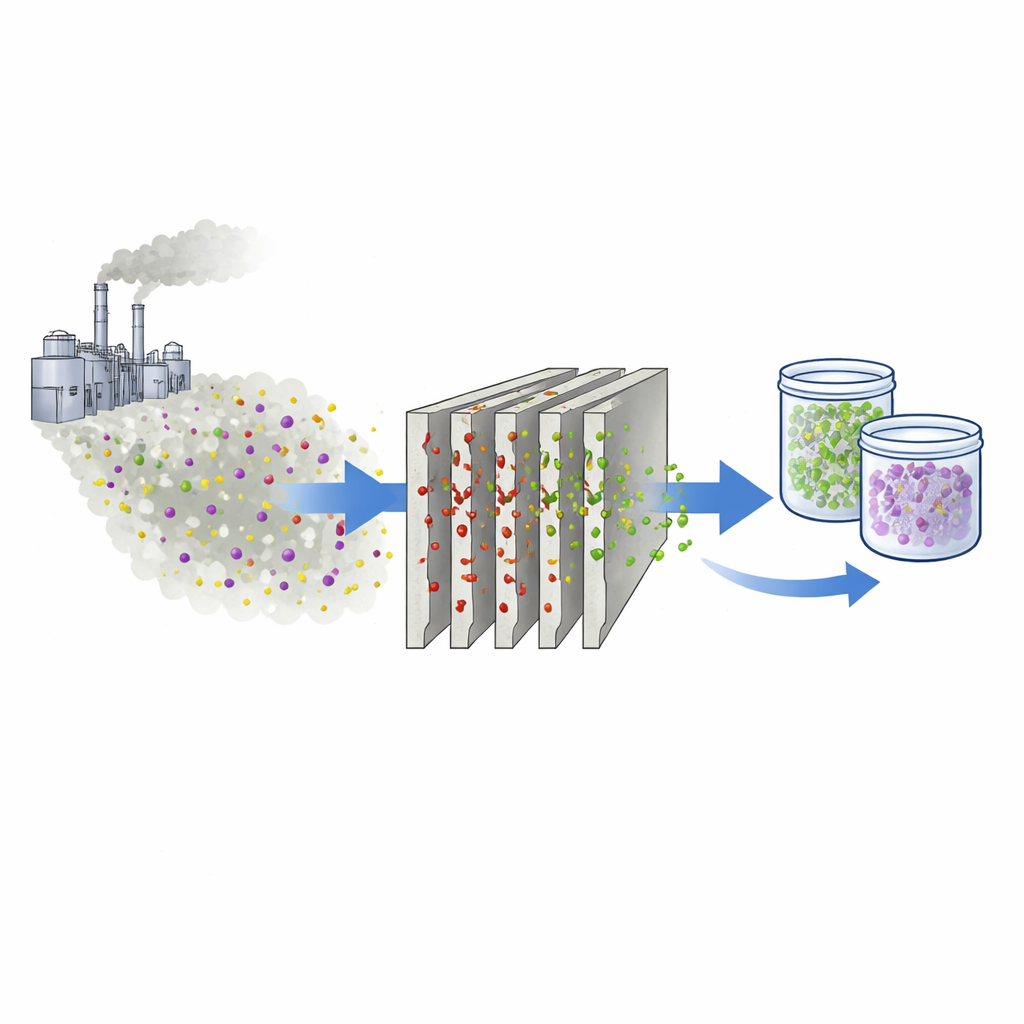
Modern industry produces vast amounts of extremely salty wastewater that is expensive to treat and often ends up as a costly liability. This study describes a new kind of ultra-thin filter that borrows tricks from nature’s own ion channels to pull table-salt ingredients out of dirty, mineral-laden brines. By doing so, it can both clean up difficult waste streams and turn what would be waste into a valuable product: high‑purity salt.
Why Separating Salts Is So Hard
Many industries—from chemical plants to pharmaceutical and dye manufacturers—generate wastewater packed with different salts. A central challenge is separating chloride ions, which form common table salt with sodium, from sulfate ions and other heavier partners. Existing membranes can usually do one of two things well: either they let ions through quickly or they distinguish sharply between different ions. Achieving both high speed and high precision in a single membrane, especially at the tiny length scales relevant to individual ions in water, has remained stubbornly difficult.
Borrowing a Blueprint from Living Cells
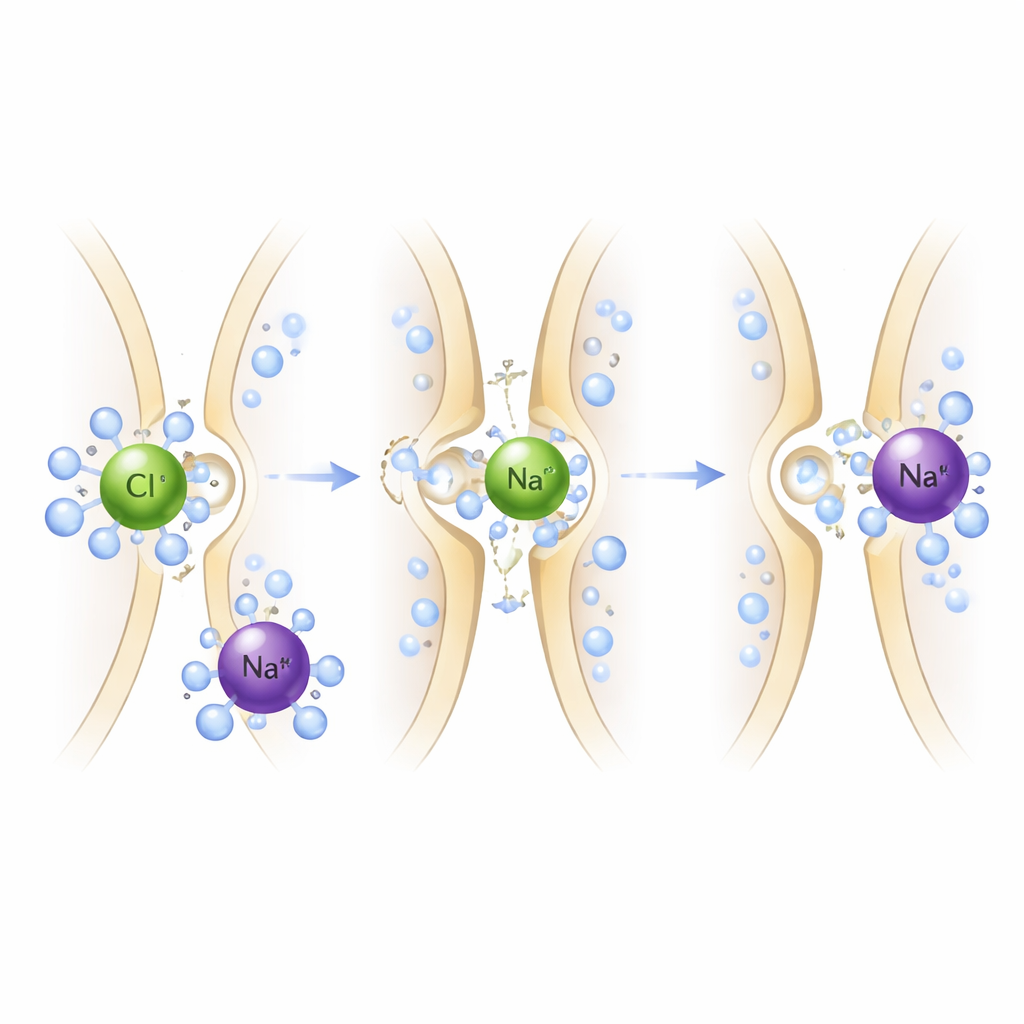
Nature has already solved a similar problem. Proteins known as chloride channels sit in cell membranes and guide chloride ions through while keeping many other ions out, and they do it with remarkable speed and selectivity. The authors set out to mimic two key features of these natural channels. First, the passageways are just wide enough to fit the ion, but flexible enough to adapt slightly as it moves. Second, the lining of the channel is decorated with groups that can form weak hydrogen bonds, helping to stabilize ions that have shed some of their surrounding water as they squeeze through.
Building a Flexible Artificial Channel
To recreate this behavior in a synthetic material, the team built membranes from a hydrogen‑bonded organic framework (HOF) called HOF‑DAT. This material self‑assembles into stacked molecular sheets, forming a regular network of ultramicropores about half a nanometer wide—only a bit larger than an ion surrounded by a thin shell of water. Crucially, the framework is held together by hydrogen bonds and stacked aromatic rings, making it both crystalline and slightly flexible. Chemical groups along the pore walls offer hydrogen‑bond donors, creating an interior environment that resembles the soft, interactive lining of biological channels rather than a rigid mineral pipe.
How the Membrane Picks Winners and Losers
Computer simulations and X‑ray measurements reveal that the pores subtly widen when chloride and similar small anions pass through, allowing them to shed only a few water molecules. As they do, the membrane’s hydrogen‑bond donors step in to replace those lost water contacts, so the chloride ion feels almost as comfortable inside the channel as it did in bulk water. Larger, doubly charged ions like sulfate must lose many more water molecules to enter, and the framework cannot fully compensate for those lost interactions. They also bind more tightly to the surrounding atoms, becoming sluggish and frequently getting stuck at the pore entrance. This difference in dehydration cost and binding behavior leads to a striking result: the membrane transports chloride over sulfate more than 400 times better, while still allowing chloride to flow at rates higher than leading commercial membranes.
From Lab Membrane to Real Wastewater
The researchers then tested their membrane in an electrodialysis system designed to upgrade hypersaline wastewater into a stream of nearly pure sodium chloride. In a two‑stage process, the HOF‑DAT membrane first pulls chloride away from sulfate and then concentrates it to near‑crystallization levels. Compared with a widely used commercial anion‑exchange membrane, the new material produced salt of much higher purity—about 99.6 weight percent versus roughly 73 percent—while cutting energy use by almost 30 percent. The membrane remained stable in strong salt solutions and across a broad range of acidity and alkalinity, suggesting it could handle the harsh conditions of industrial brines.
A New Way to Design Smart Filters
By carefully imitating how biological chloride channels balance pore size, flexibility, and gentle hydrogen‑bonding interactions, this work breaks the usual trade‑off between speed and selectivity in ion‑separating membranes. The HOF‑based design shows that it is possible to guide specific ions through subnanometer channels with very low energy barriers, while strongly rejecting others. Beyond improving salt recovery from tough wastewaters, this bioinspired approach offers a general blueprint for designing next‑generation membranes for tasks ranging from water purification to resource recovery and energy technologies.
Citation: Zhang, S., Wan, Z., Zhang, X. et al. Engineering biomimetic chloride channels in ultramicroporous hydrogen-bonded organic framework membranes for high-salinity wastewater valorization. Nat Commun 17, 3047 (2026). https://doi.org/10.1038/s41467-026-69947-3
Keywords: ion-selective membranes, chloride separation, hypersaline wastewater, bioinspired materials, electrodialysis