Clear Sky Science · en
Structural insights into the activation of the chicken ROS1 receptor by the NEL/NICOL ligand complex
Why this study matters
Cells constantly make decisions—when to grow, when to mature, and when to stay quiet—based on signals received at their surface. One such signal pathway, built around a receptor called ROS1, is crucial for normal development, sperm maturation, and is also hijacked in several cancers. Yet, how ROS1 is turned on by its natural partners has been a mystery. This study uses high-resolution structural imaging to reveal, in unprecedented detail, how two secreted proteins, NEL and NICOL, come together to switch ROS1 from a lone, quiet receptor into a clustered, active signaling hub.
A large receptor with a flexible shape
ROS1 is the largest known member of a major family of cell-surface receptors that control growth and development. The authors first examined the outer portion of chicken ROS1, which closely resembles the human version. Using state-of-the-art cryo–electron microscopy, they found that ROS1’s exterior forms an arc-shaped structure with two main regions, dubbed the “head” and the “leg,” connected by a hinge. The head is compact and rigid, while the leg extends like a stiff arm. This architecture allows some motion between the two parts without disrupting the overall stability of the receptor, setting the stage for how incoming signals are received.
How the main ligand NEL grabs ROS1
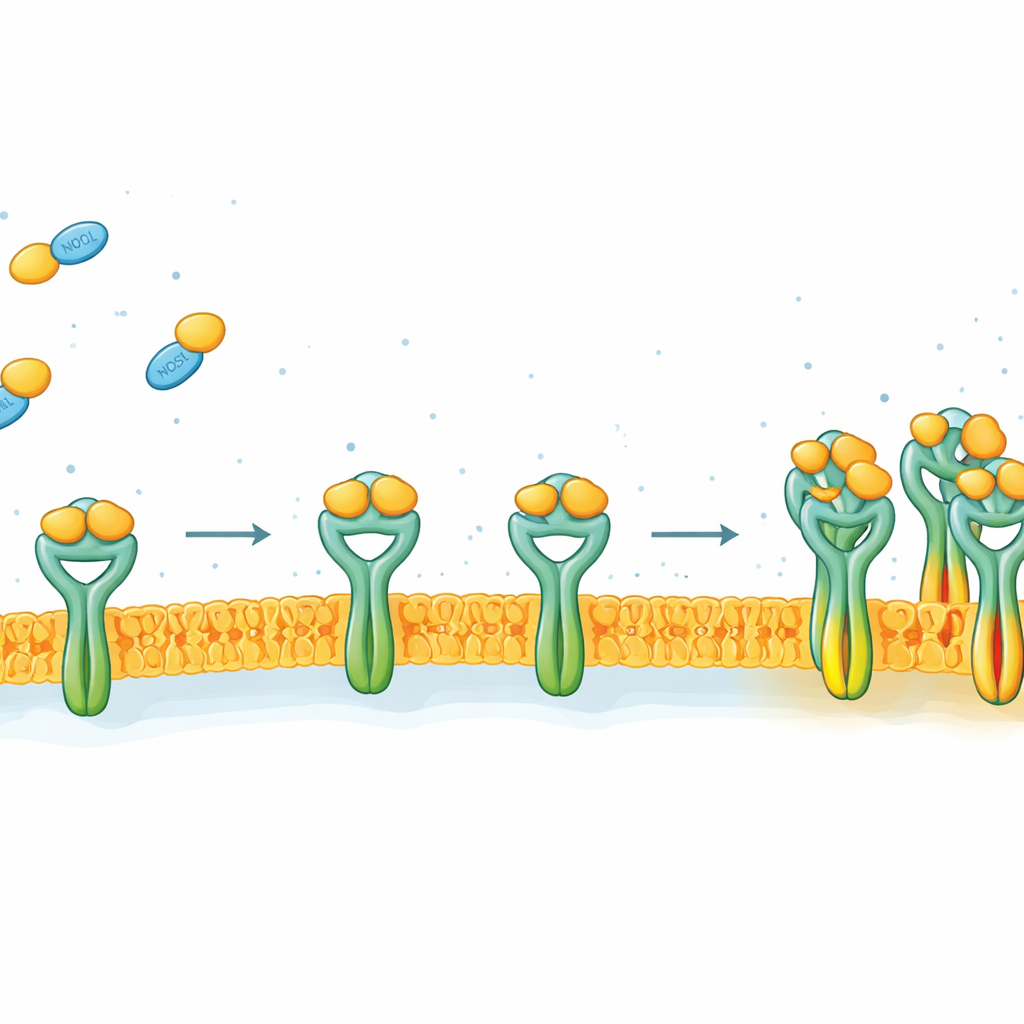
To understand how ROS1 senses its environment, the team studied its interaction with NEL, a secreted protein previously shown to be essential for sperm maturation. They discovered that NEL binds tightly to a specific site on the head of ROS1, using a region called VWC2 to clasp a surface on a β-sheet of ROS1. At atomic resolution, the interface is held together by a network of hydrophobic contacts and salt bridges between key amino acids. When these contact points were individually mutated, ROS1 became much less responsive to NEL in cell-based signaling tests. Interestingly, binding NEL did not force ROS1 to change its overall shape, suggesting that simple “ligand binding” is not enough to fully turn the receptor on.
NICOL stiffens NEL into a signaling scaffold
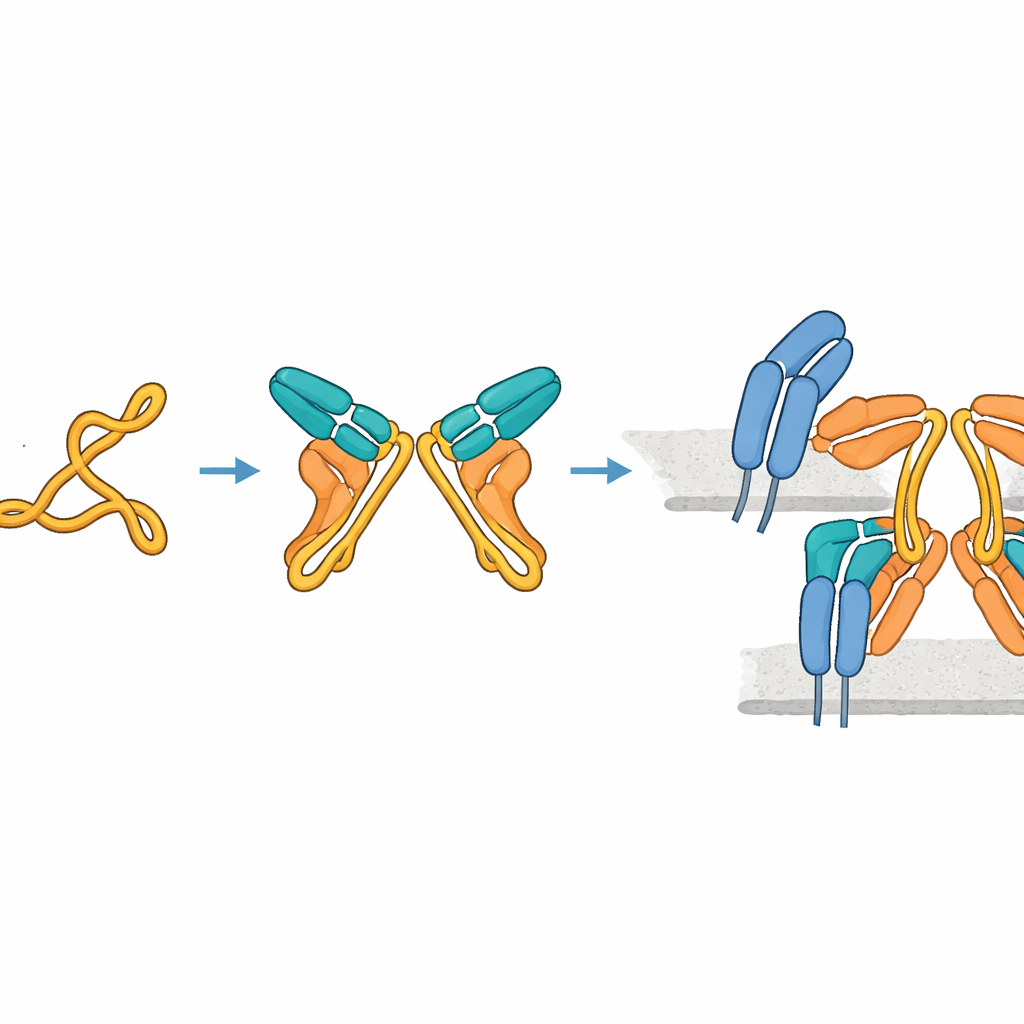
Earlier work had identified NICOL, a small secreted protein, as an essential helper for NEL–ROS1 signaling, but its structural role was unknown. The authors co-produced NEL with NICOL and visualized the resulting complex. They found that two NEL molecules pair up through a coiled-coil segment, and a single NICOL molecule nestles between them, forming a three-helix bundle stabilized by six disulfide bonds. This rigid core reshapes the NEL dimer into an asymmetric, batwing-like assembly. Because of this geometry, the complex can bind only one ROS1 molecule at a time—attaching via the same VWC2 site on NEL—since a second ROS1 would clash sterically. Thus, a 2:1 NEL–NICOL complex alone cannot explain how multiple ROS1 receptors are brought together for strong activation.
Building signaling chains by higher-order clustering
The crucial insight came when the researchers noticed that NEL–NICOL complexes can connect to one another. Structural hints and biochemical measurements showed that a domain of NEL called LamG on one complex can engage another domain, VWC4, on a neighboring complex. In solution, both NEL alone and NEL–NICOL were seen to self-assemble into larger chains and clusters, and when ROS1 was present, these assemblies grew even bigger. When the team deleted either the coiled-coil region (needed for NICOL binding) or the LamG domain (needed for complex–complex contacts), NEL lost its ability to build higher-order structures and could no longer robustly activate ROS1 in cells. A truncated NEL that still bound ROS1 but could not oligomerize actually blocked signaling, acting as a decoy.
A new way to switch on a growth receptor
Most related receptors are activated when a dimeric ligand simply brings two receptor molecules together. This study reveals that ROS1 works differently. Here, NEL and NICOL first assemble into a rigid heterotrimer that can recruit one ROS1, and then these units chain together into flexible oligomers that cluster many ROS1 receptors side by side. This crowding enables them to phosphorylate each other and amplify downstream signals such as ERK, which influence tissue development and sperm maturation. By clarifying this multi-step, ligand-driven clustering mechanism, the work not only reshapes our understanding of how ROS1 is controlled in normal physiology but also points toward new strategies to modulate ROS1 activity in diseases ranging from male infertility to ROS1-driven cancers.
Citation: An, W., Zhang, X. & Bai, Xc. Structural insights into the activation of the chicken ROS1 receptor by the NEL/NICOL ligand complex. Nat Commun 17, 3124 (2026). https://doi.org/10.1038/s41467-026-69942-8
Keywords: ROS1 receptor, NEL NICOL signaling, receptor clustering, sperm maturation, receptor tyrosine kinases