Clear Sky Science · en
Kibble-Zurek mechanism and beyond in a holographic superfluid disk
Watching Order Emerge from Chaos
When matter cools through a phase transition, it can suddenly organize itself, like water freezing into ice or a gas turning into a superfluid. But this reordering is rarely perfectly smooth: tiny whirlpools and other “defects” often appear as scars of the change. This article uses cutting-edge gravitational theory, surprisingly, to understand how such defects form and how many we should expect—even when the change happens extremely fast. The results reveal a simple, universal pattern that holds far beyond what traditional theories predicted.
Why Sudden Changes Create Tiny Whirlpools
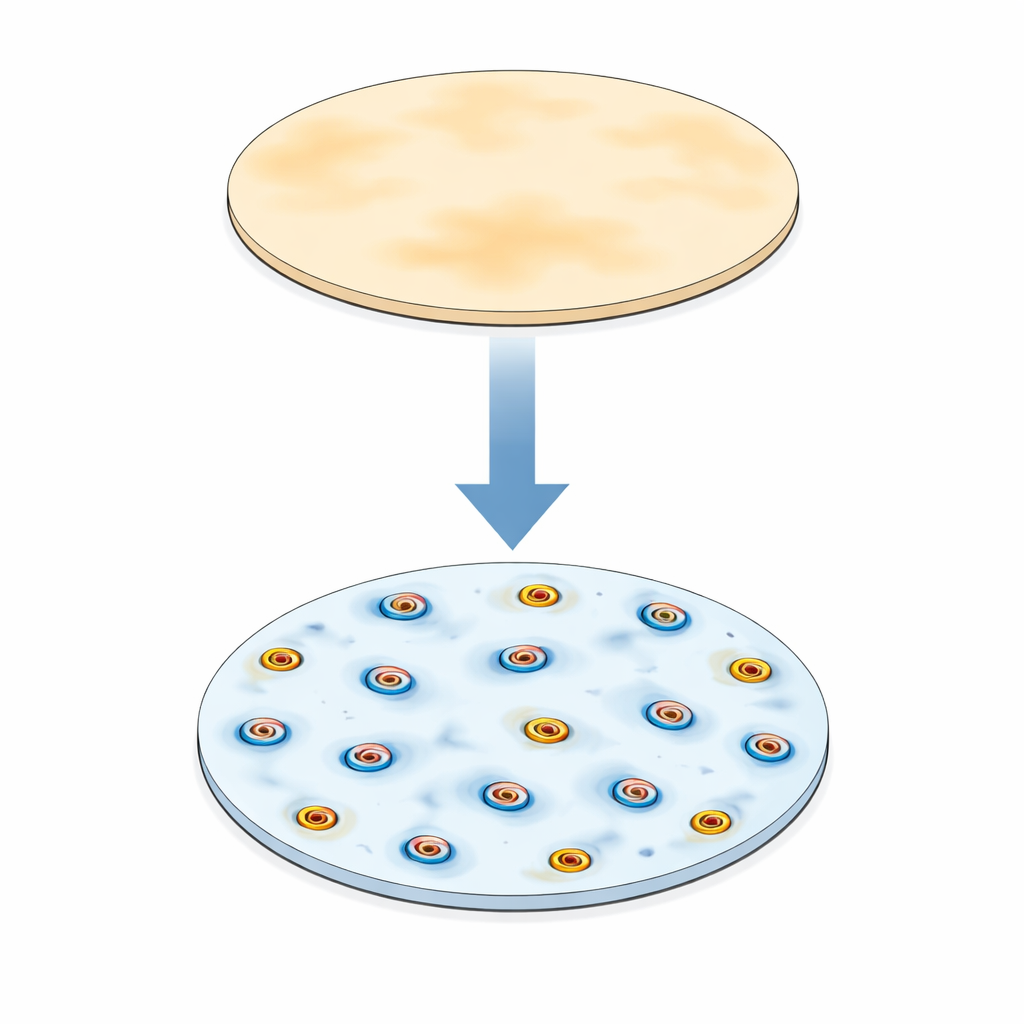
In many systems, from early-universe matter to superfluids in the lab, a continuous phase transition takes place when a control knob—such as temperature—crosses a critical value. Near this point, the system relaxes more and more slowly, a phenomenon known as “critical slowing down.” Because it cannot keep up with the change, regions that are too far apart make independent choices about how to order themselves. Where these differently ordered patches meet, mismatches appear as topological defects: in two-dimensional superfluids, these are vortices and anti-vortices, tiny whirlpools of circulating flow. The classic Kibble–Zurek mechanism predicts how the average number of such defects scales with how quickly the system is driven through the transition.
Using Gravity to Model Strongly Interacting Matter
To explore this process in a strongly interacting quantum fluid, the authors turn to holography—a mathematical correspondence that replaces a difficult many-body problem with a more tractable gravitational one in a higher-dimensional space. They study a “holographic superfluid disk,” a circular quantum fluid represented by fields living near a black hole horizon in a four-dimensional curved spacetime. By changing the chemical potential in the gravitational model, they effectively cool the boundary fluid through its critical temperature, triggering a transition from a normal state to a superfluid state. In this disk, vortices can appear, move, annihilate in pairs, and even escape through the boundary, mimicking realistic laboratory conditions with open edges.
Slow Versus Fast Quenches: When Old Rules Break Down
The authors run large numbers of numerical experiments, each corresponding to a different “quench” time—that is, how rapidly the system is cooled—and to different final temperatures. For slow quenches, they confirm the familiar Kibble–Zurek picture: the average vortex number follows a power law in the cooling time, with an exponent matching mean-field expectations. However, as the quench becomes faster, the system leaves the near-adiabatic regime. The Kibble–Zurek scaling bends and then breaks down entirely, giving way to a plateau where the average number of vortices no longer depends on how fast the quench is, but only on how deep into the low-temperature phase the system ends up. This rapid-quench regime is far from equilibrium, yet still displays robust universal behavior set by the final temperature.
Hidden Order in Fluctuations and Vortex Counts
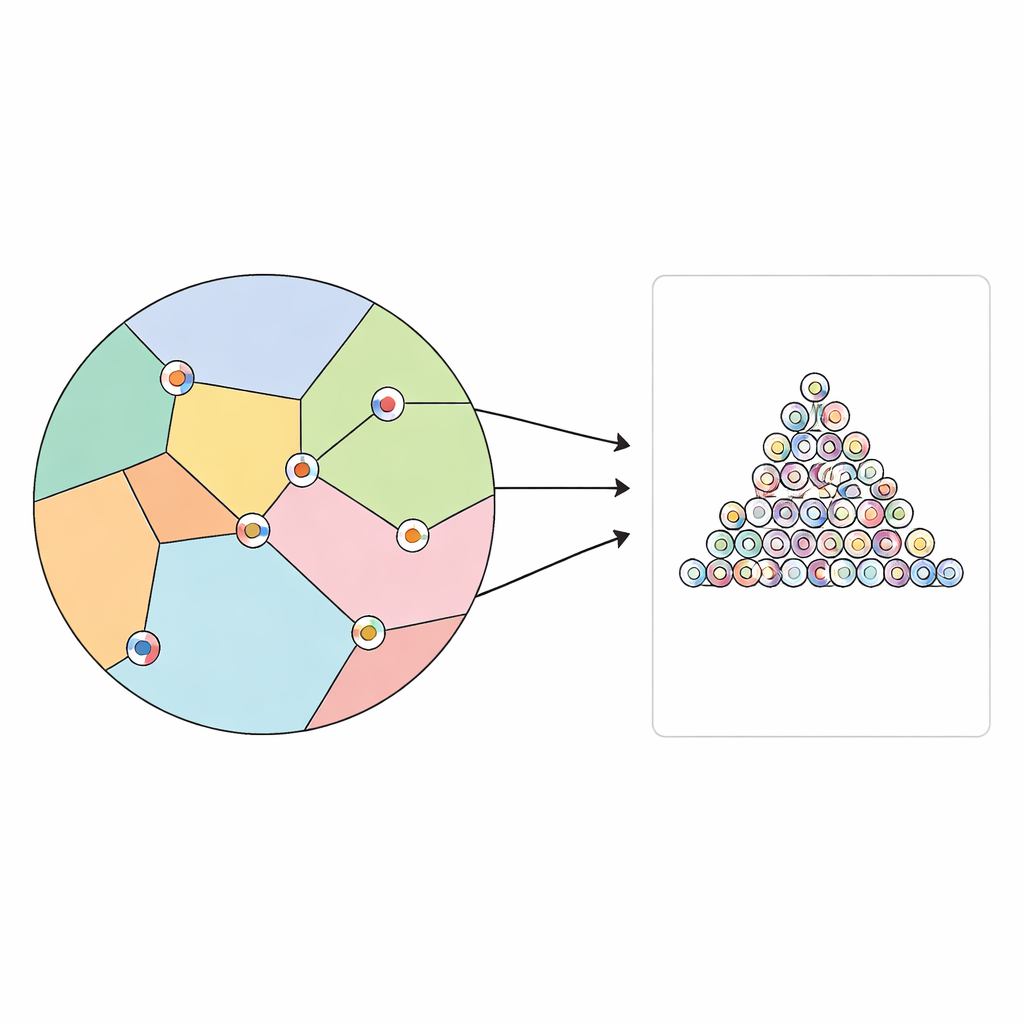
Looking only at the average number of vortices hides much of the story. The authors go further and analyze the full statistics of vortex counts across hundreds of thousands of runs. At first glance the distributions look nearly normal (bell-shaped), but a closer examination of higher moments—the variance, skewness, and beyond—reveals subtle non-Gaussian features. These cannot be captured by a simple binomial model in which each possible vortex-formation site behaves identically. Instead, the data are remarkably well described by a Poisson binomial distribution, in which many independent events occur with slightly different probabilities. In physical terms, this corresponds to vortices forming at boundaries between multiple growing domains of the new phase, where the number and geometry of meeting domains vary from place to place.
A Universal Pattern for Defects in Newborn Fluids
The key message is that the same Poisson binomial statistics describe vortex formation over the entire range of cooling rates, from very slow (where the Kibble–Zurek mechanism holds) to extremely fast (where its predictions fail and the defect density saturates). The size of fluctuations and the shape of the distribution follow simple power-law rules in both regimes, governed only by equilibrium properties such as critical exponents and the final distance from the critical temperature. Although derived in a sophisticated holographic model, these results should apply broadly to continuous phase transitions in real materials. They offer concrete, testable predictions for experiments on ultracold atomic gases, quantum fluids of light, and other systems where researchers can image and count vortices shot by shot, revealing the universal fingerprint of how order emerges from a rapid change.
Citation: Xia, CY., Zeng, HB., Grabarits, A. et al. Kibble-Zurek mechanism and beyond in a holographic superfluid disk. Nat Commun 17, 3668 (2026). https://doi.org/10.1038/s41467-026-69940-w
Keywords: Kibble-Zurek mechanism, holographic superfluid, topological defects, vortex formation, phase transition dynamics